
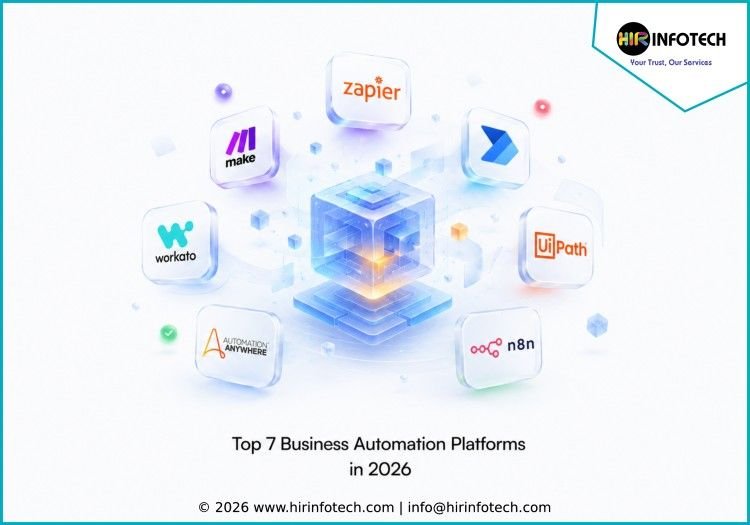
Top 7 Business Automation Platforms in 2026
1. Zapier
Short overview:
Zapier is a widely used business automation platform that helps companies connect apps and automate repetitive tasks without heavy coding. It supports workflows across sales, marketing, customer support, operations, finance, and productivity tools. In 2026, Zapier is especially useful for teams that want to build AI workflows, automate app actions, manage forms, connect tables, and trigger actions across thousands of business applications.
Key strengths:
No-code workflow automation, broad app integrations, AI workflows, webhooks, forms, tables, and easy setup.
Best for:
Small businesses, marketers, agencies, sales teams, and operations teams that need fast app-to-app automation.
2. Make
Short overview:
Make is a visual automation platform that helps businesses design, build, and scale workflows using a drag-and-drop interface. It is known for giving teams more control over complex automation logic while still remaining accessible for non-developers. Make supports workflow automation across thousands of apps and includes AI automation features for teams that want to connect systems, transform data, and automate multi-step business processes.
Key strengths:
Visual workflow builder, AI agents, no-code automation, app integrations, data transformation, scheduling, and collaboration tools.
Best for:
Operations teams, agencies, startups, and businesses that need flexible visual automation for complex workflows.
3. Microsoft Power Automate
Short overview:
Microsoft Power Automate is a business process automation platform built for organizations that use Microsoft 365, Dynamics, SharePoint, Teams, Outlook, and other enterprise tools. It helps companies automate approvals, notifications, file movement, data collection, reporting, and repetitive workflows. With low-code and AI-powered automation, Power Automate is useful for enterprises that need scalable workflows across departments and existing Microsoft systems.
Key strengths:
Low-code automation, robotic process automation, Microsoft 365 integration, AI support, approvals, connectors, and enterprise governance.
Best for:
Enterprises, Microsoft 365 users, IT teams, finance teams, HR teams, and process-driven organizations.
4. Workato
Short overview:
Workato is an enterprise automation and integration platform designed for businesses that need secure, scalable, and governed workflows. It helps organizations connect applications, automate business processes, manage data movement, and support cross-functional operations. Workato is especially useful for larger companies that need strong governance, compliance, observability, and enterprise-grade automation across sales, finance, HR, IT, and customer operations.
Key strengths:
Enterprise integrations, process automation, governance, security, observability, AI-ready workflows, and business app connectivity.
Best for:
Mid-market and enterprise companies that need advanced automation, integration, and process orchestration.
5. UiPath
Short overview:
UiPath is a business automation platform focused on robotic process automation, AI agents, process automation, and enterprise orchestration. It helps companies automate both simple tasks and end-to-end business processes across systems, applications, documents, and teams. UiPath is especially useful for organizations with high-volume repetitive work, legacy systems, compliance needs, and large operational teams.
Key strengths:
RPA, agentic automation, process orchestration, document automation, testing automation, AI support, and enterprise governance.
Best for:
Large enterprises, finance teams, operations teams, insurance companies, healthcare organizations, and shared service centers.
6. Automation Anywhere
Short overview:
Automation Anywhere provides AI-powered automation tools for businesses that want to streamline operations, reduce manual tasks, and scale automation programs. Its platform includes robotic process automation, AI agents, process discovery, document automation, and governance features. It is useful for enterprises that want to automate structured and semi-structured work across departments such as finance, HR, customer service, procurement, and operations.
Key strengths:
AI-powered automation, RPA, document automation, process discovery, governance, workflow scaling, and operational efficiency tools.
Best for:
Enterprises, operations teams, finance departments, service teams, and organizations with repetitive process-heavy workflows.
7. n8n
Short overview:
n8n is a workflow automation platform popular among technical teams that want flexibility, control, and deeper customization. It allows users to build visual workflows, connect applications, add custom logic, and deploy automations in the cloud or on their own infrastructure. n8n is especially useful for data teams, developers, and businesses that want automation with more technical control than traditional no-code tools.
Key strengths:
Visual workflow automation, AI workflows, custom code support, self-hosting options, integrations, monitoring, and developer flexibility.
Best for:
Developers, data teams, technical startups, IT teams, and businesses that need customizable workflow automation.
Why Choosing the Right Company Matters
Choosing from the Top 7 Business Automation Platforms in 2026 is important because every business has different workflows, systems, budgets, and growth goals. A simple no-code tool may work well for a small marketing team, while an enterprise may need governance, security, compliance, AI orchestration, and complex process automation.
Businesses should compare platforms based on expertise, pricing, data quality, technology, support, and scalability. The right automation platform should connect smoothly with existing tools, reduce repetitive work, improve accuracy, and make processes easier to manage. It should also support the company’s long-term needs instead of solving only short-term tasks.
Technology is one of the biggest factors. Companies should check whether a platform supports app integrations, APIs, webhooks, AI workflows, robotic process automation, approval flows, error handling, monitoring, and reporting. For larger organizations, access control, audit logs, compliance support, and IT governance are also important.
Data quality also matters. Automation is only useful when the information moving between systems is accurate, clean, and properly mapped. Poorly designed workflows can create duplicate records, broken processes, missed notifications, or incorrect reports. Businesses should review how each platform handles data transformation, validation, retries, and workflow monitoring.
Support and scalability should also be reviewed carefully. A platform that works for a few simple automations may not be enough when the business grows to hundreds of workflows across multiple departments. Companies should consider documentation, customer support, implementation partners, training resources, and enterprise readiness.
The best business automation platform should help teams save time, reduce errors, improve collaboration, and make operations more predictable. It should also give decision-makers better visibility into how work moves across the organization.
Conclusion
The Top 7 Business Automation Platforms in 2026 help businesses work faster, reduce manual effort, and improve operational efficiency. Zapier, Make, Microsoft Power Automate, Workato, UiPath, Automation Anywhere, and n8n each serve different business needs. Some are best for simple no-code automation, while others support enterprise process automation, RPA, AI agents, and technical workflow control. The right choice depends on your business goals, team skills, technology stack, budget, support needs, and long-term automation strategy.









