
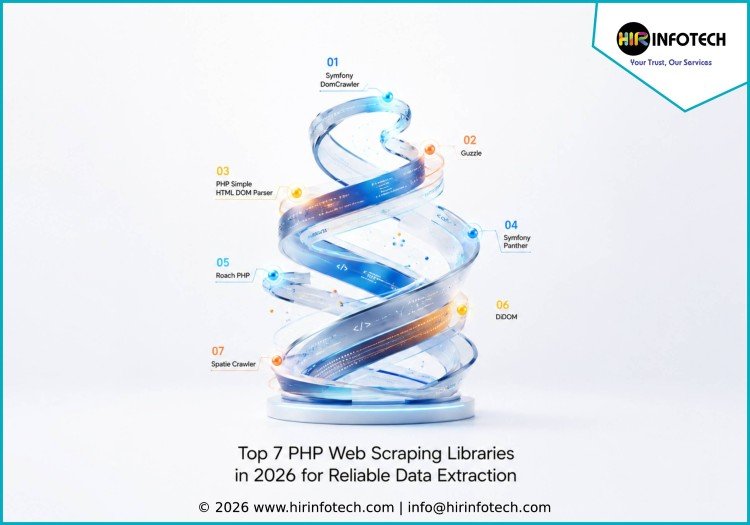
Top 7 PHP Web Scraping Libraries in 2026
1. Symfony DomCrawler
Short overview:
Symfony DomCrawler is one of the most useful PHP libraries for navigating and extracting data from HTML and XML documents. It is commonly used with Symfony projects, Laravel applications, and custom PHP scraping workflows where developers need clean DOM traversal and reliable data extraction.
Key strengths:
Its key strengths include CSS selector support, XPath support, HTML navigation, XML handling, and smooth integration with Symfony components. It works well when pages are mostly static and the goal is to extract product details, links, headings, tables, or structured content.
Best for:
PHP developers, Laravel teams, Symfony users, data teams, and businesses scraping static websites or structured HTML pages.
2. Guzzle
Short overview:
Guzzle is a popular PHP HTTP client used to send requests, manage responses, handle headers, work with APIs, and fetch web pages for scraping workflows. While it is not a full scraping framework by itself, it is often used as the request layer before parsing content with DomCrawler, DiDOM, or other PHP scraping libraries.
Key strengths:
Guzzle supports HTTP requests, middleware, async requests, cookies, redirects, headers, authentication, and API communication. It is especially useful for building reliable scraping pipelines where request handling, retries, and response management matter.
Best for:
Developers building custom PHP scrapers, API data collectors, lead generation tools, and lightweight web data extraction systems.
3. PHP Simple HTML DOM Parser
Short overview:
PHP Simple HTML DOM Parser is a beginner-friendly PHP library used to parse HTML and extract data from web pages. It allows developers to search HTML elements using simple selector-style syntax, making it useful for quick scraping tasks and small data extraction projects.
This library is helpful when developers need to extract links, images, headings, product details, article content, tables, or metadata from static web pages. It is easy to use and works well for lightweight scraping workflows where complex browser automation is not required.
Key strengths:
Simple HTML parsing, easy element selection, quick setup, lightweight structure, link extraction, content extraction, and beginner-friendly usage.
Best for:
PHP beginners, small scraping projects, content extraction, simple product data scraping, and lightweight HTML parsing workflows.
4. Symfony Panther
Short overview:
Symfony Panther is a PHP browser automation and web scraping library designed for websites that need real browser interaction. It can control browsers like Chrome and Firefox through WebDriver, making it useful when websites rely on JavaScript, dynamic loading, forms, or user-like navigation.
Key strengths:
Panther supports browser-based scraping, JavaScript rendering, end-to-end testing, form interaction, screenshots, and dynamic page navigation. It is helpful when simple HTTP requests are not enough to access or extract the required content.
Best for:
Developers scraping JavaScript-heavy websites, dynamic pages, web apps, and projects that need browser-level automation.
5. Roach PHP
Short overview:
Roach PHP is a web scraping toolkit for PHP inspired by the structure of Python’s Scrapy framework. It allows developers to define spiders, crawl web pages, extract data, and process scraped information through structured pipelines. It is useful for teams that want more organization than a simple script.
Key strengths:
Roach PHP offers spider-based crawling, data extraction, pipelines, middleware-style architecture, and Laravel-friendly scraping workflows. It is a practical option for projects that need repeatable crawling logic and cleaner scraping structure.
Best for:
Laravel developers, backend teams, structured crawling projects, and businesses building PHP-based scraping systems.
6. DiDOM
Short overview:
DiDOM is a lightweight PHP HTML parser that helps developers search, filter, and extract content from HTML documents. It offers a simple API for working with DOM elements and is often used in projects where developers want faster setup and clean parsing without a large framework.
Key strengths:
DiDOM supports CSS selectors, XPath, DOM traversal, element filtering, and simple HTML parsing. It is useful for extracting links, metadata, product information, article content, and structured page elements from static websites.
Best for:
Small scraping projects, PHP developers, content extraction tasks, and lightweight HTML parsing workflows.
7. Spatie Crawler
Short overview:
Spatie Crawler is a PHP crawling package often used in Laravel and PHP projects to crawl websites and discover URLs. It is helpful when businesses need to scan websites, collect pages, monitor content, or build crawlers that move across internal links in a controlled way.
Key strengths:
Its strengths include URL discovery, crawl control, event handling, response processing, and Laravel-friendly implementation. It works well when the main requirement is crawling website structures before extracting or analyzing page-level data.
Best for:
Laravel teams, website crawlers, SEO data collection, content monitoring, and projects that require controlled URL discovery.
Why Choosing the Right Company Matters
Choosing the right option from the Top 7 PHP Web Scraping Libraries in 2026 matters because every scraping project has different technical and business requirements. A simple static website may only need Guzzle and DomCrawler, while a JavaScript-heavy site may need Panther or a managed scraping solution.
Businesses should compare expertise, pricing, data quality, technology, support, and scalability before choosing a provider or library. Open-source PHP libraries can be cost-effective, but they still require skilled developers, maintenance, proxy handling, error management, and compliance awareness.
Data quality is one of the most important factors. Scraped data should be accurate, clean, validated, and delivered in a usable format. Poorly structured data can create reporting issues, bad decisions, and wasted time for sales, marketing, product, or research teams.
Technology fit also matters. Some tools are better for parsing HTML, while others are better for crawling, browser automation, or API-based workflows. Businesses should consider whether they need static scraping, dynamic scraping, scheduled extraction, marketplace data, lead generation, or enterprise-scale automation.
Support and scalability should also be reviewed. As scraping volume grows, teams may need proxy infrastructure, retry logic, CAPTCHA handling, monitoring, data validation, and structured delivery. The right choice should match current requirements while supporting future growth.
Conclusion
The Top 7 PHP Web Scraping Libraries in 2026 give developers and businesses practical options for collecting web data, parsing HTML, crawling websites, and automating extraction workflows. Symfony DomCrawler, Guzzle, PHP Simple HTML DOM Parser, Symfony Panther, Roach PHP, DiDOM, and Spatie Crawler each support different scraping needs.
The best choice depends on your project size, data complexity, technical skills, automation goals, and long-term scalability.









