
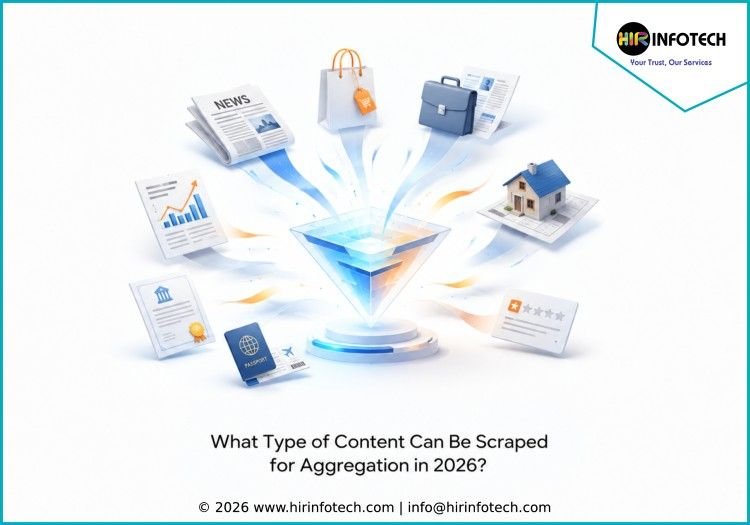
What Type of Content Can Be Scraped for Aggregation in 2026?
Introduction
Content aggregation platforms rely on structured and continuously updated information from multiple online sources. As businesses increasingly use automation to collect and organize digital information, understanding what type of content can be scraped for aggregation has become essential for scalability, compliance, and operational efficiency in 2026.
Understanding Content Aggregation and Web Scraping
Content aggregation involves collecting information from multiple online sources and presenting it in a centralized, searchable, or analyzable format. Web scraping is one of the most widely used methods for gathering this information automatically.
Businesses use content aggregation for several purposes, including:
- Market monitoring
- Competitive analysis
- Ecommerce intelligence
- News aggregation
- Lead generation
- Pricing analysis
- Research automation
- Trend monitoring
- Product discovery
- Data analytics
However, not all online content can or should be scraped in the same way. Businesses must evaluate both technical feasibility and legal or operational considerations before collecting data at scale.
What Type of Content Can Be Scraped for Aggregation?
Public Website Content
One of the most common sources for aggregation is publicly visible website content.
This may include:
- Article headlines
- Blog summaries
- Product listings
- Service descriptions
- Public announcements
- Event listings
- Company profiles
- Public business directories
Aggregation platforms often collect this information to improve searchability, comparison capabilities, or centralized access to distributed information.
Businesses should still evaluate copyright restrictions before republishing large portions of original content.
News and Media Content
News aggregation remains one of the largest applications of web scraping.
Aggregators typically scrape:
- Headlines
- Publication dates
- Author names
- Categories
- Short excerpts
- Source URLs
- Trending topics
Most news aggregators avoid republishing full copyrighted articles without licensing agreements. Instead, they focus on metadata, snippets, summaries, and source attribution.
In 2026, AI-assisted summarization tools are also being integrated into many aggregation workflows to reduce duplication risks while improving user accessibility.
Ecommerce and Product Data
Retail and ecommerce platforms frequently use content aggregation to monitor product availability, pricing, and market trends.
Commonly scraped ecommerce data includes:
- Product titles
- Pricing information
- Product specifications
- Availability status
- Ratings and reviews
- Product categories
- Discount information
- Shipping details
This type of aggregation supports:
- Price comparison platforms
- Inventory intelligence systems
- Market analysis tools
- Product discovery engines
Because ecommerce websites change frequently, businesses often require dynamic scraping systems capable of adapting to layout changes and anti-bot mechanisms.
Job Listings and Recruitment Data
Recruitment platforms and hiring intelligence systems commonly aggregate publicly available job postings.
Scraped recruitment data may include:
- Job titles
- Company names
- Location information
- Skill requirements
- Salary ranges
- Employment types
- Posting dates
- Application links
This information helps businesses monitor hiring trends, workforce demand, and competitive talent activity.
Organizations must still ensure compliance with privacy regulations when handling candidate-related information.
Real Estate Listings
Property aggregation platforms use scraping to collect publicly listed real estate information.
Typical scraped property data includes:
- Listing prices
- Property descriptions
- Property features
- Location details
- Images
- Listing status
- Broker information
Real estate aggregation systems often require large-scale data normalization because listings vary significantly across platforms.
Social Media and Public Community Data
Some aggregation projects involve collecting publicly visible social content such as:
- Public posts
- Hashtags
- Engagement metrics
- Comments
- Public profile metadata
- Community discussions
However, social media scraping carries higher compliance and platform policy risks. Many platforms restrict automated access heavily in 2026.
Businesses must carefully evaluate:
- Platform terms of service
- API restrictions
- Privacy obligations
- User consent considerations
Unauthorized large-scale scraping of social platforms can result in access restrictions or legal disputes.
Financial and Market Data
Financial aggregation systems often collect:
- Stock prices
- Market indicators
- Public filings
- Cryptocurrency prices
- Economic reports
- Commodity trends
- Trading volumes
Financial data aggregation usually prioritizes accuracy, real-time updates, and structured formatting.
Because market-sensitive information changes rapidly, businesses often require automated pipelines capable of continuous monitoring and validation.
Travel and Hospitality Information
Travel aggregation platforms commonly scrape:
- Hotel listings
- Flight availability
- Pricing updates
- Travel packages
- Reviews
- Booking details
- Destination information
This type of aggregation helps users compare services across multiple providers efficiently.
Government and Public Records
Many businesses aggregate publicly available government information such as:
- Regulatory filings
- Business registrations
- Public tenders
- Legal notices
- Census data
- Public datasets
- Licensing information
Government data is often highly valuable for research, compliance, and analytics applications.
Open-data initiatives in many countries have made structured public information increasingly accessible for legitimate aggregation use cases.
Review and Reputation Data
Review aggregation platforms collect public feedback from multiple websites to centralize customer sentiment analysis.
This may include:
- Ratings
- Review excerpts
- Reviewer metadata
- Sentiment trends
- Customer feedback categories
Businesses use aggregated review data for:
- Brand monitoring
- Reputation management
- Competitive analysis
- Customer experience research
Structured vs Unstructured Content in Aggregation
Structured Content
Structured data follows consistent formatting and is easier to process automatically.
Examples include:
- Tables
- Product catalogs
- Databases
- Listings
- APIs
- Financial feeds
Structured data is typically easier to normalize and integrate into dashboards or analytics systems.
Unstructured Content
Unstructured data requires more advanced extraction techniques.
Examples include:
- Articles
- Reviews
- Social posts
- PDFs
- Images
- Multimedia descriptions
AI-assisted parsing and natural language processing tools are increasingly used in 2026 to process unstructured content more efficiently.
Legal and Compliance Considerations
Not all scrapeable content is legally safe to aggregate. Businesses must evaluate several important factors before launching aggregation projects.
Copyright Restrictions
Copying and republishing full copyrighted content may create legal exposure. Aggregators typically reduce risk by using:
- Snippets
- Metadata
- Summaries
- Attribution links
Privacy Regulations
If scraped data contains personally identifiable information, businesses may need to comply with privacy laws such as:
- GDPR
- DPDP regulations
- Consumer privacy frameworks
- Regional data protection rules
Terms of Service
Many websites define acceptable usage policies regarding automated access.
Ignoring these policies may result in:
- IP blocking
- Legal complaints
- Account restrictions
- Access denial
Ethical Data Collection
Responsible aggregation practices have become increasingly important in 2026.
Businesses are expected to:
- Avoid excessive server requests
- Respect platform limitations
- Use transparent data handling policies
- Maintain secure data storage
- Implement responsible crawling frequency
Technical Challenges in Large-Scale Content Aggregation
Modern aggregation systems require much more than basic scraping scripts.
Businesses often need:
- Dynamic rendering support
- JavaScript execution handling
- Anti-bot bypass strategies
- Proxy rotation systems
- CAPTCHA handling
- Data cleaning workflows
- Deduplication systems
- Real-time synchronization
- Scalable storage infrastructure
- AI-powered extraction logic
As websites become more dynamic and anti-scraping technologies improve, maintaining reliable aggregation pipelines has become increasingly specialized.
Why Businesses Use Content Aggregation in 2026
Organizations continue investing in aggregation systems because centralized information access creates measurable business value.
Faster Decision-Making
Aggregated data helps teams access consolidated insights without manually reviewing multiple sources.
Improved Market Visibility
Businesses gain better visibility into trends, pricing, competitors, and customer behavior.
Automation Efficiency
Automated extraction reduces repetitive manual research work.
Better Analytics
Structured aggregated data supports reporting, forecasting, and operational intelligence.
Enhanced User Experience
Aggregation platforms simplify information discovery for end users by organizing fragmented online content into centralized interfaces.
How Hir Infotech Supports Content Aggregation Services
Hir Infotech provides content aggregation services designed to help businesses collect, organize, and process information from multiple digital sources efficiently.
Its capabilities support modern aggregation requirements such as:
- Automated data collection
- Multi-source aggregation workflows
- Structured content extraction
- Real-time data monitoring
- Ecommerce and market intelligence aggregation
- Scalable web scraping support
- Data normalization and processing
- Dynamic website handling
For businesses managing large-scale aggregation operations, scalable infrastructure and reliable extraction workflows are critical for maintaining consistent data quality and operational performance. As aggregation systems become increasingly complex in 2026, businesses often require specialized support to manage changing website structures, automation reliability, and compliance expectations effectively.
Frequently Asked Questions
What is the most common type of content scraped for aggregation?
Commonly aggregated content includes product listings, news headlines, job postings, pricing data, reviews, public directories, and market information.
Can businesses scrape ecommerce product data legally?
Businesses can often scrape publicly accessible ecommerce data, but they must still evaluate copyright protections, platform policies, and compliance requirements before using the data commercially.
Is social media content commonly used in aggregation?
Yes, but social media aggregation carries higher compliance and platform policy risks. Many platforms impose strict controls on automated data access.
What is the difference between structured and unstructured scraped content?
Structured content follows consistent formats such as tables or listings, while unstructured content includes articles, reviews, social posts, and multimedia information that require more advanced processing.
Why do businesses use content aggregation services?
Businesses use aggregation services to centralize information, improve market visibility, automate research, support analytics, and streamline decision-making processes.
Does Hir Infotech provide scalable content aggregation services?
Yes. Hir Infotech provides content aggregation services that support automated extraction, structured data collection, and scalable multi-source aggregation workflows.
Conclusion
Content aggregation in 2026 covers a wide range of publicly accessible digital information, from ecommerce listings and news updates to financial data and public records. However, successful aggregation requires more than simply collecting information at scale. Businesses must balance automation, compliance, data quality, infrastructure scalability, and responsible data practices. As online ecosystems become increasingly dynamic, professional content aggregation services play an important role in helping organizations maintain reliable, structured, and scalable access to valuable digital information.









