
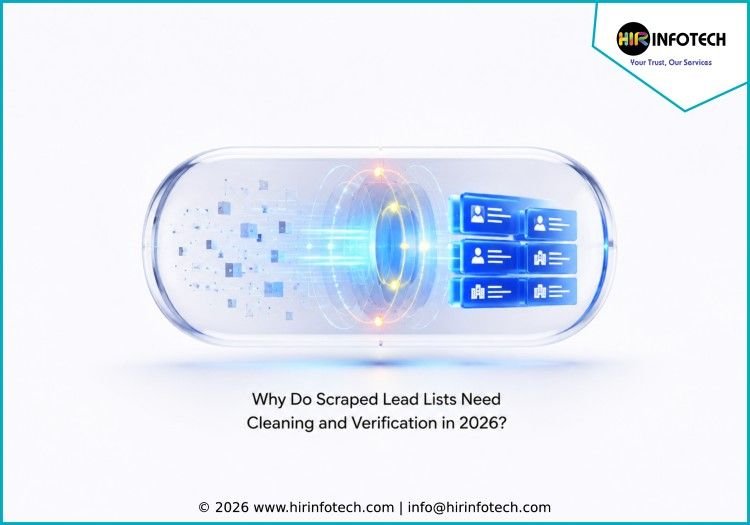
Why Do Scraped Lead Lists Need Cleaning and Verification in 2026?
Introduction
Scraped lead lists can help businesses scale outreach faster, but raw data alone rarely delivers reliable results. In 2026, companies across the USA, Europe, and global markets need clean, verified lead data to avoid wasted marketing spend, poor deliverability, compliance risks, and low conversion rates.
What Are Scraped Lead Lists?
Scraped lead lists are collections of business or contact information extracted from publicly available online sources such as:
- Company websites
- Business directories
- LinkedIn profiles
- Industry listings
- Ecommerce stores
- Marketplace platforms
- Public databases
- Review platforms
- Trade association websites
These datasets often include:
- Company names
- Contact names
- Email addresses
- Phone numbers
- Job titles
- Website URLs
- Geographic locations
- Industry categories
- Revenue or employee estimates
Businesses use scraped lead lists to support:
- B2B sales outreach
- Market research
- Recruitment
- Lead generation
- Partnership development
- Account-based marketing
- Competitive intelligence
However, raw scraped data is rarely ready for direct use.
Why Raw Scraped Lead Lists Often Contain Problems
Web data changes constantly. Companies update websites, employees switch roles, domains expire, and contact information becomes outdated quickly.
Without cleaning and verification, scraped lead lists usually contain:
Duplicate Records
The same company or contact may appear multiple times from different sources. Duplicate records create confusion in CRM systems and waste sales efforts.
Invalid Email Addresses
Many scraped email addresses are outdated, inactive, role-based, or incorrectly formatted.
This leads to:
- High email bounce rates
- Reduced sender reputation
- Lower campaign deliverability
- Increased spam classification risk
Missing Data Fields
Incomplete records reduce the usefulness of a lead database. Missing company size, industry, or decision-maker information makes targeting less effective.
Incorrect Company Information
Businesses frequently change:
- Locations
- Domains
- Team structures
- Contact details
- Ownership
- Service offerings
Unverified scraped data may reflect outdated business information.
Irrelevant Leads
Scraping broad datasets without filtering often produces low-quality leads outside the intended market, industry, or buying profile.
Compliance Risks
Poorly managed scraped data can create legal and compliance concerns related to privacy regulations and outreach practices in regions such as:
- USA
- Germany
- United Kingdom
- France
- Netherlands
- Switzerland
- Canada
- Australia
Why Data Cleaning Matters for Businesses in 2026
Lead quality directly impacts marketing efficiency, sales productivity, and campaign ROI.
Businesses now rely heavily on automation, AI-driven personalization, CRM integrations, and outbound workflows. Poor-quality data weakens every stage of the process.
Better Email Deliverability
Clean lead lists help businesses avoid sending emails to invalid addresses.
Verified email datasets improve:
- Inbox placement
- Open rates
- Domain reputation
- Outreach scalability
- Marketing automation performance
In 2026, email platforms apply stricter sender quality monitoring, making verification even more important.
Improved Sales Efficiency
Sales teams lose time when contacting outdated or irrelevant leads.
Cleaned datasets allow representatives to focus on:
- Real decision-makers
- Active businesses
- Relevant industries
- Qualified prospects
This improves productivity and reduces wasted outreach efforts.
Stronger CRM Accuracy
Dirty data creates reporting problems inside CRMs and sales platforms.
Clean records improve:
- Pipeline visibility
- Forecasting accuracy
- Segmentation
- Lead scoring
- Territory management
- Campaign attribution
Reliable CRM data supports better business decisions.
Reduced Compliance Exposure
Businesses operating across Europe and international markets must carefully manage scraped contact data.
Verification and cleaning processes help organizations:
- Remove risky records
- Identify role-based emails
- Filter sensitive categories
- Maintain data governance standards
- Support lawful outreach workflows
This is especially important for companies targeting regions with strict privacy expectations such as Germany, France, Ireland, and Switzerland.
Higher Lead Conversion Rates
Accurate lead data improves targeting precision.
Sales and marketing teams can better personalize outreach using verified:
- Industry classifications
- Company size data
- Geographic targeting
- Job roles
- Technology usage
- Business intent indicators
This creates more relevant conversations and stronger conversion opportunities.
Common Lead List Cleaning Processes
Professional lead cleaning involves multiple validation and enrichment steps.
Deduplication
Duplicate records are identified and merged based on:
- Email addresses
- Domains
- Company names
- Phone numbers
- CRM identifiers
This prevents redundant outreach and database clutter.
Email Verification
Email validation tools check whether addresses are:
- Properly formatted
- Active
- Deliverable
- Disposable
- Spam traps
- Catch-all domains
Advanced verification systems also identify high-risk addresses before campaigns launch.
Standardization
Data formatting is normalized for consistency across systems.
Examples include:
- Country naming conventions
- Phone number formatting
- Industry classifications
- Job title structures
- URL formatting
Standardized datasets improve automation compatibility.
Industry and Company Filtering
Businesses often refine lead lists by:
- Industry vertical
- Employee size
- Revenue range
- Geographic region
- Technology stack
- Buyer intent
This removes irrelevant prospects and improves targeting quality.
Data Enrichment
Enrichment adds missing business intelligence data such as:
- Social profiles
- Company descriptions
- Estimated revenue
- Employee count
- Technology usage
- Funding status
- Location intelligence
Enriched lead lists provide deeper prospect insights.
Compliance Screening
Businesses increasingly apply screening rules to reduce compliance concerns.
This may include:
- Region-specific filtering
- Consent management checks
- Suppression list matching
- Sensitive category exclusions
- Role-account filtering
Why Verification Is Essential for International Lead Generation
International B2B outreach introduces additional challenges.
Businesses targeting countries such as:
- USA
- United Kingdom
- Germany
- Spain
- Italy
- Netherlands
- Poland
- Australia
- Canada
- Hong Kong
- Thailand
must handle different data structures, languages, regulations, and business formats.
Verification becomes critical because:
- International directories may contain outdated records
- Formatting varies between countries
- Contact naming standards differ
- Domains frequently change
- Regional compliance expectations vary
Without verification, global lead generation campaigns can quickly lose efficiency.
How Poor-Quality Lead Lists Hurt Business Performance
Many companies underestimate the operational damage caused by dirty lead data.
Lower Marketing ROI
Advertising and outreach budgets get wasted targeting invalid or irrelevant contacts.
Damaged Brand Reputation
Repeated outreach to inaccurate contacts creates negative brand experiences.
Sales Team Frustration
Low-quality data reduces trust in marketing-generated leads.
Reduced Automation Accuracy
AI personalization and marketing automation systems depend on clean structured data.
Poor Analytics
Inaccurate records distort reporting and strategic decision-making.
How Hirinfotech Supports Reliable Lead Data Workflows
hirinfotech helps businesses build scalable web data extraction and lead processing workflows designed for modern B2B operations. For companies using scraped lead lists for sales, research, recruitment, or market intelligence, reliable data quality management is essential.
Its capabilities support businesses that require:
- Public web data extraction
- Lead dataset structuring
- Data normalization
- Duplicate removal
- Data verification workflows
- CRM-ready formatting
- Industry-specific lead targeting
- Large-scale scraping operations
Organizations operating across the USA, Europe, Australia, Canada, and Asia often require lead datasets that are usable, structured, and operationally reliable rather than simply large in volume. Clean and verified datasets help businesses improve outreach quality, reduce operational inefficiencies, and support more accurate targeting strategies.
As businesses increasingly depend on automation, AI-driven prospecting, and outbound scalability in 2026, structured lead data workflows have become an important part of sustainable B2B growth strategies.
Best Practices for Maintaining Clean Lead Databases
Lead cleaning should not be treated as a one-time process.
Businesses should establish ongoing data maintenance workflows.
Schedule Regular Verification
Contact data should be revalidated frequently to maintain accuracy.
Remove Inactive Records
Old or unresponsive contacts should be archived or removed.
Monitor Bounce Rates
High bounce rates often indicate declining database quality.
Use Structured Data Standards
Consistent formatting improves CRM and automation performance.
Combine Scraping With Human Review
Automated scraping works best when paired with quality assurance checks.
Prioritize Relevance Over Volume
Smaller verified lead lists usually outperform massive unfiltered datasets.
Frequently Asked Questions
Why is lead list cleaning necessary after web scraping?
Raw scraped data often contains duplicates, invalid emails, outdated contacts, and incomplete records. Cleaning improves accuracy, deliverability, and outreach effectiveness.
How often should businesses verify scraped lead lists?
Businesses running active outreach campaigns should verify lead data regularly, especially before launching email or sales campaigns.
Can dirty lead data affect email deliverability?
Yes. Invalid or outdated email addresses increase bounce rates and may damage sender reputation, reducing inbox placement rates.
Is scraped lead data legal to use for B2B outreach?
The legality depends on the country, the type of data collected, and how businesses use it. Companies should follow applicable privacy and communication regulations in their target regions.
What industries benefit most from cleaned lead data?
Industries including SaaS, recruitment, manufacturing, ecommerce, consulting, logistics, finance, and B2B services commonly rely on verified lead datasets.
How does Hirinfotech help businesses manage scraped lead data?
hirinfotech supports businesses with web scraping, structured lead extraction, data processing, normalization, and scalable data workflow solutions.
Conclusion
Scraped lead lists can provide valuable business intelligence and outreach opportunities, but raw datasets alone rarely produce reliable results. In 2026, businesses need clean, verified, and structured lead data to improve targeting accuracy, protect deliverability, support compliance, and maximize sales efficiency.
As B2B outreach becomes increasingly automated and data-driven, lead verification and cleaning are no longer optional operational steps. Businesses using web scraping and large-scale lead generation workflows benefit most when data quality remains a central priority throughout the entire process.









