
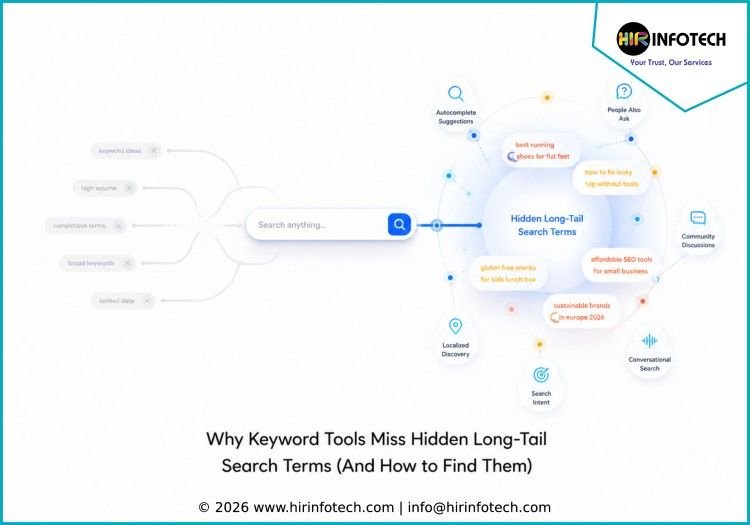
Why Keyword Tools Miss Hidden Long-Tail Search Terms (And How to Find Them)
Introduction
Your keyword research tools are lying to you. Not maliciously, but systematically. The terms Google’s Keyword Planner dismisses as “low volume” are often the very queries that convert at 10x the rate of high-volume competitors. In 2026, as seventy percent of Google searches now contain four or more words, the gap between what tools surface and what users actually search has become a chasm . Understanding why this gap exists — and how to bridge it — separates content that ranks from content that gets ignored.
The Volume Deception: Why “Low Search Volume” Is a Signal, Not a Problem
Traditional keyword tools have a fundamental bias. They are optimized for platform revenue, not your profitability. Google’s Keyword Planner naturally surfaces terms with high advertiser demand—meaning high competition—because that is where Google makes its margin . It de-emphasizes long-tail, low-competition terms that are actually more profitable for efficient businesses.
The “average monthly searches” metric is a mirage. For low-volume terms, tools often show vague ranges like “1K-10K,” which is functionally useless. Worse, that number represents all searches, not relevant, purchasible searches. A query like “[product] vs competitor” might show volume, but that user is researching, not buying. The tool does not tell you the intent behind the volume .
Here is the counterintuitive truth: your best keywords are often the ones the Keyword Planner tells you have no volume. When you enter a hyper-specific, problem-focused phrase like “how to fix niche product without expensive tool,” Google’s tool often returns “0” or “Low Volume.” Most marketers move on. But this query represents a user with a high-pain problem and specific intent. They are not browsing. They are ready to take action.
The Geo-Modifier Blind Spot
Traditional keyword tools struggle with location-specific long-tail variations. A search pattern specific to a single city or neighborhood may never reach the volume threshold required to appear in aggregated databases. Yet for multi-location businesses, these hyper-local queries represent critical opportunities.
For businesses operating across the USA, Germany, United Kingdom, France, Italy, Russia, Spain, Netherlands, Switzerland, Poland, Ireland, Australia, Canada, Thailand, and Hong Kong, the same seed keyword can produce completely different long-tail variations in each market due to local search behavior, language nuances, and cultural context. Traditional tools with country filters still rely on the same underlying database, missing these localized intent patterns entirely.
The Cultural Fragmentation Factor
Seventy percent of Google searches now contain four or more words. That statistic signals a major shift in how people discover content. Users no longer search broadly; they search specifically, reflecting cultural micro-intent shaped by identity, community, and shared experience .
Search is fragmenting into subcultures. Communities—sneaker collectors, endurance athletes, K-pop fans, sustainable fashion advocates—use unique language that reinforces group identity. The words they search reflect in‑group knowledge, slang, tone, and references that outsiders might not understand .
Traditional keyword research tells you what people type. It does not tell you why they type it. A query like “vegan protein powder for women over 40” is not just a keyword. It is a cultural signal—shorthand for identity, lifestyle, and belonging . No volume-based tool surfaces this nuance.
How AI Search Is Reshaping Long-Tail Discovery
Generative search is accelerating this fragmentation. As AI systems personalize results based on user context, interests, and engagement patterns, the internet is splitting into thousands of micro-ecosystems . A search for “running shoes” no longer produces a universal ranking. It is filtered through a user’s browsing history, purchase data, and preferred communities.
Users are increasingly submitting long-tail queries when interacting with AI chatbots, phrasing questions naturally as they would ask a friend. The accuracy of AI outputs is improving, building user confidence . In 2026, brands need a keen understanding of how their customers phrase questions in real life—not how keyword tools aggregate them.
Why Tools Cannot Capture What Has Not Been Searched Yet
Traditional keyword databases are historical. They can only reflect what has already been searched enough times to reach volume thresholds. They cannot predict emerging questions, trending topics, or shifts in conversational language until those patterns have become mainstream.
This is where the gap between tool-based research and actual user behavior becomes most visible. When a new search trend emerges—driven by news, product launches, or cultural events—traditional tools may take weeks or months to reflect it. By the time a keyword appears in their databases, early adopters have already captured significant visibility.
The Technical Limitations of Aggregated Databases
Premium SEO platforms maintain massive keyword databases claiming billions of keywords. But these databases share a fundamental limitation: they work from historical or periodically refreshed data sets. The computational cost of crawling, processing, and indexing the entire search landscape means updates happen on schedules, not in real time.
Furthermore, these databases prioritize keywords with measurable search volume. Question-based queries and conversational search patterns are often underrepresented because they are harder to aggregate at scale. A People Also Ask question that appears for a specific query may never make it into a standalone keyword database, even though it represents a real user need.
Where Hidden Long-Tail Keywords Actually Live
Hidden long-tail search terms are not hidden because users are not searching them. They are hidden from traditional tools because they exist in sources those tools do not access.
Google Autocomplete and Alphabet Expansion
Google Autocomplete reveals what users are actively typing, not what they searched for months ago. With alphabet expansion—appending each letter of the alphabet to a seed keyword—a single seed can generate up to 360 unique long-tail suggestions. Traditional tools do not offer this level of granular exploration because the computational cost would be prohibitive at database scale.
People Also Ask Questions with Depth Expansion
The People Also Ask feature appears in approximately 40 to 45 percent of Google searches. When scraped with depth expansion, a single seed keyword can return 15 to 30 or more related questions. Each question represents a distinct long-tail opportunity that traditional keyword tools miss entirely .
Forums, Reddit, and Quora
Discussion platforms provide direct access to audience language. Users on Reddit and Quora ask questions using the exact phrasing of their real problems—phrases that may never appear in keyword databases .
The process is straightforward: identify relevant threads, observe the language and recurring questions, and extract keywords directly from user-generated content. A question like “What can a person do to strengthen their immune system?” can become a targeted long-tail keyword with approximately 20 monthly searches and low competition .
The Cultural Layer: Subreddits and Community Dialects
For truly hidden gems, go deeper. Subreddits are echo chambers of specific language. The terms a community uses internally—“EDC” for everyday carry enthusiasts, “reps” for counterfeit sneaker buyers, “stack” for nootropics users—are almost never surfaced by traditional tools. Optimizing for these terms means speaking your audience’s dialect, not the dictionary.
Search Term Reports from Your Own Campaigns
Your search term reports are a goldmine that most advertisers ignore. They show the exact queries that drove impressions and conversions—including the “other” queries that traditional tools never surface . Mining these reports reveals high-intent, low-competition terms specific to your business and audience.
The Blind Spot for AI and Multi-Modal Queries
As search becomes more conversational, queries are becoming longer and more specific. In scholarly and technical contexts, precision still matters. Specific product codes, chemical formulas, and exact phrases require deterministic matching that today’s AI systems struggle with . Traditional keyword tools are not designed to capture these.
Image-based and figure-dependent queries remain largely invisible to both traditional tools and many AI systems. A user searching for a specific chart, diagram, or infographic may never trigger a keyword that appears in any database.
How to Build a Workflow That Finds Hidden Long-Tail Terms
Escaping the limitations of traditional keyword tools requires a different workflow.
Start by deconstructing the customer, not the algorithm. Before touching any tool, write down real-world questions your customers ask. These are your seed keywords. Ignore the Planner until you have this list .
Next, scrape live search data. Use autocomplete scraping with alphabet expansion, People Also Ask extraction with depth expansion, and related searches collection. This captures what users are actually searching right now.
Then mine community conversations. Extract questions and recurring phrases from Reddit, Quora, and industry-specific forums. Pay attention to subcultural language—the slang, acronyms, and inside references your audience uses.
Use traditional tools only for validation, not discovery. Take your human-generated and scraped keywords and check their performance post-hoc. If a term has low volume but high intent based on your understanding of the customer, that is your opportunity .
Finally, build intent buckets rather than keyword lists. Organize around jobs to be done: help me understand my problem, help me compare options, I am ready to buy. No keyword tool can build this structure.
Why Hir Infotech Takes a Different Approach
At Hir Infotech, we have built our search intelligence practice around delivering the long-tail keywords that traditional tools miss. With over 13 years of experience and 2,745+ satisfied clients across the USA, Europe, and Australia, we have deployed SERP extraction for hundreds of keyword research use cases .
Our approach focuses on three capabilities that traditional tools cannot match. First, we extract discovery-level keyword data including Google Autocomplete suggestions with alphabet expansion, People Also Ask questions with depth expansion, and related searches from any seed keyword list. This provides the raw material for long-tail discovery.
Second, we capture cultural and community language. Our extraction pipelines target forums, review sites, and community platforms to surface the specific phrasing your audience uses—the language that never appears in aggregated databases.
Third, we support multi-market collection across all target locations. Using country-specific parameters for the USA, Germany, United Kingdom, France, Italy, Russia, Spain, Netherlands, Switzerland, Poland, Ireland, Australia, Canada, Thailand, and Hong Kong, we reveal localized long-tail variations that single-market research would miss entirely.
We deliver structured, decision-ready keyword datasets that feed directly into content calendars and strategy workflows. For organizations ready to move beyond the volume deception and build content around what users are actually searching, we provide the infrastructure to find the hidden long-tail terms that drive qualified traffic.
Frequently Asked Questions
Why does Google’s Keyword Planner hide low-volume, high-intent keywords?
Google’s Keyword Planner is optimized for platform revenue, not advertiser profitability. It prioritizes terms with high advertiser demand because that is where Google maximizes cost-per-click. Low-volume, high-intent terms generate less auction activity and are therefore de-emphasized .
What types of long-tail keywords do traditional tools consistently miss?
Traditional tools miss real-time emerging trends before they reach volume thresholds, hyper-local variations specific to individual cities or neighborhoods, question-based queries from People Also Ask boxes, cultural and community-specific language from forums and subreddits, and long-tail variations revealed through alphabet expansion.
How does cultural fragmentation affect keyword research?
Search is splitting into micro-communities where language, tone, and values matter more than volume. Users search in the dialect of their communities—using slang, references, and phrasing that outsiders might not understand. Traditional tools cannot capture this because it requires cultural research, not keyword matching .
Is search volume data completely useless for long-tail research?
No, but it should be used for validation, not discovery. Use volume data to prioritize among already-discovered terms, not to generate initial keyword ideas. A term with low volume but high intent based on customer understanding is often more valuable than a high-volume term with mixed intent .
Can long-tail keyword scraping work for the countries you serve?
Yes. Using country-specific parameters, scraping captures localized long-tail variations for the USA, Germany, United Kingdom, France, Italy, Russia, Spain, Netherlands, Switzerland, Poland, Ireland, Australia, Canada, Thailand, and Hong Kong. Results vary significantly by market and should be analyzed separately.
Conclusion
Traditional keyword research tools are not broken. They are designed for a purpose that does not align with finding hidden long-tail search terms. Their volume-first bias, historical data limitations, and inability to capture cultural and community language create blind spots that content strategists cannot afford to ignore. The hidden long-tail terms that traditional tools miss are often the most valuable—high-intent, low-competition queries that drive conversions, not just traffic. Finding them requires a different workflow: deconstructing the customer before touching tools, scraping live search data from autocomplete and PAA boxes, mining community conversations on forums and subreddits, and using traditional tools only for validation. For organizations ready to move beyond the volume deception and build content around what users are actually searching right now, Hir Infotech provides the search intelligence infrastructure to find the hidden long-tail terms across every market you serve—turning invisible queries into visible results.









