
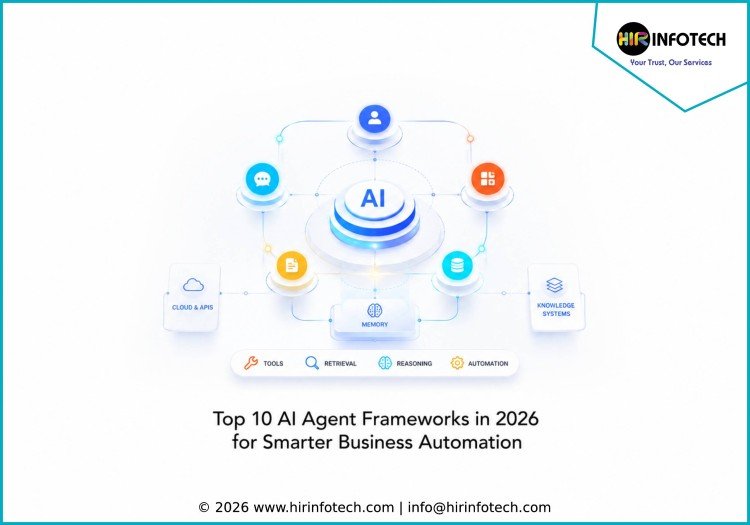
Top 10 AI Agent Frameworks in 2026
1. LangGraph
Short overview:
LangGraph, built by LangChain, is one of the most popular AI agent frameworks for creating stateful, controllable, and production-ready agent workflows. It helps developers design agents as graph-based systems, where each step, decision, tool call, and response can be managed clearly. This makes it useful for businesses building reliable AI agents for research, support, data workflows, and automation.
Key strengths:
Graph-based orchestration, state management, tool calling, memory support, workflow control, debugging, and production-friendly agent design.
Best for:
AI product teams, developers, data teams, automation teams, and companies building complex agent workflows.
2. LlamaIndex
Short overview:
LlamaIndex is a strong framework for building data-connected AI agents, especially when businesses need agents that work with documents, databases, APIs, and internal knowledge. It is widely used for retrieval-augmented generation, enterprise search, knowledge assistants, and data analysis workflows. LlamaIndex helps companies connect large language models with trusted business information.
Key strengths:
RAG workflows, document indexing, data connectors, knowledge agents, query engines, workflow tools, and enterprise data integration.
Best for:
Data teams, knowledge management teams, SaaS companies, enterprise search teams, and businesses building document-based AI agents.
3. CrewAI
Short overview:
CrewAI is a practical AI agent framework designed for building role-based multi-agent systems. It allows teams to create agents with specific roles, goals, tasks, and collaboration patterns. Businesses use CrewAI for research automation, content workflows, sales tasks, business analysis, reporting, and operations support where multiple agents need to work together.
Key strengths:
Role-based agents, multi-agent collaboration, task delegation, workflow automation, easy setup, and business-friendly agent design.
Best for:
Startups, agencies, marketers, sales teams, operations teams, and businesses building collaborative AI workflows.
4. Microsoft AutoGen
Short overview:
Microsoft AutoGen is an AI agent framework focused on multi-agent conversations and collaborative problem-solving. It helps developers create agents that can communicate with each other, use tools, involve humans when needed, and complete complex tasks. AutoGen is useful for businesses that want flexible agent systems for coding, research, planning, analysis, and workflow automation.
Key strengths:
Multi-agent conversations, human-in-the-loop support, tool use, automation workflows, flexible agent communication, and Microsoft ecosystem alignment.
Best for:
Developers, research teams, enterprise AI teams, automation engineers, and companies building conversational agent systems.
5. Microsoft Semantic Kernel
Short overview:
Microsoft Semantic Kernel is an open-source SDK for building AI agents and intelligent applications using natural language, plugins, memory, and enterprise workflows. It works well with Microsoft Azure and supports business applications that need AI orchestration, tool integration, and structured automation. It is especially useful for companies already using Microsoft technologies.
Key strengths:
Plugin architecture, memory support, AI orchestration, enterprise integration, Azure compatibility, and structured workflow development.
Best for:
Microsoft-based businesses, enterprise developers, Azure users, internal automation teams, and companies building AI-powered applications.
6. OpenAI Agents SDK
Short overview:
OpenAI Agents SDK helps developers build AI agents that can use tools, follow instructions, call functions, and complete complex workflows. It is useful for businesses building assistants for customer support, research, data tasks, internal operations, and productivity automation. The framework is especially relevant for teams already building applications with OpenAI models.
Key strengths:
Tool calling, agent instructions, workflow design, model integration, function execution, and developer-friendly AI application building.
Best for:
AI startups, developers, SaaS companies, customer support teams, and businesses building OpenAI-based agents.
7. Google Agent Development Kit
Short overview:
Google Agent Development Kit, also known as Google ADK, is designed to help developers build AI agents connected to Google’s AI and cloud ecosystem. It supports structured agent development, tool use, and integration with cloud services. Businesses using Google Cloud can use it to create agents for enterprise workflows, data access, automation, and application support.
Key strengths:
Google Cloud integration, agent orchestration, tool support, cloud-native development, structured workflows, and enterprise AI compatibility.
Best for:
Google Cloud users, data teams, AI developers, SaaS businesses, and enterprises building cloud-connected AI agents.
8. PydanticAI
Short overview:
PydanticAI is a Python-focused AI agent framework designed for developers who want type-safe, structured, and reliable agent applications. It is useful for teams that care about clean code, validation, testing, and predictable outputs. Businesses can use PydanticAI for production AI agents where data structure, correctness, and developer control are important.
Key strengths:
Type-safe development, Python support, structured outputs, validation, clean developer experience, and reliable agent design.
Best for:
Python developers, technical startups, backend teams, data engineers, and businesses building structured AI applications.
9. Haystack
Short overview:
Haystack, developed by deepset, is an AI framework for building search, question-answering, and retrieval-based applications. It supports pipelines that combine language models, document stores, retrievers, and ranking systems. For businesses, Haystack is useful when AI agents need to search internal knowledge, answer questions, summarize documents, or support customer-facing information systems.
Key strengths:
RAG pipelines, document search, question answering, retrievers, ranking, model flexibility, and enterprise knowledge workflows.
Best for:
Enterprise search teams, support teams, legal teams, research teams, and companies building knowledge-based AI assistants.
10. Agno
Short overview:
Agno is an AI agent framework focused on building lightweight, fast, and flexible agent systems. It supports tool use, memory, multimodal workflows, and multi-agent development. Businesses can use Agno for creating assistants, automation workflows, research agents, and data-connected AI applications without unnecessary complexity.
Key strengths:
Lightweight agent development, tool use, memory, multimodal support, multi-agent workflows, and flexible implementation.
Best for:
Startups, developers, AI builders, automation teams, and companies experimenting with practical agent applications.
Why Choosing the Right Company Matters
Choosing from the Top 10 AI Agent Frameworks in 2026 is important because the right framework can directly affect automation quality, development speed, data reliability, and long-term scalability.
AI agents are not simple chatbots. They can use tools, call APIs, search documents, analyze data, manage workflows, and complete multi-step tasks. Because of this, businesses should compare each framework based on real use cases, not only popularity.
Expertise matters first. Some frameworks are better for multi-agent collaboration, while others are stronger for retrieval, enterprise workflows, cloud integration, or type-safe development. A data-heavy business may prefer LlamaIndex or Haystack, while a company building complex workflow agents may choose LangGraph or AutoGen.
Pricing should also be reviewed carefully. Many frameworks are open source, but costs can come from model usage, hosting, infrastructure, cloud services, engineering time, monitoring, and support. Businesses should understand the full cost before building production systems.
Data quality is another key factor. AI agents are only useful when they access accurate, updated, and trusted data. If an agent connects to poor-quality documents, outdated databases, or weak APIs, its output may become unreliable.
Technology and integrations are equally important. A strong AI agent framework should connect with APIs, databases, CRMs, cloud platforms, vector databases, business apps, and internal workflows. Good integrations reduce manual work and make agents more useful in daily operations.
Support and scalability should not be ignored. A small prototype may work with a simple setup, but production agents need monitoring, logging, error handling, permissions, testing, and security controls. The right framework should support both experimentation and growth.
The best AI agent framework is the one that fits your business goals, technical stack, data environment, team skills, and long-term automation strategy.
Conclusion
The Top 10 AI Agent Frameworks in 2026—LangGraph, LlamaIndex, CrewAI, Microsoft AutoGen, Microsoft Semantic Kernel, OpenAI Agents SDK, Google Agent Development Kit, PydanticAI, Haystack, and Agno—support different needs across automation, multi-agent workflows, enterprise AI, and data-connected applications.
LangGraph is strong for controlled workflow agents. LlamaIndex and Haystack are useful for knowledge and retrieval-based systems. CrewAI and AutoGen support multi-agent collaboration. Semantic Kernel and Google ADK work well for enterprise cloud ecosystems. OpenAI Agents SDK is practical for OpenAI-based applications, while PydanticAI and Agno help developers build structured and flexible agents.
Before choosing a framework, businesses should compare expertise, pricing, data quality, integrations, support, security, and scalability. With the right AI agent framework, companies can build smarter automation systems and improve productivity in 2026.









