
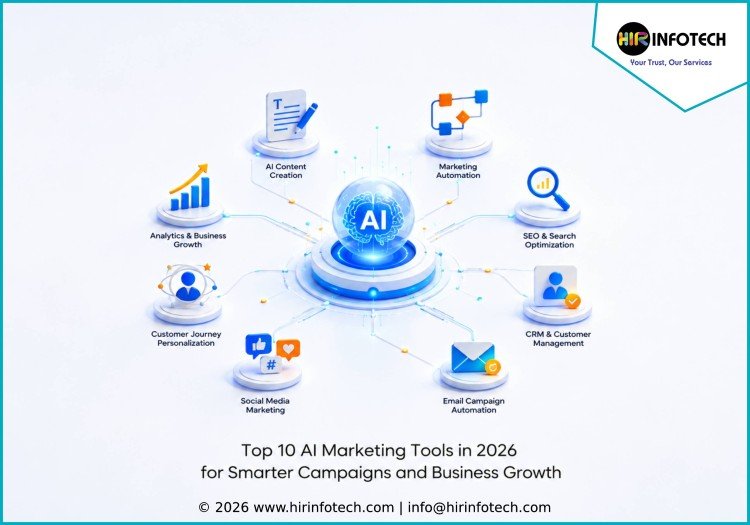
Top 10 AI Marketing Tools in 2026
1. HubSpot Marketing Hub
Short overview:
HubSpot Marketing Hub is a powerful marketing automation platform with AI features for email campaigns, landing pages, lead management, content creation, reporting, and customer journeys. It helps businesses attract, nurture, and convert leads from one connected platform. HubSpot is especially useful for companies that want AI marketing tools combined with CRM and sales alignment.
Key strengths:
Marketing automation, AI content support, email workflows, lead nurturing, CRM integration, campaign analytics, forms, and landing pages.
Best for:
B2B companies, SaaS businesses, agencies, sales-led teams, startups, and companies needing connected marketing and CRM workflows.
2. Jasper
Short overview:
Jasper is an AI content creation platform built for marketing teams that need blog content, ad copy, social posts, email campaigns, landing page copy, and brand-aligned messaging. It helps businesses speed up content production while maintaining tone, structure, and campaign consistency. Jasper is useful for companies producing large volumes of marketing content across multiple channels.
Key strengths:
AI copywriting, brand voice control, campaign content creation, blog drafting, ad copy, social content, and marketing workflow support.
Best for:
Content teams, agencies, SaaS marketers, eCommerce brands, growth teams, and businesses needing scalable marketing content.
3. Semrush
Short overview:
Semrush is a complete digital marketing and SEO platform with AI-supported tools for keyword research, competitor analysis, content planning, SEO audits, backlink tracking, and advertising research. Businesses use Semrush to understand search demand, monitor competitors, improve content strategy, and grow organic visibility. It is one of the most useful AI marketing tools for data-driven SEO campaigns.
Key strengths:
Keyword research, competitor insights, SEO audits, content optimization, backlink analysis, PPC research, and marketing reporting.
Best for:
SEO teams, content marketers, agencies, SaaS companies, eCommerce brands, and businesses focused on organic growth.
4. Surfer SEO
Short overview:
Surfer SEO helps businesses create and optimize content based on search engine data. It analyzes top-ranking pages and provides content recommendations around keywords, headings, structure, word count, and topical relevance. With AI-supported writing and optimization features, Surfer SEO is useful for marketers who want to improve blog posts, service pages, and landing pages.
Key strengths:
Content optimization, SERP analysis, AI writing support, keyword suggestions, content scoring, topical recommendations, and SEO audits.
Best for:
SEO writers, bloggers, agencies, content teams, SaaS companies, and businesses focused on search-friendly content.
5. Canva
Short overview:
Canva is a design and content creation platform that uses AI to help businesses create social media graphics, presentations, ads, videos, brand kits, and marketing visuals. It is popular because non-designers can create professional-looking assets quickly. Canva is useful for teams that need fast creative production without relying on complex design software.
Key strengths:
AI design tools, templates, brand kits, social media graphics, video creation, presentations, image editing, and team collaboration.
Best for:
Small businesses, marketers, social media teams, agencies, creators, startups, and companies needing quick visual content.
6. Klaviyo
Short overview:
Klaviyo is an AI-powered marketing automation platform focused on email, SMS, customer segmentation, and lifecycle marketing. It is widely used by eCommerce and DTC brands to personalize campaigns based on customer behavior, purchase history, and engagement. Klaviyo helps businesses automate customer journeys and improve retention through targeted messaging.
Key strengths:
Email automation, SMS marketing, AI segmentation, customer behavior tracking, predictive analytics, personalization, and eCommerce integrations.
Best for:
eCommerce brands, DTC businesses, online retailers, customer retention teams, and companies focused on personalized campaigns.
7. Mailchimp
Short overview:
Mailchimp is a marketing platform that helps businesses manage email campaigns, customer journeys, audience segmentation, landing pages, and campaign reporting. Its AI features support content suggestions, send-time optimization, segmentation, and performance insights. Mailchimp is useful for small and growing businesses that need an accessible marketing automation tool.
Key strengths:
Email marketing, AI recommendations, audience segmentation, journey automation, landing pages, reporting, and campaign templates.
Best for:
Small businesses, startups, creators, local companies, service providers, and teams starting with email marketing automation.
8. Hootsuite
Short overview:
Hootsuite is a social media management platform with AI features for scheduling, content planning, post ideas, analytics, and social listening. It helps businesses manage multiple social channels from one dashboard. Marketing teams use Hootsuite to organize publishing calendars, monitor brand mentions, measure engagement, and maintain a consistent social media presence.
Key strengths:
Social media scheduling, AI content suggestions, analytics, social listening, publishing calendar, engagement management, and team collaboration.
Best for:
Social media teams, agencies, brands, marketing departments, creators, and businesses managing multiple social platforms.
9. Sprout Social
Short overview:
Sprout Social is a social media management and analytics platform built for businesses that need stronger social listening, engagement, reporting, and customer insights. Its AI features support message analysis, content assistance, sentiment understanding, and workflow efficiency. Sprout Social is useful for companies that treat social media as a serious marketing, support, and brand intelligence channel.
Key strengths:
Social listening, analytics, engagement management, sentiment insights, AI assistance, reporting dashboards, and team workflows.
Best for:
Mid-sized businesses, enterprises, agencies, social media teams, customer experience teams, and brands needing deeper social insights.
10. Salesforce Marketing Cloud
Short overview:
Salesforce Marketing Cloud is an enterprise marketing platform with AI capabilities for customer journeys, personalization, email campaigns, advertising, analytics, and cross-channel engagement. It helps large businesses connect marketing data with customer relationship management. Salesforce Marketing Cloud is useful for companies that need advanced segmentation, automation, and customer lifecycle management at scale.
Key strengths:
Customer journey automation, AI personalization, CRM integration, campaign analytics, segmentation, email marketing, and enterprise scalability.
Best for:
Enterprises, large B2B teams, retail brands, financial services, healthcare companies, and businesses with complex customer journeys.
Why Choosing the Right Company Matters
Choosing from the Top 10 AI Marketing Tools in 2026 is important because every platform solves a different marketing challenge. Some tools focus on content creation, while others support SEO, email automation, social media, customer journeys, design, analytics, or CRM-connected campaigns.
Businesses should first compare expertise and use case fit. A content team may benefit from Jasper or Surfer SEO, while an eCommerce brand may need Klaviyo. A company focused on social media may prefer Hootsuite or Sprout Social, while a larger enterprise may need HubSpot or Salesforce Marketing Cloud.
Pricing should also be reviewed carefully. AI marketing tools may charge by users, contacts, campaigns, credits, content volume, automation features, or enterprise plans. A tool that looks affordable at first may become expensive as usage grows.
Data quality matters because AI marketing depends on accurate customer data, campaign performance data, search data, and engagement insights. Poor data can lead to weak personalization, low-quality content, and inaccurate reporting.
Technology and integrations are equally important. The best AI marketing tools should connect with CRM systems, email platforms, analytics tools, eCommerce stores, ad platforms, social media channels, and reporting dashboards. Strong integrations help teams reduce manual work and improve campaign performance.
Support and scalability should not be ignored. As businesses grow, they may need better permissions, advanced reporting, automation workflows, brand controls, and customer support. The right tool should support both current marketing needs and future growth.
The best AI marketing tool is the one that fits your goals, team skills, budget, data needs, and long-term growth strategy.
Conclusion
The Top 10 AI Marketing Tools in 2026—HubSpot Marketing Hub, Jasper, Semrush, Surfer SEO, Canva, Klaviyo, Mailchimp, Hootsuite, Sprout Social, and Salesforce Marketing Cloud—help businesses improve content, SEO, email campaigns, automation, design, social media, and customer engagement.
HubSpot and Salesforce Marketing Cloud are strong for full marketing automation. Jasper, Surfer SEO, and Canva support content and creative production. Semrush helps with SEO and competitor research. Klaviyo and Mailchimp improve email marketing, while Hootsuite and Sprout Social support social media management.
Before choosing a platform, businesses should compare pricing, features, AI capabilities, integrations, data quality, support, ease of use, and scalability. With the right AI marketing tools, companies can save time, improve personalization, and build stronger marketing campaigns in 2026.









