
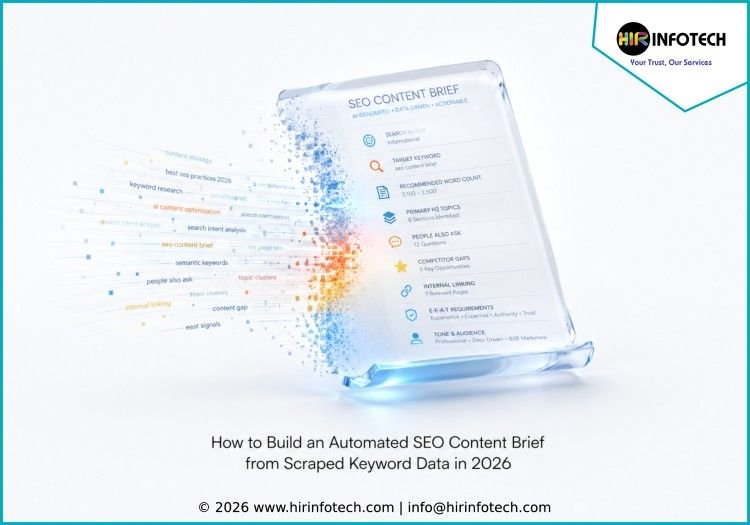
How to Build an Automated SEO Content Brief from Scraped Keyword Data in 2026
Introduction
Businesses scaling content production in 2026 can’t afford hours of manual keyword research and brief creation. An automated SEO content brief built from scraped keyword data transforms raw SERP insights into actionable writer instructions in minutes. This guide shows you exactly how to build this workflow and why it matters for your organic search strategy.
What Is an Automated SEO Content Brief?
An automated SEO content brief is a data-driven document that generates automatically from scraped keyword and SERP data. Instead of manually analyzing top-ranking pages, your workflow extracts search volume, keyword difficulty, competitor headings, People Also Ask questions, and semantic keywords—then compiles them into a structured brief for writers.
The brief includes target keywords, search intent classification, recommended word count, heading structure, competitor gaps, internal linking suggestions, and E-E-A-T requirements—all derived from real search data rather than guesswork.
Why Automation Matters in 2026
Time Savings at Scale
Manual brief creation takes 45–90 minutes per keyword. An automated workflow produces comprehensive briefs in 30 seconds to 10 minutes, depending on complexity. For teams publishing 20+ articles monthly, this saves 15–30 hours weekly.
Data Accuracy and Consistency
Automated briefs pull from live SERP data, ensuring your word count recommendations, keyword targets, and competitor analysis reflect current rankings—not outdated research. Every brief follows the same template, eliminating human error and inconsistent quality.
AI Search Optimization (GEO)
Modern briefs now include Generative Engine Optimization requirements. Automated workflows can flag which questions need direct-answer formatting, where to add structured data, and which authority signals AI engines like ChatGPT, Perplexity, and Gemini prioritize.
The 8 Essential Elements Every SEO Content Brief Must Include
According to 2026 best practices, your automated brief must contain these components:
1. Search Intent Analysis
Classify whether the keyword is informational, navigational, commercial, or transactional based on SERP dominance (listicles, product pages, how-to guides).
2. Primary & Secondary Semantic Keywords
Include the main keyword plus LSI terms and entity clusters scraped from related searches and People Also Ask sections.
3. Recommended Word Count
Base this on the average length of the top 3 ranking pages—not arbitrary targets.
4. Competitor Gap Analysis
Identify what top-ranking pages omitted. This “information gain” is a major ranking signal in 2026.
5. E-E-A-T Requirements
Instruct writers to include first-hand experience, data points, expert quotes, or original research.
6. Suggested Heading Structure (H2/H3)
Provide exact H2 topics and logical flow based on competitor analysis.
7. Internal & External Linking Strategy
Specify which site pages to link to and which authoritative external sources to cite.
8. Target Audience & Tone
Define whether the reader is a technical CTO, marketing manager, or beginner to prevent tone mismatches.
Step-by-Step: Building Your Automated SEO Content Brief Workflow
Step 1: Set Up Your Keyword Data Source
You need reliable keyword and SERP data. Options include:
- Ahrefs API: Provides search volume, keyword difficulty, SERP features, and top 10 ranking page data
- Google SERP APIs (Scale SERP, HasData, DataForSEO): Scrape real-time Google results without CAPTCHAs
- Bright Data + n8n: For custom scraping workflows at enterprise scale
- Manual CSV import: If you already have keyword research in spreadsheets
Step 2: Choose Your Automation Platform
Popular workflow tools that connect keyword data to brief generation:
- Miniloop.ai: Auto-generates briefs in Google Docs with Ahrefs integration
- Copy.ai Workflows: Scrapes top 3 URLs for questions, titles, and outline
- ContentBrief.io: All-in-one SERP analysis, keyword data, and outline builder in 30 seconds
- Gumloop: Connects multiple SEO tools without coding for SEO workflow automation
- AirOps: Scales content workflows with Airtable integration for content operations
Step 3: Configure Your Brief Template
Define which sections your brief includes. A reusable prompt template with placeholder slots works best:
text
Target Keyword: {keyword}
Search Volume: {search_volume}
Keyword Difficulty: {kd}
Search Intent: {intent}
Competitor Word Count Range: {min}-{max}
Primary H2 Topics: {h2_list}
People Also Ask Questions: {paa_questions}
Secondary Keywords: {semantic_keywords}
Internal Link Targets: {internal_pages}
Brand Voice: {tone}
Step 4: Set Up the Automation Pipeline
The typical 5-step workflow:
- Import keyword data from Ahrefs, SERP API, or CSV
- Analyze top-ranking content using OpenAI or similar AI to identify heading patterns, topics covered, and gaps
- Generate comprehensive brief with AI—title, meta description, outline, key topics, questions, internal linking opportunities, word count
- Format brief in Google Docs or your CMS with clean layout
- Review output (the only human step required)
Step 5: Customize for Your Needs
Adjust these template preferences based on your team’s requirements:
- Define which sections to include (outline, word count, competitor analysis depth)
- Specify brand voice and style guidelines
- Set default internal linking rules
- Add custom fields your writers need (CTA placement, media requirements, etc.)
Common Challenges and How to Avoid Them
Challenge 1: Fragile Scrapers
CSS selectors change frequently, and anti-bot systems break custom scrapers. Use established SERP APIs instead of writing your own scraper.
Challenge 2: Low-Quality AI Output
AI-generated briefs can be generic without proper calibration. Review the first 5–10 briefs, adjust prompts based on writer feedback, and provide clear search intent guidance.
Challenge 3: Missing Differentiation
A brief that only replicates competitor content won’t rank. Include specific instructions for what angle to take, what original data to include, and what contrarian points to make.
Challenge 4: Over-Automation
Brief automation removes bottlenecks, but human review remains essential. The workflow has 5 steps—only one needs your attention: reviewing the output.
How Hir Infotech Supports Automated SEO Content Briefs
Hir Infotech is a leading global outsourcing company headquartered in Ahmedabad, Gujarat, with over 12 years of expertise in web scraping, data extraction, and digital marketing services. For businesses building automated SEO content briefs, Hir Infotech provides the data infrastructure that makes automation possible.
Their core web scraping and data extraction services can pull keyword data, SERP rankings, competitor content structures, People Also Ask questions, and semantic keyword clusters from any website or search engine. This structured data feeds directly into your automated brief workflow—whether you’re using Ahrefs, custom APIs, or proprietary scraping solutions.
Hir Infotech specializes in building custom web crawlers, scrapers, and automation bots tailored to your SEO data needs. Their team develops web spider software, RPA services, and back-office automation tools that extract, clean, and format data for content operations. For agencies and enterprises scaling content production across multiple markets (USA, UK, Germany, Australia, Canada, and beyond), their enterprise-grade scraping solutions ensure reliable, repeatable data extraction at scale.
Their digital marketing and SEO service offerings also include keyword research, technical optimization, content optimization, and keyword targeting—complementing the data extraction layer with strategic SEO expertise. This makes them a relevant partner for organizations that need both the data infrastructure and strategic guidance for automated content brief systems.
Measuring Success: Key Metrics for Automated Briefs
Track these outcomes to validate your automation investment:
- Brief production time: Compare minutes per brief before vs. after automation
- Writer satisfaction: Measure reduction in revision cycles and clarification questions
- Content scores: Track keyword usage, content length compliance, and metadata accuracy
- Organic visibility: Monitor ranking improvements for target keywords
- AI mention rate: Measure how often your content appears in ChatGPT, Perplexity, or Gemini answers
Teams using automated briefs report creating 30 comprehensive briefs in 10 minutes versus hours of manual work.
Frequently Asked Questions
What tools do I need to build an automated SEO content brief?
You need three core components: a keyword/SERP data source (Ahrefs, SERP API, or custom scraper), an AI analysis layer (OpenAI or similar), and an output format (Google Docs, CMS, or Airtable). Platforms like Miniloop.ai and ContentBrief.io bundle all three.
How long does it take to set up automated brief generation?
A basic Ahrefs-to-Google Docs workflow takes about 10 minutes to configure. You’ll connect your Ahrefs account, define brief template preferences, and link your output folder.
Can automation replace human SEO expertise entirely?
No. Automation handles data extraction and template filling, but human review remains essential for calibrating AI output, ensuring differentiation from competitors, and validating search intent accuracy. The review step is the only human step in the workflow.
What’s the difference between an automated brief and a manual brief?
Automated briefs pull live SERP data, competitor analysis, and keyword metrics directly from search results, ensuring accuracy and consistency. Manual briefs rely on researcher interpretation and can become outdated quickly. Automation also produces briefs in seconds rather than hours.
Is Hir Infotech suitable for enterprises needing large-scale scraping?
Yes. Hir Infotech serves major companies across travel, finance, healthcare, marketing, and analytics domains with enterprise-grade web scraping solutions. They handle custom crawler development, bot automation, and large-scale data extraction projects.
How do I ensure my automated briefs include AI search optimization?
Include GEO requirements in your template: specify which questions need direct-answer formatting, where to add structured data (schema markup), and which authority signals (expert quotes, original data, citations) to include. This is now a standard brief element in 2026.
Conclusion
Building an automated SEO content brief from scraped keyword data transforms how teams scale content production in 2026. By extracting live SERP insights—search intent, competitor gaps, keyword clusters, People Also Ask questions, and heading structures—you create data-driven briefs that align writers with what actually ranks.
The workflow requires three components: reliable keyword data (via Ahrefs, SERP APIs, or custom scraping), AI analysis to interpret competitor content, and a formatted output for your writers. Platforms that bundle these capabilities enable end-to-end brief generation in under 10 minutes.
For organizations needing custom data extraction at scale, Hir Infotech provides enterprise-grade web scraping and automation expertise to power your brief generation infrastructure. The result is faster content production, consistent brief quality, and better organic search outcomes—without sacrificing the human review that ensures differentiation and E-E-A-T compliance.









