
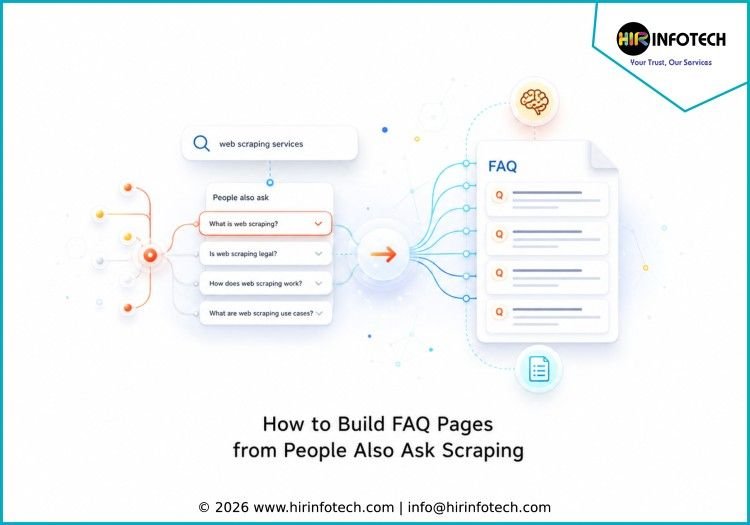
How to Build FAQ Pages from People Also Ask Scraping
Introduction
FAQ pages often fail because they answer questions nobody asked. People Also Ask scraping solves this problem by extracting the exact questions real users type into Google. When you build FAQ content from PAA data, you answer verified search queries — not guesses about what your audience might want to know.
Why PAA Data Is Perfect for FAQ Pages
The People Also Ask feature appears in roughly 40 to 45 percent of Google searches. These are not random suggestions. Google surfaces PAA questions based on real search behavior, user intent patterns, and semantic relationships between queries .
When you scrape PAA boxes, you are not collecting hypothetical questions. You are capturing the specific information gaps users are actively trying to fill. Each question represents a search query that Google has validated as relevant to the topic.
For FAQ pages, this alignment is critical. A FAQ section built from PAA data answers questions that already have demonstrated search demand. You are not guessing what visitors want to know. You are giving them exactly what they came to find .
The sequence of PAA questions also reveals the user’s information journey. The first question is what users ask immediately. The expanded questions show what they want to know next. This sequential pattern helps you structure FAQ sections in a logical order that mirrors real search behavior .
What PAA Scraping Captures for FAQ Construction
A complete PAA scraping operation captures several data elements that feed directly into FAQ page construction.
The question text is the most obvious element. Each PAA box contains a question that users ask about the topic. These questions use natural language, complete with the phrasing and vocabulary real people employ .
The answer snippet is Google’s extracted answer to each question, typically pulled from the source page. While you should not copy Google’s snippet directly, it tells you the format and length Google prefers for that query .
The source URL reveals which page Google considers authoritative enough to answer each question. This helps identify competitors and understand what content currently satisfies that query .
The parent-child relationship between questions matters. PAA boxes have a tree structure. Clicking a question expands to show 2 to 4 nested questions. This relationship tells you which questions are top-level and which are follow-ups .
For multi-market FAQ pages, running PAA scraping separately for each target location is essential. The same seed keyword generates different questions in the USA versus Germany versus Thailand due to local search behavior, language, and cultural context .
Step-by-Step Workflow for FAQ Page Construction
Building FAQ pages from scraped PAA data follows a systematic workflow. Each stage transforms raw extraction into structured, user-ready content.
Stage 1: Scrape PAA Questions with Depth Expansion
Start with your target seed keywords — the core topics your FAQ page will address. For each seed, scrape the PAA box with full depth expansion enabled.
A typical PAA box shows 3 to 4 initial questions. With depth expansion, clicking each question reveals 2 to 4 nested questions. A complete scrape with depth set to 2 or 3 levels returns 15 to 30 or more related questions from a single seed .
Store the extracted data including the question text, the answer snippet (for format reference only), the source URL, the depth level (which question triggered this one), and the parent-child relationships.
For multi-market FAQ pages, run this scrape separately for each target country including USA, Germany, United Kingdom, France, Italy, Russia, Spain, Netherlands, Switzerland, Poland, Ireland, Australia, Canada, Thailand, and Hong Kong. Store results with market tags.
Stage 2: Deduplicate and Prioritize Questions
Raw PAA data contains duplicate or near-duplicate questions that must be cleaned. Questions like “What is SEO?” and “What does SEO mean?” are functionally identical for FAQ purposes .
Prioritize questions based on several factors. Frequency across multiple seed keywords suggests broader relevance. PAA position within the box — questions appearing earlier may have higher priority. Depth level matters: top-level questions are primary user intents; nested questions are follow-ups. Market consistency where the same question appears across multiple countries suggests universal FAQ content.
The goal is a prioritized list of 10 to 20 questions per FAQ page. More questions risk overwhelming users. Fewer questions may miss key user intents.
Stage 3: Write Original, High-Quality Answers
The scraped answer snippet tells you what Google currently surfaces. Your answer must be better. Write original answers that provide more detail, clearer explanations, or unique insights not found in the source page .
Each answer should be concise but complete. Aim for 40 to 60 words for simple questions, up to 150 words for complex topics. Use plain language that matches the question’s natural phrasing .
Structure answers with bullet points or short paragraphs for scannability. Include relevant internal links to your service pages or related content. Add external links to authoritative sources where appropriate, but keep these minimal .
For answers that require nuance, acknowledge complexity. A question like “Is web scraping legal?” deserves a balanced answer that covers jurisdictional differences, not a simplistic yes or no.
Stage 4: Implement FAQ Schema Markup
FAQ schema is structured data that tells search engines exactly what your FAQ page contains. Proper implementation increases eligibility for rich results and featured snippets .
The schema markup should wrap each question-answer pair in a Question and Answer structure. Required fields include name for the question text, acceptedAnswer containing text for the answer content .
Schema can be implemented in JSON-LD format in the page head or as inline markup. JSON-LD is generally preferred because it keeps structured data separate from visible content .
For multi-language FAQ pages covering multiple countries, use inLanguage properties to specify the language of each question-answer pair .
Stage 5: Optimize FAQ Page Structure for Users and Search
The visual layout of your FAQ page affects user engagement and SEO performance.
Group questions into logical categories using H2 headings for each category. For example, a web scraping FAQ page might have categories including “Getting Started,” “Technical Questions,” “Legal and Ethical Considerations,” and “Data Output and Formats” .
Use details and summary HTML elements to create expandable sections. This keeps the page scannable while allowing users to expand only the questions they care about .
Place the most common or highest-priority questions at the top of each category. Users should see the questions most relevant to them without scrolling .
Add internal links from relevant service pages to your FAQ page. If you have a service page about proxy rotation, link to the FAQ question about avoiding IP blocks .
Multi-Market FAQ Pages: Localization Strategies
For businesses serving multiple countries, FAQ pages need localization — not just translation. The questions users ask in Germany differ from those in Thailand due to different regulations, search behavior, and cultural context .
Run separate PAA scrapes for each target market. Compare the question sets across markets . Identify universal questions that appear consistently across countries for global FAQ sections. Identify market-specific questions unique to each country for localized FAQ content.
For the universal questions, translate answers while preserving accuracy. For market-specific questions, write original answers that address local regulations, providers, and use cases .
Consider creating separate FAQ pages per market rather than one multilingual page. This allows you to optimize headings, metadata, and internal linking for local search behavior .
Advanced Techniques: From FAQs to Topic Clusters
The questions you extract from PAA scraping can inform more than FAQ sections. They can drive entire content strategies.
When you scrape PAA for a core topic, you typically get a mix of quick-answer questions and deep-dive questions. The quick-answer questions — short, factual, low-competition — belong in FAQ sections. The deep-dive questions — complex, high-competition, research-oriented — deserve dedicated blog posts .
Map each PAA question to a content type: FAQ entry (40-60 words on the same page), supporting blog post (1,000-1,500 words), pillar page section (200-300 words), or video script (visual answer).
This mapping ensures you are not wasting deep content opportunities on FAQ sections, and not missing quick-answer opportunities that belong on FAQ pages .
Monitoring and Updating FAQ Pages
PAA data changes over time. Google refreshes questions based on trending topics, seasonality, and evolving search behavior . Your FAQ pages must evolve too.
Schedule regular PAA rescrapes for your core topics — monthly for stable B2B topics, weekly for news-driven or seasonal industries . Compare new question sets against existing FAQ content.
Add new questions that appear consistently across multiple scrape cycles. Remove or archive questions that no longer appear in PAA data. Update answers when new information, regulations, or best practices emerge .
Track FAQ page performance in Google Search Console. Monitor which questions generate impressions and clicks. Use this data to reorder questions, improve underperforming answers, and identify gaps where users are searching but your page does not rank .
Why Hir Infotech Builds PAA-Driven FAQ Pages
At Hir Infotech, we have built our web scraping practice around delivering actionable search intelligence to B2B teams. With over 13 years of experience and 2,745+ satisfied clients across real estate, retail, healthcare, travel, and technology sectors, we have deployed PAA extraction for hundreds of content strategy use cases .
Our approach to FAQ page construction from PAA data focuses on three core deliverables:
First, we extract complete PAA question trees with depth expansion. For any seed keyword list, we capture top-level questions and all nested follow-ups, preserving parent-child relationships that reveal user information journeys .
Second, we support multi-market collection across all target locations. Running identical seed queries with country-specific parameters for the USA, Germany, United Kingdom, France, Italy, Russia, Spain, Netherlands, Switzerland, Poland, Ireland, Australia, Canada, Thailand, and Hong Kong reveals regional question differences that single-market research would miss .
Third, we deliver structured output ready for content production. Our deliverables include prioritized question lists with frequency scoring, recommended answer structures based on Google’s snippet patterns, schema markup templates in JSON-LD format, and content briefs for deeper questions that deserve dedicated posts .
We do not sell software subscriptions. We deliver structured, decision-ready PAA data that feeds directly into FAQ page construction and broader content strategy. For organizations ready to move beyond guess-based FAQ sections and build content around actual user questions, we provide the infrastructure and expertise to deliver PAA-driven FAQ pages across every market you serve.
Frequently Asked Questions
What is the difference between PAA scraping and traditional keyword research for FAQs?
Traditional keyword research provides search volume for keywords, not questions. PAA scraping delivers the exact questions users ask, the order they ask them, and the answer format Google prefers. For FAQ pages, PAA data is more directly applicable than keyword volume metrics .
How many questions should a PAA-driven FAQ page include?
Prioritize 10 to 20 questions per FAQ page based on PAA frequency, position, and depth level. More questions risk overwhelming users. Fewer questions may miss key user intents .
Does PAA data vary by country, and how should I handle that?
Yes, significantly. PAA questions are localized based on search history, language, and regional behavior. Run separate PAA scrapes for each target country, compare question sets, then create universal sections for cross-market questions and localized sections for market-specific questions.
How often should I update FAQ pages built from PAA data?
Rescrape PAA data monthly for stable B2B topics, weekly for news-driven or seasonal industries. Add new questions that appear consistently, update answers when information changes, and remove questions that no longer appear in PAA data .
Can I use PAA snippets directly in my FAQ answers?
No. Google’s snippets are copyrighted content from source pages. Use the snippet as a reference for format and length expectations, but write original answers that provide more value than the snippet you scraped .
Conclusion
FAQ pages built from People Also Ask scraping outperform guess-based alternatives because they answer the questions users are actually asking. The workflow is straightforward: scrape PAA with depth expansion across your target markets, deduplicate and prioritize questions by frequency and position, write original answers that improve on Google’s snippets, implement FAQ schema markup, and organize the page for scannability. For multi-market businesses, separate PAA scrapes per country reveal regional question variations that demand localized FAQ content. The same PAA data can drive broader content strategies, mapping quick-answer questions to FAQ sections and deep-dive questions to dedicated blog posts. Regular rescraping keeps FAQ pages current as search behavior evolves. For organizations ready to move beyond guess-based FAQ sections and build content that directly answers verified user questions, Hir Infotech delivers structured PAA extraction across the USA, Germany, United Kingdom, France, Italy, Russia, Spain, Netherlands, Switzerland, Poland, Ireland, Australia, Canada, Thailand, and Hong Kong — turning Google’s question boxes into your FAQ content roadmap.









