
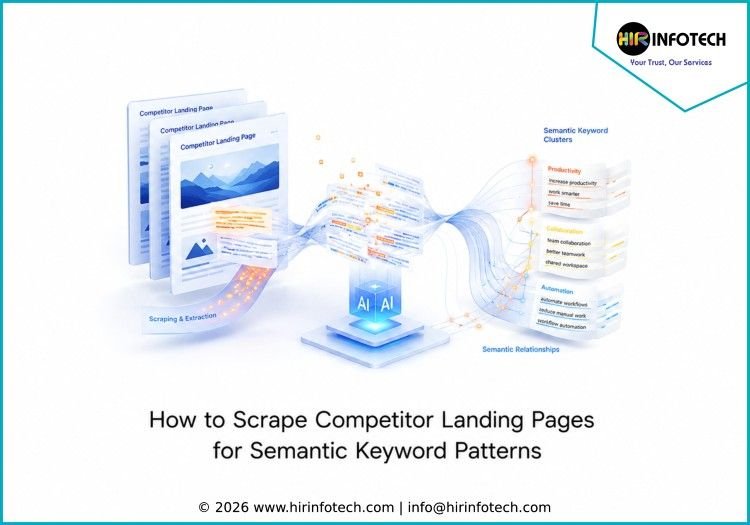
How to Scrape Competitor Landing Pages for Semantic Keyword Patterns
Introduction
Competitor landing pages contain your most valuable keyword research data. But manually reviewing competitor content misses the patterns that matter. Semantic keyword extraction — analyzing the relationships between keywords, themes, and topics — reveals how competitors structure their authority. By scraping competitor pages at scale, you can identify the exact keyword families, topic clusters, and content gaps that drive their rankings.
What Semantic Keyword Patterns Are and Why They Matter
Semantic keyword patterns go beyond simple keyword frequency. They capture the relationships between keywords, the themes that connect them, and the context in which terms appear. A single landing page might use “real estate attorney,” “property lawyer,” and “closing counsel” interchangeably. These are not separate keywords. They are semantic variants of the same underlying topic.
When you scrape competitor landing pages for semantic patterns, you are not just collecting keyword lists. You are building a map of how competitors organize their topical authority. This map reveals which themes they prioritize, which concepts they treat as related, and which specific phrasing they use to match search intent.
The core difference between traditional keyword extraction and semantic pattern analysis is grouping. Traditional extraction gives you a flat list. Semantic analysis groups variants into themes, identifies which themes appear across multiple competitors, and surfaces the concepts that define your competitive landscape.
Scraping Competitor Landing Pages: What to Extract
Before analyzing semantic patterns, you need structured data from competitor pages. The essential fields for semantic analysis include the full page title, all heading elements from H1 through H3, the meta description, visible body text excluding navigation and footer content, and any structured data or schema markup present on the page.
For multi-market analysis across the USA, Germany, United Kingdom, France, Italy, Russia, Spain, Netherlands, Switzerland, Poland, Ireland, Australia, Canada, Thailand, and Hong Kong, run separate scrapes for each target location. Semantic patterns vary by language, cultural context, and local search behavior. A keyword theme that appears consistently in US competitor pages may be entirely absent from German competitors.
The technical approach can range from custom scripts using Python libraries like BeautifulSoup or Scrapy to managed scraping workflows using platforms like Decodo or the CustomJS Scraper node in n8n, which fetch raw HTML and extract key SEO elements including title, headings, and meta data.
Extracting Keywords and N-Grams from Scraped Content
Once you have the raw content, the next step is extracting keyword phrases at multiple lengths. Unigrams — single words — are too noisy for semantic analysis. Focus on n-grams, which are phrases of two to four words. Bigrams like “real estate” and trigrams like “real estate attorney” capture the specific language competitors use.
The Apify SEO Keyword Extractor uses a transformer-based model to extract multi-word keyphrases from page content, filters out numeric strings and technical junk, and keeps the most relevant two to four word keyphrases per page. The Apify Analyze Website Content tool extracts the most frequent n-grams across two to four words and identifies keywords from HTML metadata.
For local or practice-area SEO, pay close attention to geo plus service combinations. Phrases like “fort lauderdale real estate lawyer” or “west palm beach probate attorney” reveal the specific location-modifier patterns competitors target. These combinations are often invisible to traditional keyword tools but appear clearly in scraped competitor content.
Clustering Keywords into Semantic Families
The most valuable output from semantic analysis is keyword families — groups of related phrases that represent the same underlying concept. Clustering similar phrases across multiple competitor pages reveals which concepts dominate your market.
The process involves identifying all extracted phrases, calculating similarity between phrases using token-set matching or Levenshtein distance, grouping phrases that share core tokens, and for each group, selecting a representative phrase. A group containing “florida real estate attorney,” “florida real estate lawyers,” and “florida real estate law” would cluster under “florida real estate attorney” as the representative.
Tools like the SEO Keyword Extractor compute cross-site keyword families by clustering similar phrases across multiple domains. The output includes the group representative, all variant keywords in the group, the number of distinct keywords in the group, and which competitor sites use each variant. This tells you not just what competitors are targeting, but how consistently they target it.
Identifying Common Cross-Site Themes
Phrases that appear across multiple competitor sites are signals of market standards. If three or four competitors all target variations of “real estate attorney near me,” that concept is not optional for your content strategy.
The SEO Keyword Extractor calculates n-gram statistics for phrases that appear on at least three different sites, treating these as strong cross-site themes. For each n-gram, the tool returns the phrase text, the number of sites using it, the total count across pages, and sample keywords showing the full phrase variants.
For example, analyzing competitor sites in the legal industry might reveal that the trigram “fort lauderdale real” appears across four competitor sites with sample keywords including “fort lauderdale real estate,” “lauderdale real estate lawyer,” and “lauderdale real estate attorneys”. This tells you that the combination of location and practice area is a mandatory theme in your market.
Building Ranked Keyword Themes
The final stage of semantic analysis is merging similar keyword families into higher-level themes and ranking them by importance. A keyword theme represents a complete topic area that your content should address.
The SEO Keyword Extractor builds themes by constructing a graph of keyword groups connected by high Jaccard similarity — meaning groups that share a high proportion of their word sets — then collapsing connected components into themes. Each theme includes a primary keyword representing the best phrase for the theme, a score indicating theme strength based on cross-site importance and cohesion, the number of distinct keyword variants in the theme, and the complete list of all variant phrases.
A theme with primary keyword “florida real estate attorney,” a score of 0.95, three sites in the theme, and variants including “florida real estate law” and “real estate litigation attorneys” is a high-priority topic for your content strategy. Treat each keyword theme as a core SEO topic suitable for a pillar page or dedicated cluster.
Automated Competitor Keyword Analysis Workflows
For SEO teams managing ongoing competitor intelligence, automated workflows save significant manual effort. Low-code platforms like n8n connect scraping, AI analysis, and structured output into repeatable pipelines.
The n8n workflow template for competitor keyword research uses Decodo for intelligent web scraping and OpenAI GPT-4.1-mini to interpret keyword intent, density, and semantic focus. The workflow accepts a target website URL and country parameter, fetches competitor web content and metadata, extracts primary and secondary keywords using the AI model, identifies focus topics and semantic entities, generates a keyword density summary and SEO strength score, and appends structured keyword data to a Google Sheet.
A separate n8n workflow for monitoring competitor SEO changes scrapes HTML content from competitor pages, extracts page title, H1 headings, H2 headings, and meta description, updates a Google Sheet with timestamps, compares new values against previous ones, and sends Slack alerts when changes are detected. This is particularly useful for tracking when competitors update their landing page targeting.
Using the Screaming Frog SEO Spider for Coverage Analysis
The Screaming Frog SEO Spider can be configured to check how well your own pages cover the semantic patterns you discover from competitors. By running custom JavaScript extractors, you can define keyword clusters and test whether those terms appear in competitor titles, H1s, meta descriptions, and body content.
The custom JavaScript snippet reads the URL to determine which keyword cluster applies, scans the page title, H1, meta description, and body text for each keyword in the cluster, calculates the percentage of keywords found, and returns both the coverage percentage and a list of missing keywords. This turns Screaming Frog into a content audit engine that compares intent — your competitor-derived semantic cluster — with reality — the actual on-page elements.
The output includes two actionable columns: Keyword Coverage percentage and Missing Keywords list. These give you a quantifiable view of how well your content aligns with the semantic patterns that competitors are already using.
Enriching Semantic Data with Search Volume
Semantic patterns tell you what topics matter. Search volume tells you how much they matter. Enriching your scraped and clustered keyword data with search volume turns pattern analysis into business prioritization.
After building your keyword clusters and themes, export the list of keyword variants to Google Keyword Planner or your preferred volume tool. Download monthly search volume data for each keyword. Combine the volume data with your coverage analysis results to calculate total cluster search volume across all keywords in the theme, volume covered by your current content versus volume missed, and percentage of missed opportunity for each competitor theme.
A theme with high cross-site adoption among competitors but low coverage on your site and high search volume is your highest optimization priority. A theme with high competitor adoption but low search volume may be a lower priority.
Multi-Market Semantic Analysis
For businesses operating across the USA, Germany, United Kingdom, France, Italy, Russia, Spain, Netherlands, Switzerland, Poland, Ireland, Australia, Canada, Thailand, and Hong Kong, semantic keyword patterns vary significantly by market. Run separate scraping and analysis workflows for each target country.
Compare the resulting keyword themes across markets to identify universal themes that appear in all markets and can be translated, regional variations where the same concept uses different phrasing, and market-specific themes unique to one country. A theme that dominates competitor pages in Germany but is absent from French competitor pages represents either a market opportunity or a cultural difference in how users search.
Why Hir Infotech Specializes in Competitor Semantic Analysis
At Hir Infotech, we have built our web scraping practice around delivering actionable competitor intelligence to B2B SEO teams. With over 13 years of experience and 2,745+ satisfied clients across real estate, retail, healthcare, travel, and technology sectors, we have deployed competitor landing page extraction for hundreds of semantic analysis projects.
Our approach to scraping competitor landing pages for semantic keyword patterns focuses on three core capabilities. First, we extract complete page content including titles, heading structures, body text, and metadata from competitor landing pages across all target markets. Our infrastructure includes rotating proxy networks to avoid blocking and supports country-specific extraction.
Second, we perform semantic clustering using n-gram analysis, token-set similarity matching, and theme building algorithms. We output keyword families with representative phrases, cross-site themes with site counts, and ranked keyword themes with priority scores based on market importance.
Third, we integrate with volume data for prioritization. We enrich semantic clusters with search volume metrics, calculate coverage gaps between your content and competitor patterns, and deliver structured outputs including CSV, JSON, Excel, or direct integration with content planning tools.
We deliver structured, decision-ready semantic keyword data that feeds directly into content strategy and page optimization. For organizations ready to move beyond flat keyword lists and build content around the semantic patterns that drive competitor rankings, we provide the infrastructure and expertise to scrape, analyze, and prioritize competitor landing pages across every market you serve.
Frequently Asked Questions
What is the difference between keyword extraction and semantic pattern analysis?
Keyword extraction produces a flat list of terms from a page. Semantic pattern analysis groups those terms into families of related phrases, identifies which themes appear across multiple competitors, and ranks themes by market importance. Semantic analysis tells you not just what words competitors use, but how they organize their topical authority.
What data should I scrape from competitor landing pages for semantic analysis?
Extract the page title, all headings from H1 through H3, the meta description, visible body text excluding navigation and footer content, and any structured data. The full text is needed for n-gram analysis, while headings reveal how competitors prioritize subtopics within a theme.
How many competitor pages should I analyze for reliable semantic patterns?
Three to five direct competitors typically provide sufficient signal for identifying market themes. Include competitors who target the same audience and service offerings. For each competitor, analyze their top 5 to 10 landing pages that align with your core service categories.
Can semantic analysis work across different languages and countries?
Yes, but you must run separate analyses per market. Semantic patterns vary by language, cultural context, and local search behavior. A keyword theme that appears in US competitor pages may use different phrasing or may not exist at all in German competitor pages. Analyze each target country separately using localized scraping.
What tools automate semantic keyword extraction from scraped content?
The Apify SEO Keyword Extractor performs n-gram analysis and cross-site theme clustering. The Analyze Website Content tool extracts frequent terms and metadata keywords. n8n workflows integrate Decodo scraping with OpenAI analysis for keyword intent and density scoring. Screaming Frog with custom JavaScript handles coverage analysis against competitor-derived clusters.
Conclusion
Scraping competitor landing pages for semantic keyword patterns transforms competitor research from manual review into systematic intelligence. The workflow is repeatable: scrape competitor page content, extract n-grams and keyword phrases, cluster phrases into semantic families, identify cross-site themes, build ranked keyword themes, and enrich with search volume for prioritization. For multi-market operations, separate analyses per country capture regional semantic variations. Automation tools including the SEO Keyword Extractor for clustering, n8n workflows for integrated scraping and AI analysis, and Screaming Frog for coverage validation make the process scalable. The output — keyword families, market themes, and coverage gaps — feeds directly into content strategy and page optimization. For organizations ready to move beyond flat keyword lists and build content around the semantic patterns that define your competitive landscape, Hir Infotech delivers competitor scraping and semantic analysis across the USA, Germany, United Kingdom, France, Italy, Russia, Spain, Netherlands, Switzerland, Poland, Ireland, Australia, Canada, Thailand, and Hong Kong — turning competitor landing pages into your semantic strategy roadmap.









