
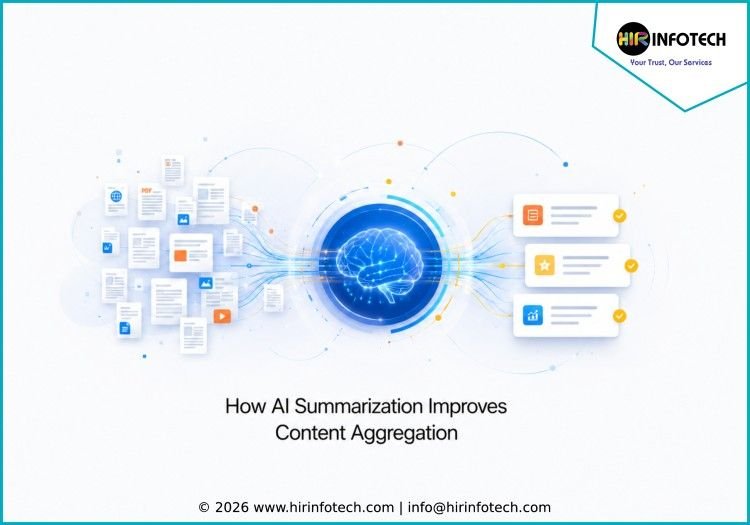
How AI Summarization Improves Content Aggregation
The Operational Limits of Traditional Content Aggregation
The internet expands exponentially every second. For organizations relying on competitive intelligence, media monitoring, market research, or digital publishing, the core challenge is no longer a lack of data. The challenge is data density. Traditional automated systems excel at harvesting billions of datapoints, but they leave businesses with an unmanageable mountain of raw text.
To transform raw data into immediate, strategic utility, collection mechanisms must evolve. Hir Infotech bridges this gap by embedding advanced natural language processing directly into data collection pipelines. Through specialized AI-driven web scraping, data is not merely extracted; it is synthesized, categorized, and contextualized at the precise moment of collection.
The Operational Limits of Traditional Content Aggregation
Content aggregation has historically operated as a two-step process: broad data harvesting followed by human-driven filtering. While standard web crawling architectures can parse HTML structures, identify text nodes, and dump data into relational databases efficiently, they remain entirely blind to the actual meaning of the information they touch.
This technical limitation introduces three distinct operational bottlenecks:
Information Overload and High Cognitive Load
When automated scrapers pull thousands of complete digital articles, research documents, legislative papers, or product reviews daily, they pass the burden of analysis downstream. Human teams face overwhelming cognitive load, sifting through millions of words to locate single, actionable insights.
Severe Structural Redundancy
The modern digital landscape is highly echoic. A single breaking news story, corporate announcement, or market shift is frequently repackaged across hundreds of web domains with minimal structural changes. Traditional keyword filters fail to recognize this conceptual duplication, forcing analysts to consume identical narratives repeatedly.
High Operational Overhead
Compensating for blind data extraction requires scaling human review teams linearly alongside data volume. This dynamic destroys the cost-efficiencies that automated web scraping promises in the first place, turning scalable data pipelines into resource-draining manual operations.
Decoupling Web Scraping from Blind Text Harvesting
AI-driven web scraping redefines the extraction layer. Instead of treating a web document as a flat collection of strings and tags, the extraction process evaluates content through the lens of semantic context.
By fusing natural language processing directly with the scraping infrastructure, Hir Infotech establishes a collection framework that dynamically handles shifting web page layouts while prioritizing semantic relevance.
Rather than waiting for data to sit in a data lake before applying analytical scripts, the data pipeline evaluates, structures, and compresses content on the fly. The output transitions instantly from unstructured digital noise into a highly organized database of distilled intelligence.
The Core Mechanisms of AI-Driven Summarization
To understand how AI transforms content aggregation, it is necessary to examine the two primary methodologies used to condense large volumes of unstructured text: Extractive and Abstractive summarization.
Extractive Summarization: Algorithmic Precision
Extractive summarization operates like a high-speed digital highlighter. The underlying algorithms analyze the statistical properties of a scraped document, ranking sentences based on keyword density, position, and contextual weight.
The system then isolates the top-performing, verbatim sentences to form a coherent overview. This method features low computational latency and zero risk of misrepresenting facts, making it ideal for processing high-volume technical documentation, regulatory updates, and financial statements.
Abstractive Summarization: Deep Conceptual Synthesis
Abstractive summarization mimics human comprehension. Rather than cutting and pasting existing phrases, abstractive models parse the entire document to construct an internal semantic map of its core arguments, themes, and conclusions.
The system then generates completely original prose to articulate those points concisely. This approach is highly effective for converting sprawling editorial pieces, long-form investigative reports, and multi-layered industry analyses into crisp executive briefings.
Key Improvements in the Aggregation Lifecycle
Integrating AI summarization directly into web scraping workflows drastically improves every phase of the information management lifecycle.
Semantic Understanding and Query Flexibility
Traditional content aggregation relies heavily on rigid Boolean strings and exact keyword matching. If an article discusses a corporate breakthrough using synonyms or industry jargon omitted from the primary filter, the system misses it entirely.
AI-driven systems evaluate contextual intent. The scraper understands what the text means, allowing organizations to surface high-value insights based on conceptual relevance rather than precise wording.
Drastic Volume Reduction and Time Savings
By filtering out boilerplate text, legal disclosures, introductory fluff, and repetitive filler phrases during the scraping process, AI summarization reduces text volume by 80% to 90%. Analysts can review ten times the amount of information in a fraction of the time, dramatically accelerating decision-making speed.
Automated Entity Extraction and Tagging
As Hir Infotech’s scraping models process and summarize text, they simultaneously run Named Entity Recognition (NER) scripts. The system automatically identifies, extracts, and tags:
Specific corporations and competitors
Executive names and titles
Key financial metrics and monetary values
Specific product models and software components
Geographic locations and legislative acts
This real-time metadata creation turns every scraped summary into an asset that can be instantly indexed, sorted, and routed to specific internal departments.
Cross-Source De-duplication and Synthesis
When multiple web domains publish content covering the same core event, an AI-augmented pipeline flags the conceptual overlap. Instead of delivering twenty separate scraped entries, the system cross-references the articles, merges unique details into a single master summary, and eliminates redundant text. This ensures an uncluttered, high-utility stream of unique updates.
Architectural Breakdown of an Intelligent Aggregation Pipeline
Building a highly scalable, AI-driven content aggregation platform requires deep alignment between web infrastructure, data engineering, and machine learning models.
Real-World Applications Across Core Business Functions
The practical implications of deploying AI-driven web scraping span across various operational workflows, changing how businesses handle competitive and environmental data.
Competitive Intelligence and Market Monitoring
Keeping track of competitors requires continuous monitoring of their websites, press rooms, product catalogs, and public job boards. An AI-enhanced scraping pipeline monitors these digital endpoints continuously, instantly flagging and summarizing critical events—such as updates to pricing structures, structural executive shifts, or new product feature disclosures—while filtering out routine site updates.
Comprehensive Media and Brand Reputation Tracking
Public relations and risk-mitigation teams need to track brand sentiment across thousands of regional news outlets, industry blogs, and discussion forums. AI summarization condenses vast volumes of daily mentions into clear sentiment reports and thematic summaries, surfacing brewing PR crises long before traditional keyword alerts flag them.
Financial Analysis and Investment Research
Investment firms monitor regulatory filings, macroeconomic reports, and alternative web data to spot market trends. AI-driven scraping processes dense financial disclosures instantly, distilling thousands of pages of dense legal text into vital bullet points highlighting debt adjustments, revenue shifts, or supply-chain exposures.
Overcoming the Technical Challenges of AI Data Extraction
Implementing machine learning algorithms into high-throughput web scraping architectures introduces specific engineering challenges that require precise technical mitigation.
Mitigating Hallucinations and Factual Drift
Generative AI models can occasionally introduce fabrications (“hallucinations”) when summarizing complex content. To secure absolute factual integrity, Hir Infotech utilizes strict grounding mechanisms, anchoring the model’s generation parameters directly to the source text and cross-checking extractive tokens against the generated summary.
Minimizing Computational Latency
Running massive neural networks over millions of scraped web pages daily introduces significant computational costs and processing delays. Optimizing the pipeline requires a multi-tiered filtering approach: using fast, lightweight extractive models to filter out unhelpful data at the edge, and reserving complex abstractive models exclusively for highly complex, high-value source materials.
Adapting to Dynamic Web Formats
Websites constantly modify their structural layouts, which can break fragile, path-dependent scrapers. Combining layout-agnostic AI models with adaptive scraping scripts ensures that even when a target website updates its user interface, the system accurately locates, extracts, and summarizes the core text body without interruption.
The Future of Knowledge Management
The competitive advantage of modern organizations depends heavily on their ability to process, digest, and utilize external information faster than the market shifts. Relying on outdated aggregation frameworks that simply dump raw text into unread databases is a recipe for operational gridlock.
By choosing Hir Infotech for custom, AI-driven web scraping architectures, your business can step past the limits of simple data harvesting. Our integrated data extraction and summarization frameworks turn the vast, chaotic digital landscape into a streamlined stream of clean, highly actionable insights. Don’t let valuable market insights get lost in the noise—automate your intelligence pipelines and let your teams focus entirely on execution.
Conclusion
AI summarization fundamentally transforms content aggregation from a passive data collection process into an intelligent, decision-ready system. By embedding semantic understanding directly into web scraping pipelines, businesses eliminate information overload, reduce redundancy, and accelerate insight generation at scale. Instead of relying on manual filtering and fragmented analysis, organizations gain access to structured, concise, and context-rich intelligence in real time. As data volumes continue to grow exponentially, adopting AI-driven summarization is no longer optional—it is a critical requirement for maintaining competitive advantage, operational efficiency, and strategic clarity in modern digital ecosystems.









