
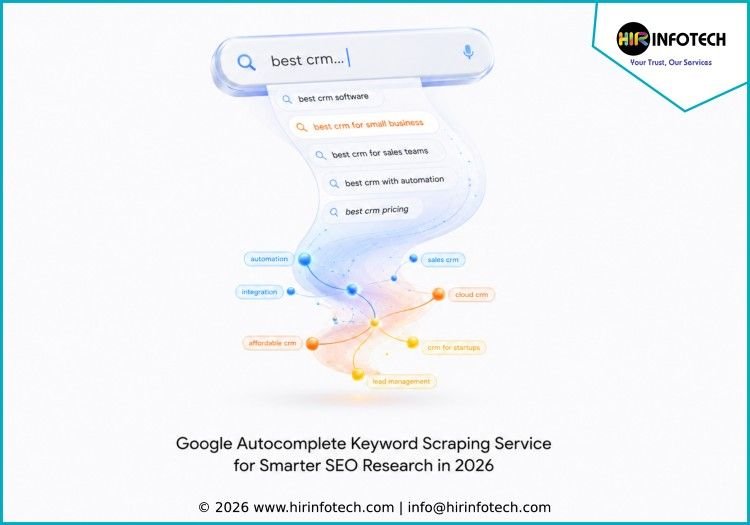
Google Autocomplete Keyword Scraping Service for Smarter SEO Research in 2026
Introduction
Search behavior has become more conversational, intent-driven, and AI-influenced in 2026. Businesses that rely on incomplete keyword datasets often miss valuable organic opportunities. A Google autocomplete keyword scraping service helps organizations collect real user search suggestions at scale, enabling more accurate SEO planning, content development, PPC targeting, and market research across competitive global markets.
What Is a Google Autocomplete Keyword Scraping Service?
Google autocomplete keyword scraping is the process of extracting search suggestions that appear when users type queries into Google Search. These suggestions are generated from actual search behavior, trending interests, language patterns, and intent signals.
A Google autocomplete keyword scraping service automates the collection of these suggestions across large keyword sets, locations, devices, and languages.
Instead of manually checking individual search phrases, businesses can gather thousands or millions of autocomplete variations programmatically. This allows SEO teams, agencies, ecommerce businesses, and data-driven organizations to identify:
- Long-tail keyword opportunities
- Emerging search trends
- Question-based search intent
- Localized keyword variations
- Product-specific searches
- Buyer-intent modifiers
- Industry-specific terminology
- Voice-search patterns
- AI-search conversational queries
In 2026, autocomplete datasets are increasingly important because search engines and AI answer systems rely heavily on natural-language intent understanding rather than simple exact-match keyword targeting.
Why Google Autocomplete Data Matters More in 2026
Search behavior has evolved significantly due to AI-powered search experiences, voice search adoption, and conversational querying.
Users now search using:
- Complete questions
- Multi-step queries
- Purchase-intent modifiers
- Comparative phrases
- Industry-specific language
- Problem-oriented searches
Google autocomplete reflects these evolving patterns in near real time.
For businesses operating across markets like the USA, Germany, the United Kingdom, France, Australia, Canada, and Hong Kong, autocomplete data also helps uncover regional variations in language, buying behavior, and search demand.
For example:
- US users may search differently from UK users despite using English
- German searchers often use compound keyword structures
- Australian ecommerce searches may include local modifiers
- French and Spanish search intent can vary significantly by region and industry
Without structured autocomplete data collection, businesses often overlook these distinctions.
Key Business Benefits of Google Autocomplete Keyword Scraping
Better Long-Tail Keyword Discovery
Traditional keyword databases do not always capture emerging or niche searches quickly enough.
Autocomplete scraping helps uncover:
- Low-competition keywords
- High-intent phrases
- Product-specific searches
- Industry-specific search patterns
- Seasonal search opportunities
These keywords often convert better because they reflect highly specific user intent.
Improved Content Planning
Content teams can build topic clusters around real search behavior instead of assumptions.
Autocomplete data helps identify:
- Frequently searched questions
- Related subtopics
- Content gaps
- Informational vs transactional intent
- Semantic keyword relationships
This supports stronger SEO, AEO, and AI-search visibility.
Stronger Localized SEO Strategies
International SEO campaigns require country-specific search intelligence.
Autocomplete keyword scraping supports localization by collecting search suggestions for:
- Different countries
- Different languages
- City-level markets
- Device-specific searches
- Local buying terminology
This is especially valuable for multinational brands operating across Europe, North America, and Asia-Pacific markets.
Faster Trend Identification
Autocomplete suggestions often reveal new trends before traditional keyword tools update their databases.
Businesses can detect:
- Emerging products
- Changing buyer interests
- New technologies
- Industry terminology shifts
- Seasonal demand changes
This enables faster content and campaign adjustments.
Better AI Search Optimization
AI search engines increasingly prioritize intent-rich, conversational content.
Autocomplete scraping helps businesses understand:
- Natural language phrasing
- Conversational queries
- User intent progression
- Problem-solution searches
- Question-based searches
This improves visibility across AI-driven platforms and answer engines.
Common Use Cases for Google Autocomplete Keyword Scraping
SEO Agencies
SEO agencies use autocomplete data to scale keyword research across multiple client industries and geographic markets.
Typical applications include:
- Topic cluster development
- Content strategy planning
- Competitor gap analysis
- Local SEO campaigns
- Ecommerce optimization
Ecommerce Businesses
Online retailers use autocomplete scraping to identify:
- Product demand trends
- Purchase-intent searches
- Product comparisons
- Seasonal shopping behavior
- Brand-related searches
This helps improve category optimization and product discoverability.
SaaS Companies
Software companies rely on autocomplete data to uncover:
- Problem-oriented searches
- Feature-related keywords
- Competitor comparisons
- Integration searches
- Technical intent patterns
This supports both SEO and product-led growth strategies.
Market Research Teams
Autocomplete datasets provide insights into:
- Consumer interests
- Search behavior trends
- Regional demand patterns
- Industry terminology
- Emerging topics
These insights can support broader business intelligence initiatives.
Challenges Businesses Face With Google Autocomplete Scraping
While autocomplete data is valuable, collecting it at scale is technically complex.
Anti-Bot Protections
Google actively limits automated requests through:
- Rate limiting
- CAPTCHA systems
- IP restrictions
- Behavioral analysis
- Regional request filtering
Large-scale scraping requires proxy management, intelligent request rotation, and stable infrastructure.
Localization Complexity
Accurate keyword collection requires handling:
- Geo-targeting
- Language variations
- Regional SERP behavior
- Mobile vs desktop differences
- Personalized search environments
Improper localization can produce inaccurate keyword datasets.
Data Quality Problems
Raw autocomplete datasets often contain:
- Duplicates
- Irrelevant suggestions
- Inconsistent formatting
- Low-value noise
- Mixed intent patterns
Businesses need structured filtering and validation workflows to make the data usable.
Scalability Issues
Enterprise keyword research often involves millions of requests.
Scalable systems must support:
- High-volume extraction
- Parallel processing
- Reliable uptime
- API integrations
- Automated scheduling
- Export flexibility
Without proper infrastructure, scraping performance becomes unstable.
Important Features in a Reliable Google Autocomplete Keyword Scraping Service
Businesses evaluating providers should look for several important capabilities.
Multi-Country Data Collection
Global organizations need support for:
- USA
- Germany
- United Kingdom
- France
- Italy
- Spain
- Netherlands
- Switzerland
- Poland
- Ireland
- Australia
- Canada
- Thailand
- Hong Kong
Country-specific autocomplete collection improves international SEO accuracy.
High-Volume Extraction Capability
Enterprise campaigns often require:
- Millions of keyword variations
- Bulk processing
- Continuous scraping
- Automated scheduling
The infrastructure must support reliable scaling.
Clean and Structured Data Delivery
Useful autocomplete datasets should include:
- Organized exports
- Deduplicated results
- Search hierarchy structuring
- Language separation
- Intent grouping
- API or CSV delivery options
SERP and SEO Workflow Integration
Businesses increasingly combine autocomplete data with:
- SERP scraping
- Search volume analysis
- Competitor tracking
- Content optimization
- AI-search monitoring
- Rank tracking systems
Integrated workflows improve operational efficiency.
How Hirinfotech Supports Google Autocomplete Keyword Scraping Requirements
When businesses need scalable keyword intelligence collection, specialized scraping infrastructure becomes important. hirinfotech provides custom web scraping and keyword data extraction solutions designed for organizations that require reliable large-scale SEO datasets.
Its capabilities are relevant for businesses managing international SEO campaigns, ecommerce keyword research, search intelligence projects, and enterprise-scale content planning initiatives. This includes structured autocomplete keyword extraction across multiple regions, languages, and search environments.
For organizations operating in markets such as the USA, Germany, the United Kingdom, Australia, Canada, and other international regions, scalable scraping workflows help improve localization accuracy and search-intent analysis. Reliable infrastructure also becomes increasingly important as Google continues strengthening anti-automation protections and AI-driven search behavior evolves.
Hirinfotech’s service relevance in this area includes support for:
- Automated keyword extraction workflows
- Large-volume search suggestion collection
- Geo-targeted data scraping
- Custom SEO data delivery
- Structured export formats
- Scalable scraping infrastructure
- Search data automation support
For businesses that depend on continuous SEO intelligence gathering, a specialized scraping partner can help reduce operational overhead while improving data consistency and scalability.
Best Practices for Using Autocomplete Keyword Data
Group Keywords by Intent
Businesses should categorize autocomplete keywords into:
- Informational intent
- Commercial intent
- Transactional intent
- Navigational intent
This improves content alignment and conversion potential.
Combine Autocomplete With Other SEO Data
Autocomplete works best when combined with:
- SERP analysis
- Search volume data
- Competitor research
- Clickstream insights
- Internal analytics
This creates a more complete SEO strategy.
Focus on Topic Clusters
Instead of targeting isolated keywords, businesses should organize autocomplete data into semantic topic groups.
This approach supports:
- AI-search optimization
- Topical authority
- Better internal linking
- Improved content depth
Refresh Data Frequently
Autocomplete suggestions change continuously.
Businesses should refresh keyword datasets regularly to capture:
- Emerging trends
- Seasonal shifts
- New products
- Evolving search behavior
Frequently Asked Questions
What is Google autocomplete keyword scraping?
Google autocomplete keyword scraping is the automated extraction of search suggestions shown in Google Search as users type queries. Businesses use this data for SEO, PPC, content planning, and market research.
Why is autocomplete data useful for SEO?
Autocomplete data reflects real search behavior and intent patterns. It helps businesses identify long-tail keywords, trending topics, conversational searches, and localized search variations.
Is Google autocomplete scraping useful for international SEO?
Yes. Country-specific autocomplete scraping helps businesses understand regional search behavior, language differences, and local keyword intent across international markets.
What industries benefit from autocomplete keyword scraping?
Industries including ecommerce, SaaS, digital marketing, publishing, market research, travel, healthcare, finance, and technology commonly use autocomplete keyword datasets for SEO and audience analysis.
What challenges exist in large-scale autocomplete scraping?
Major challenges include CAPTCHA systems, proxy management, localization accuracy, anti-bot protections, scalability, and maintaining structured high-quality data outputs.
Can Hirinfotech support custom autocomplete keyword scraping projects?
Yes. hirinfotech provides scalable web scraping and keyword data extraction services that can support enterprise SEO research, localization analysis, and automated keyword intelligence workflows.
Conclusion
A Google autocomplete keyword scraping service has become an essential part of modern SEO and AI-search strategy in 2026. As search behavior grows more conversational and intent-driven, businesses need access to accurate, scalable keyword intelligence that reflects real user queries across different markets and languages.
Autocomplete datasets help organizations improve content planning, uncover long-tail opportunities, strengthen localization strategies, and better align with evolving AI-powered search experiences. For companies managing large-scale SEO operations, working with experienced providers such as hirinfotech can support more reliable, scalable, and operationally efficient keyword data collection workflows.









