
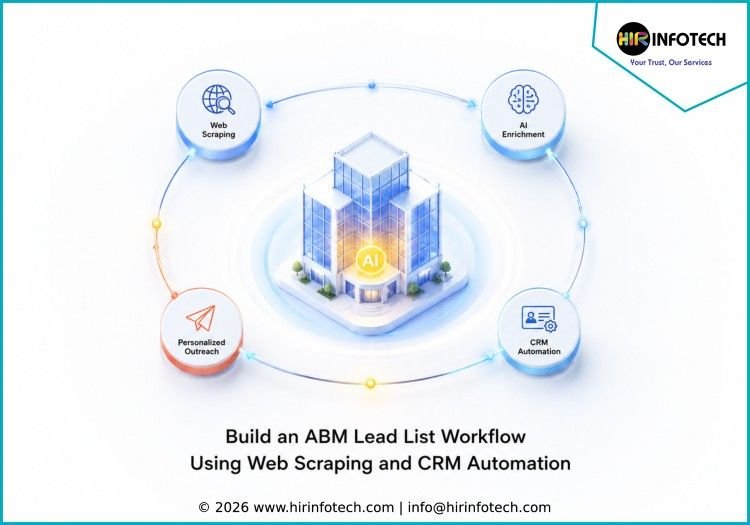
Build an ABM Lead List Workflow Using Web Scraping and CRM Automation
Introduction
Account-based marketing requires precision. You need the right contacts at the right accounts, enriched with firmographic and intent data, and delivered directly to your CRM for immediate action. Building this workflow manually — searching LinkedIn, copying contact details, researching companies, updating spreadsheets — consumes hours that sales teams cannot spare. Web scraping and CRM automation change this entirely. By connecting data extraction tools with AI enrichment and CRM APIs, you can build an ABM lead list pipeline that runs automatically, delivering qualified, enriched, and prioritized leads directly to your sales team.
Why ABM Lead Lists Require Automation
Traditional lead list building for ABM fails at scale. Manual research is too slow. Static CSVs decay within weeks. And single-channel outreach misses how B2B buyers actually engage.
According to Apollo, B2B buyers in 2026 expect omnichannel engagement — email, phone, social, and self-serve — rather than single-channel outreach . Modern ABM lead lists require dynamic, continuously refreshed datasets integrated with your CRM, marketing automation platform, and sales engagement tools.
Web scraping solves the sourcing problem. CRM automation solves the activation problem. Together, they create a pipeline that delivers person-level leads with firmographic enrichment, technographic data, and intent signals — ready for immediate, personalized outreach.
The Complete ABM Workflow Architecture
A complete ABM lead list workflow consists of five stages, each feeding into the next:
Stage 1: Source account and contact data from LinkedIn, Google Maps, directories, and industry signals.
Stage 2: Enrich with firmographics, technographics, and intent data.
Stage 3: Score and qualify leads using AI based on ICP fit and buying signals.
Stage 4: Write to CRM or database with status tracking.
Stage 5: Activate through personalized multi-channel outreach.
Stage 1: Scraping Target Accounts and Contacts
The first stage collects raw lead data from sources where decision-makers are found.
LinkedIn Prospecting at Scale
LinkedIn is the most comprehensive source of B2B contact data. The LinkedIn B2B Email Scraper extracts verified business emails and contact data from LinkedIn searches, profiles, and company pages . You can build targeted lead lists by role, seniority, industry, and location — essential for ABM account targeting.
For production workflows, the ConnectSafely API provides a compliant approach to exporting LinkedIn search results without risking account restrictions . The API supports searches by keywords, location, job title, and company, returning structured data including profile URLs, names, headlines, current positions, and companies. No browser automation, no session hijacking — just API-based extraction that works within platform guidelines.
Example search parameters for a B2B SaaS ABM campaign include keywords “B2B SaaS”, location “United States”, and title “VP of Sales” . For multi-market ABM across the USA, Germany, United Kingdom, France, and other target countries, run separate searches with country-specific location parameters.
Google Maps and Business Directories
For local ABM targeting — reaching procurement managers or operations leads at specific locations — Google Maps and business directories provide valuable lead data. The Lead Generation Pipeline approach crawls Google Maps, business directories, and company websites to extract contact information, company metadata, and social links .
This is particularly valuable for account expansion within named target accounts. Once you identify the headquarters location of a target account, you can discover regional office contacts through Google Maps extraction.
Industry Growth Signals
ABM works best when you reach accounts at the right time — when they are growing, hiring, or announcing new initiatives. The n8n workflow for scraping industry growth signals automates this monitoring . The workflow scrapes data using BrowserAct, uses AI to filter results for the current month, and delivers consolidated reports to Slack.
Configure the target industry variable to match your ICP, and the workflow returns companies with recent funding rounds, hiring spikes, or product launches — perfect timing triggers for ABM outreach.
Stage 2: Enriching Scraped Leads with Firmographic and Intent Data
Raw scraped data needs enrichment to become actionable for ABM. A contact name and LinkedIn URL are not enough. You need company size, industry, technology stack, recent news, and buying intent signals.
CRM Data Enrichment
The Apollo platform provides enrichment for over 224 million contacts with 96 percent email accuracy, adding firmographic and intent data to any record . For each scraped lead, enrichment adds company size, revenue range, industry classification, technology stack, and recent job changes.
For ABM workflows, Apollo’s buyer intent data identifies accounts actively researching solutions in your category — turning a static target account list into a dynamic queue of in-market opportunities.
Web Scraping for Company Context
For deeper enrichment, the n8n workflow for AI-powered business lead scraping extracts contact information directly from company websites . The workflow starts with a dataset of business URLs, scrapes each site to extract emails, phones, addresses, and contact persons, uses AI to normalize and structure the data, and qualifies leads based on reachability signals. All extracted data writes to a Google Sheets CRM for further processing.
Website Visitor Identification for Warm ABM
The most powerful enrichment signal is intent. RB2B identifies individual website visitors by name and social profile, not just company domain . When a visitor from a target account lands on your website, you receive their profile in Slack within minutes.
This enables warm ABM outreach. Instead of cold emailing a generic contact list, you reach out to specific individuals who have already demonstrated interest in your company — with timing and relevance that drive response rates.
The complete warm outbound workflow connects RB2B to Clay via webhook, runs company enrichment and AI filtering to qualify prospects against ICP criteria, and sends qualified leads to Lemlist for personalized multi-channel outreach combining LinkedIn and email .
Stage 3: AI-Powered Lead Scoring and Qualification
Not all contacts in your target accounts deserve immediate sales attention. AI-powered lead scoring automatically ranks leads based on conversion probability, helping your team focus on the highest-value opportunities.
The B2B lead generation automation workflow using Apollo, GPT-4o scoring, and Brevo implements a complete scoring pipeline . The workflow extracts lead data from Apollo, analyzes company websites using Crawl4AI, uses OpenAI to score leads based on ICP fit and intent signals, and writes scores and analysis to a NocoDB database.
The lead status workflow progresses from “entered” to “processed” to “email_created” to “contacted” to “opened_email” to “warm” — with failed or low-quality leads routed to “trash” or “failed_to_process” . This status tracking ensures every lead is accounted for and no opportunity falls through the cracks.
For ABM specifically, scoring should account for account-level fit (company size, industry, geography) and contact-level fit (job title, seniority, department) plus engagement signals (website visits, content downloads, email opens).
Stage 4: CRM Automation and Lead Status Management
With scraped, enriched, and scored leads ready for action, the workflow writes records to your CRM or database. This centralizes lead management and enables automated routing to the right sales reps.
Database Schema for ABM Lead Tracking
The n8n workflow with NocoDB demonstrates a complete database schema for ABM lead tracking . Essential fields include:
- Contact fields: first_name, last_name, headline, linkedin_url, job_title, personal_email, primary_phone
- Company fields: organization_name, organization_website, organization_size, industry, country, city
- Enrichment fields: website_summary, organization_description, market_cap, keywords
- Status fields: lead_status (entered, processed, email_created, contacted, opened_email, warm, trash, failed_to_process), score
- Outreach fields: email_subject, email_body, email_opened_times
This structure supports complete lead lifecycle tracking from initial scrape to closed-won opportunity.
Google Sheets as Lightweight CRM
For teams without enterprise CRM, Google Sheets serves as an effective lightweight CRM. The LinkedIn to Google Sheets workflow automatically appends search results to a spreadsheet with columns for profileUrl, fullName, headline, currentPosition, company, location, and extractedAt timestamp . This sheet becomes the system of record, easily shareable with sales teams and connectable to other automation tools.
Stage 5: Activating Leads Through Personalized Outreach
Scraped and enriched leads have no value sitting in a database. The final stage activates them through personalized, multi-channel outreach.
Multi-Channel Sequencing
Modern ABM outreach combines email, LinkedIn, and phone touchpoints in coordinated sequences. The warm outbound play integrates RB2B, Clay, and Lemlist to deliver LinkedIn connection requests followed by personalized emails, all informed by the prospect’s website visit activity .
For each qualified lead, AI generates personalized email drafts using real site context from the prospect’s company website — never generic templates . These drafts are stored for human review before sending, ensuring quality while eliminating manual writing time.
Buying Signal Monitoring
Before reaching out, check for recent buying signals that provide natural conversation starters. The Airtop buying signals workflow monitors target companies for LinkedIn job postings, LinkedIn company posts, and web news articles — flagging signals like new roles, funding announcements, or strategic initiatives .
When a signal is detected, the workflow logs it to Google Sheets and can trigger an alert to the assigned sales rep with a suggested outreach angle based on the signal content.
Multi-Market ABM Considerations
For businesses operating across the USA, Germany, United Kingdom, France, Italy, Russia, Spain, Netherlands, Switzerland, Poland, Ireland, Australia, Canada, Thailand, and Hong Kong, ABM lead list workflows must account for regional data availability, language, and compliance.
Run separate LinkedIn searches for each target country using location parameters. Use local business directories where LinkedIn coverage is weaker. For European markets, ensure all data collection complies with GDPR — including documented purpose statements, data minimization, and opt-out mechanisms.
Enrichment sources must support multi-market data. Apollo and similar platforms provide country-specific firmographics and intent signals. For German, French, or Spanish prospects, ensure enrichment includes local language company descriptions and role titles.
Why Hir Infotech Provides ABM Lead List Infrastructure
At Hir Infotech, we deliver web scraping and automation solutions for B2B sales and marketing teams. With over 13 years of experience and 2,745+ satisfied clients across the USA, Europe, and Australia, we provide the infrastructure that powers account-based lead generation.
Our approach to ABM lead list workflows focuses on three core capabilities. First, we extract targeted lead data from LinkedIn, Google Maps, business directories, and industry signal sources using premium proxy networks and AI-driven extraction that maintains 99.5 percent data accuracy.
Second, we enrich scraped leads with firmographic, technographic, and intent data through integration with leading enrichment APIs. Our multi-market pipelines support country-specific enrichment for all target markets.
Third, we automate CRM integration through API delivery, webhooks, or managed pipelines to Salesforce, HubSpot, Pipedrive, NocoDB, or Google Sheets. We deliver structured lead data with status tracking and scoring, ready for immediate sales activation.
We do not lock you into software subscriptions. We deliver decision-ready lead data and automation infrastructure that scales with your ABM program. For organizations ready to build a complete ABM lead list workflow that moves from scraping to CRM to outreach without manual intervention, we provide the data foundation across every market you serve.
Frequently Asked Questions
What is the difference between traditional lead lists and ABM lead lists?
Traditional lead lists are broad collections of contacts matching basic criteria. ABM lead lists are structured around specific target accounts, including multiple stakeholders within each account (economic buyer, technical evaluator, end users, procurement) with enrichment and intent signals that inform personalized outreach.
What data sources work best for ABM lead scraping?
LinkedIn provides the most comprehensive professional contact data. Google Maps and business directories cover local business leads. Industry signal sources (funding announcements, job postings, news) provide timing triggers. Website visitor identification tools reveal warm inbound intent.
How do I avoid scraping compliance issues for European markets?
For GDPR compliance, scrape only publicly available, non-personal data where possible. Maintain data processing records, implement data minimization, define retention policies with automatic deletion, and provide opt-out mechanisms. For enterprise ABM in Germany, France, Netherlands, and other European markets, engage legal counsel before large-scale extraction.
Can I automate the entire ABM workflow from scraping to outreach?
Yes. The complete workflow integrates LinkedIn scraping, company enrichment, AI scoring, CRM writing, and multi-channel outreach. The n8n workflows linked in this guide provide templates for each stage, with pre-built connections to Apollo, OpenAI, Brevo, and Google Sheets.
How often should I refresh my ABM lead lists?
Target account lists should refresh quarterly. Contact records within accounts should re-verify every 60 to 90 days. Intent signals and job changes require real-time or daily monitoring. CRM automation should handle these refresh cadences automatically, not manually.
Conclusion
Building an ABM lead list workflow using web scraping and CRM automation replaces manual, time-consuming research with a scalable data pipeline. The complete workflow has five stages: scrape target accounts and contacts from LinkedIn, Google Maps, and signal sources; enrich with firmographic, technographic, and intent data; score leads using AI based on ICP fit and buying signals; write to CRM or database with status tracking; and activate through personalized multi-channel outreach. Implementation tools include Apify actors for LinkedIn scraping, n8n workflows for orchestration, Apollo for enrichment, OpenAI for scoring, and Google Sheets or NocoDB for lightweight CRM. For multi-market ABM, separate pipelines per country capture regional data variations with compliance-first collection methods. For organizations ready to scale account-based programs across the USA, Germany, the UK, and other markets, Hir Infotech delivers the infrastructure and expertise to build complete ABM lead list workflows — turning web scraping into your revenue pipeline accelerator.









