
How to Match Competitor Products Before Comparing Ecommerce Prices
A competitor’s listing may look like the same product as yours and still be a poor price comparison. It might have a different size, model, color, bundle, condition, seller, or delivery location. If those differences go unnoticed, a price report can compare offers that customers would not consider equivalent.
Product matching is the process of deciding whether two listings represent the same item or a sufficiently similar alternative for a specific analysis. The goal is not to match as many listings as possible. It is to make comparisons that are useful for the decision being made—and to leave uncertain matches visible for review.
Start by defining what “comparable” means
Before matching listings, decide what the pricing team needs to compare. An exact match may require the same manufacturer product, variant, size, and pack quantity. A category analysis may allow a broader comparison between similar products, but it should label those results as substitutes rather than identical items.
That distinction matters. A 1.5-litre appliance and a 1.7-litre appliance may be alternatives in a category review, but they are not the same item. Their prices should not be combined under an “exact competitor price” label.
Use identifiers as strong evidence, not as the whole decision
When available, compare standardized identifiers such as a GTIN, UPC, EAN, or manufacturer part number (MPN), along with the brand. GS1 describes a GTIN as an identifier for trade items. Google Merchant Center also advises merchants to provide correct product identifiers and warns against guessing or using identifiers from similar products. (GS1 on GTINs; Google Merchant Center on product identifiers)
Identifiers are valuable when they are correct and refer to the same product level. A product can have separate identifiers for different sizes or colors. A multipack or bundle can also represent a different trade item from a single unit. Confirm the identifier’s meaning before treating two listings as identical.
A seller’s internal SKU can help identify a listing in that seller’s catalog, but it should not automatically be treated as a manufacturer-wide identifier. If identifiers are absent or inconsistent, compare additional attributes and lower the match confidence when evidence is weak.
Compare the attributes that can change the offer
Titles are useful for finding candidate listings, but they are not sufficient proof of a match. Product titles may omit important details, use abbreviations, or place the same attributes in a different order.
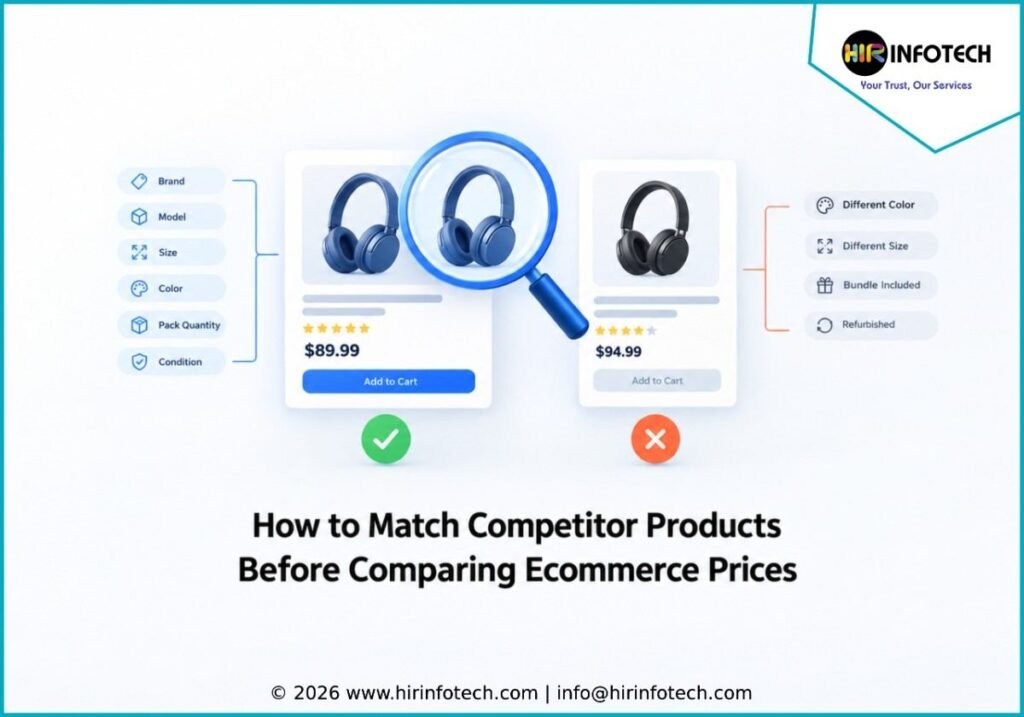
Compare attributes that matter to the product category, such as:
- Brand, manufacturer, and model number
- Size, capacity, dimensions, or weight
- Color, material, or other variant information
- Pack quantity and included accessories
- Product condition, such as new, used, or refurbished
- Technical specifications that distinguish models
Not every attribute carries equal weight. A color difference may be minor for one category and commercially important for another. A model-number mismatch may be a decisive reason to reject a match even if the titles are nearly identical.
Separate product identity from the seller’s offer
Once the product itself is identified, compare the offer attached to it. The same item can be sold by different sellers with different prices, shipping costs, promotions, stock status, or delivery conditions.
Before comparing prices, define whether the analysis includes shipping, taxes, coupons, membership-only discounts, or other charges. Keep the country, currency, and delivery location attached to each observation. A displayed price is a dated observation of an offer; it does not necessarily represent the final amount every customer will pay.
Record the observation time and the listing source. This helps teams distinguish a genuine price change from a change in location, promotion, or stock status.
Use a match decision table
The following examples are illustrative. They show how a team might classify listings before using them in a price comparison.
| Listings being compared | Suggested decision | Reason |
|---|---|---|
| Same brand, model, size, and valid product identifier | Potential exact match; verify the offer details | Strong identity evidence, subject to checking condition, pack, and seller offer. |
| Same appliance model, but different capacity | Do not label as an exact match | Capacity is a meaningful product difference; it may be a substitute for a separate category analysis. |
| Single camera body compared with a camera-and-lens bundle | Do not compare as the same offer | The bundle includes additional items that change the offer and price. |
| Same product model, but one listing is refurbished | Separate by condition | Condition affects the offer and buyer expectation. |
| Similar titles but no reliable identifier or matching specifications | Manual review or no match | Title similarity alone does not establish product equivalence. |
Give every match a confidence status
A useful system should not force every candidate into a yes-or-no result. It can label records as exact match, probable match, review required, or no match. The labels should have written rules so that pricing analysts know how each group may be used.
For example, a confirmed exact match might feed a direct price comparison. A probable match could appear in a separate review queue. A no-match record should not silently enter an exact-match report.
Review a sample of accepted and rejected matches. Track false matches—different products treated as the same—and missed matches—equivalent products treated as different. This helps teams refine their rules without claiming that any automated method is perfectly accurate.
Keep the matching logic auditable
For each decision, retain the source listing, observed product attributes, identifiers found, match status, and any reviewer decision. If a match is changed later, keep enough history to understand why.
This record is especially useful when listings change. A seller may update a title, replace an image, add a bundle, or change the product variant. The team can then reassess the match using the evidence rather than relying only on an earlier decision.
Short product-matching checklist
- Define whether the analysis needs exact products or comparable substitutes.
- Check valid GTIN, UPC, EAN, MPN, and brand values where available.
- Compare model, size, variant, pack quantity, accessories, and condition.
- Separate product identity from seller, price, shipping, promotion, and stock details.
- Attach source, location, currency, and observation time to each offer.
- Use confidence labels and route uncertain matches for review.
- Measure false matches and missed matches on reviewed samples.
Hir Infotech describes product matching and competitor price monitoring as part of its Price Intelligence services. Confirm any specific claims about matching methods, marketplace coverage, data frequency, or accuracy with the team before including them in promotional copy. (Hir Infotech Price Intelligence)
Price comparisons are only as useful as the product and offer comparisons behind them. Establish what counts as an equivalent item, preserve the evidence for each match, and keep uncertain listings separate until they have been reviewed.