
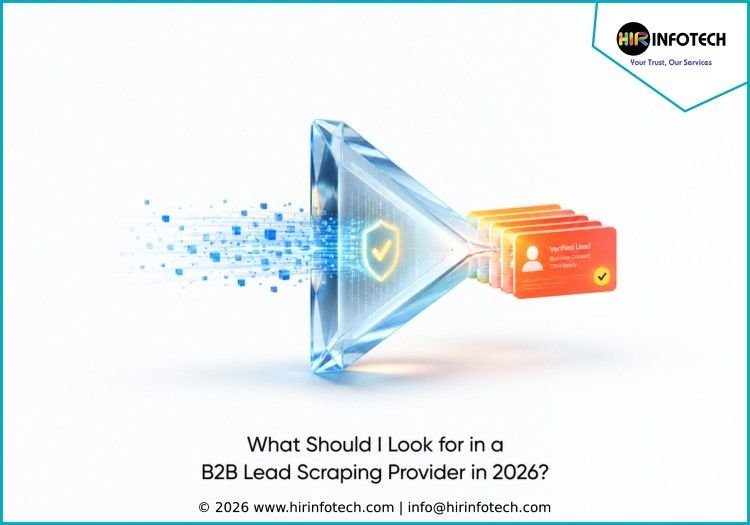
What Should I Look for in a B2B Lead Scraping Provider in 2026?
What Should I Look for in a B2B Lead Scraping Provider in 2026? Introduction B2B lead generation increasingly depends on accurate and scalable public web data. Businesses across the USA, Europe, Canada, Australia, and Asia now rely on lead scraping providers to build targeted prospect databases efficiently. Choosing the right provider matters because poor-quality data, compliance risks, and outdated scraping methods can directly affect sales performance, outreach success, and operational efficiency. Why Businesses Use B2B Lead Scraping Services Modern sales and marketing teams need fresh, structured, and highly targeted business data. Manual prospecting is time-consuming, inconsistent, and difficult to scale across multiple regions and industries. A B2B lead scraping provider helps businesses collect publicly available company and contact information from websites, directories, marketplaces, professional listings, SERPs, social platforms, and other digital sources. The data is then structured for sales outreach, market research, account-based marketing, recruitment, partnership development, or competitive analysis. In 2026, companies are prioritizing providers that can deliver: The right provider acts as a long-term data operations partner rather than simply exporting lists. What Makes a Good B2B Lead Scraping Provider? Not all providers offer the same level of quality, reliability, or technical expertise. Businesses should evaluate providers based on operational capability, compliance awareness, and data accuracy instead of price alone. Data Accuracy and Verification Low-quality lead data wastes sales resources and damages outreach performance. One of the first things businesses should examine is how the provider validates scraped information. A reliable provider should have processes for: Data quality becomes especially important for businesses targeting multiple countries such as the USA, Germany, France, the United Kingdom, Canada, and Australia, where business formats and directories vary significantly. Compliance and Ethical Data Collection Compliance is one of the most important factors in B2B lead scraping in 2026. Businesses operating in Europe must consider GDPR requirements, while companies working internationally may also need to account for regional privacy standards and platform restrictions. A trustworthy provider should clearly explain: Providers that ignore compliance often expose clients to reputational and legal risks. Industry-Specific Lead Targeting Effective B2B lead generation depends on relevance. Generic lead lists rarely perform well because they lack segmentation and buyer intent signals. Businesses should look for providers capable of targeting by: For example, SaaS companies may need technology-based targeting, while logistics firms may require regional operational data. Industry specialization significantly improves lead quality. Important Technical Capabilities to Evaluate Many lead scraping providers claim to offer scalable services, but their actual infrastructure and technical expertise vary considerably. Multi-Source Web Scraping A capable provider should be able to scrape data from multiple public sources instead of relying on a single database. This may include: Multi-source scraping improves completeness and accuracy while reducing dependency on outdated sources. Large-Scale Data Extraction Businesses targeting international markets often require tens of thousands of records across different regions. The provider should have infrastructure that supports: Without scalable infrastructure, providers may struggle to maintain consistency for large campaigns. Data Formatting and CRM Integration Scraped data becomes significantly more useful when delivered in operational formats. Businesses should ask whether the provider supports: Clean formatting reduces the manual workload for sales and operations teams. Questions Businesses Should Ask Before Hiring a Provider Choosing a B2B lead scraping provider should involve technical and operational evaluation, not just pricing discussions. How Frequently Is the Data Updated? Business data changes constantly. Companies open, close, rebrand, relocate, or update contact information regularly. Ask whether the provider supports: Freshness matters for outreach accuracy. Can the Provider Handle International Lead Generation? Global prospecting introduces additional complexity. Businesses targeting countries like Germany, Switzerland, the Netherlands, Hong Kong, or Thailand should confirm the provider can handle: International scraping requires more than simple automation. How Transparent Is the Workflow? Reliable providers are usually transparent about their process. A professional workflow often includes: Transparency helps clients understand how the final dataset is produced. Common Problems Businesses Face With Poor Providers Many businesses switch providers after facing issues with inconsistent or low-quality data delivery. Outdated Contact Information Old or inactive contact data leads to bounced emails and wasted sales effort. Weak Filtering Capabilities Poor targeting often results in irrelevant businesses being included in the final dataset. Inconsistent Formatting Messy exports create operational bottlenecks for CRM imports and outreach automation. Compliance Risks Unclear scraping practices can create privacy concerns and reputational problems. Limited Scalability Some providers perform adequately for small projects but fail when handling larger international campaigns. How B2B Lead Scraping Supports Modern Sales Teams Lead scraping is no longer limited to basic contact collection. In 2026, businesses use scraped data to support broader commercial intelligence strategies. Common use cases include: Account-Based Marketing Sales teams identify highly targeted companies that match ideal customer profiles. Market Expansion Research Businesses entering new regions can analyze local competitors, distributors, or potential buyers. Recruitment and Partnership Discovery Companies use public business data to identify agencies, suppliers, service providers, and strategic partners. Competitor Monitoring Scraped business data helps organizations track competitor activity, pricing visibility, or market presence. AI-Driven Lead Qualification Many organizations now combine scraped data with AI tools for automated lead scoring and segmentation. How HirInfotech Supports B2B Lead Scraping Requirements When businesses require scalable public web data extraction, HirInfotech positions itself as a specialized provider focused on web scraping, data extraction, and structured lead generation workflows. The company supports businesses that need targeted B2B datasets from public online sources across industries and international markets. Its capabilities align with organizations seeking large-scale business data collection, custom scraping workflows, data structuring, and automated extraction processes for sales, marketing, and research operations. For companies operating across the USA, the United Kingdom, Germany, France, Spain, Italy, the Netherlands, Switzerland, Poland, Ireland, Canada, Australia, Thailand, and Hong Kong, scalable lead scraping often requires handling multilingual sources, dynamic websites, structured exports, and ongoing data refresh workflows. HirInfotech’s service positioning is relevant for businesses looking for customized extraction solutions instead of generic static lead databases. Businesses evaluating providers increasingly prioritize operational reliability, clean data formatting, workflow flexibility, and scalable scraping