Author name: s940m874bi9jjiq5xpiu

Uncategorized

Compare Web Scraping, Apollo, and ZoomInfo for B2B Lead Generation in 2026

Compare Web Scraping, Apollo, and ZoomInfo for B2B Lead Generation in 2026 Introduction B2B sales teams depend on accurate contact data to build strong pipelines and generate revenue. Choosing the right lead generation solution can significantly impact outreach success, conversion rates, and overall sales efficiency. In 2026, businesses commonly choose between three major approaches for B2B lead generation: Each solution offers different advantages in pricing, data quality, scalability, compliance, and international market coverage. This guide compares web scraping, Apollo, and ZoomInfo to help businesses select the best solution for their lead generation goals across the USA, Europe, Asia, and global markets. What Are the Three B2B Lead Generation Approaches? Web Scraping Web scraping is the automated extraction of publicly available business information from: Businesses control the data sources, extraction frequency, compliance workflow, and enrichment process. Web scraping offers maximum flexibility and lower long-term costs but requires technical setup and automation infrastructure. Apollo.io Apollo.io is a B2B sales intelligence platform with more than 275 million contacts and 73 million companies. It combines lead databases with outreach automation tools, CRM integrations, email sequencing, and prospect filtering. Apollo is designed primarily for startups and mid-market sales teams seeking affordable all-in-one lead generation software. ZoomInfo ZoomInfo is an enterprise-grade sales intelligence platform that combines proprietary web scraping, user contributions, and verified updates to maintain highly detailed B2B contact databases. The platform focuses heavily on: ZoomInfo primarily targets large enterprise sales organizations with substantial budgets. Data Coverage and Market Reach Comparison Web Scraping Data Coverage Web scraping provides complete flexibility over data collection. Businesses can extract information from virtually any public source and target: Popular data sources include: This makes web scraping highly effective for custom prospecting strategies. Apollo Data Coverage Apollo claims coverage of: Its database is strongest in: Apollo provides: However, its coverage is weaker in many European and Asian markets. ZoomInfo Data Coverage ZoomInfo focuses heavily on: The platform excels at providing: International coverage exists but remains strongest in the United States enterprise market. Data Accuracy and Freshness Comparison Web Scraping Accuracy Web scraping accuracy depends entirely on: Raw scraped data generally requires: When combined with waterfall verification and enrichment workflows, web scraping can achieve: Daily scraping ensures continuously updated contact data. Apollo Accuracy Independent testing places Apollo’s data accuracy between: Typical performance includes: Most Apollo users still require additional email verification before large-scale outreach campaigns. ZoomInfo Accuracy ZoomInfo delivers approximately: The platform continuously refreshes data using: ZoomInfo provides stronger enterprise data quality but at significantly higher costs. Pricing Comparison for 2026 Web Scraping Pricing Web scraping is the most cost-effective long-term solution. Typical costs include: Common tools include: The largest investment is initial setup and development time. Apollo Pricing Apollo pricing includes: Apollo is highly affordable for: A five-person SDR team typically spends around 9000 dollars annually. ZoomInfo Pricing ZoomInfo pricing usually starts around: Enterprise packages commonly range between: ZoomInfo is significantly more expensive than Apollo but offers premium enterprise intelligence and data accuracy. Compliance and Legal Considerations Web Scraping Compliance Businesses using web scraping must manage compliance independently by: When handled properly, compliant web scraping is legal for B2B lead generation in most jurisdictions. Apollo Compliance Apollo provides built-in compliance support including: However, businesses should still verify contact accuracy and maintain suppression lists. ZoomInfo Compliance ZoomInfo includes enterprise compliance tools designed for: Enterprise customers often prefer ZoomInfo because of its detailed compliance documentation and lower compliance risks. Features and Capabilities Comparison Web Scraping Features Web scraping offers complete customization with features such as: Businesses control every aspect of the workflow. Apollo Features Apollo combines data and outreach tools including: Apollo works well as an affordable all-in-one sales platform. ZoomInfo Features ZoomInfo provides advanced enterprise intelligence including: The platform offers deeper intelligence than Apollo but has a steeper learning curve. Time Investment and Setup Comparison Web Scraping Setup Time Basic scraping workflows can be configured within: Enterprise-grade systems may require: Once automated, web scraping can save: Technical expertise is required for setup and maintenance. Apollo Setup Time Apollo requires almost no technical setup. Sales teams can: Minimal onboarding makes Apollo attractive for smaller teams. ZoomInfo Setup Time ZoomInfo implementation typically takes: Enterprise onboarding includes: The platform requires more training but delivers stronger enterprise capabilities. Best Use Cases for Each Solution When to Choose Web Scraping Choose web scraping if you: Web scraping is ideal for customized B2B prospecting strategies. When to Choose Apollo Choose Apollo if you: Apollo works well for startups and SMB sales teams. When to Choose ZoomInfo Choose ZoomInfo if you: ZoomInfo is best suited for large enterprise organizations. How Hir Infotech Supports Web Scraping for B2B Lead Generation Hir Infotech is a leading global outsourcing company headquartered in Ahmedabad, Gujarat, with over 12 years of experience in: For organizations choosing web scraping over Apollo or ZoomInfo, Hir Infotech builds enterprise-grade scraping infrastructure that extracts highly customized B2B lead data across global markets. Their services include: Their development team works with: Hir Infotech builds compliant workflows supporting: This enables businesses to generate: Businesses needing global prospecting, niche market coverage, or fully customized lead generation workflows benefit from enterprise-grade scraping systems at significantly lower costs than traditional data providers. Key Decision Factors Summary Important factors to compare include: Cost Comparison Accuracy Comparison Technical Requirements Frequently Asked Questions Which solution is most affordable? Web scraping is the most cost-effective long-term solution. Apollo is affordable for startups and SMB teams. ZoomInfo is the most expensive enterprise option. Which platform has the best data quality? ZoomInfo provides strong enterprise data quality. However, verified web scraping workflows can achieve even higher accuracy when properly configured. Can web scraping be GDPR-compliant? Yes. Web scraping can be fully GDPR-compliant when businesses: Which solution works best internationally? Web scraping provides the best international flexibility because businesses control the data sources directly. Is Hir Infotech suitable for enterprise scraping projects? Yes. Hir Infotech develops enterprise-grade scraping systems supporting large-scale B2B lead generation and global compliance requirements. How long does setup take? Conclusion Choosing between web scraping,

Uncategorized

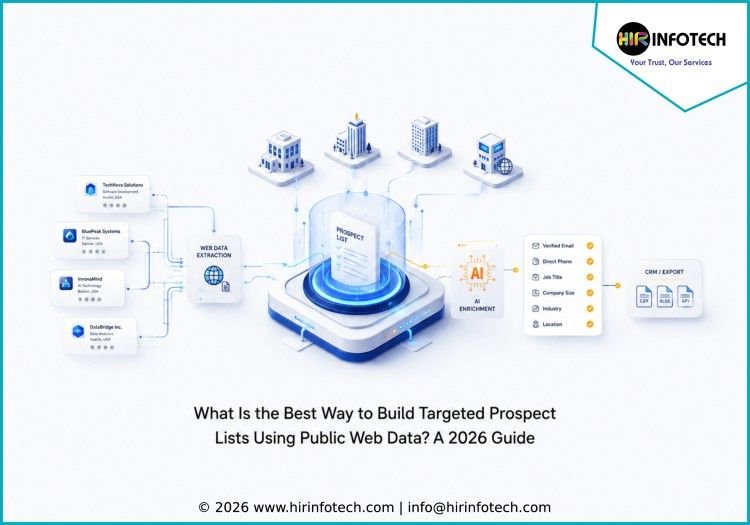
What Is the Best Way to Build Targeted Prospect Lists Using Public Web Data? A 2026 Guide

What Is the Best Way to Build Targeted Prospect Lists Using Public Web Data? A 2026 Guide Introduction Sales teams need high-quality prospect lists to drive revenue, but purchasing outdated databases wastes money and damages outreach performance. Building targeted prospect lists using public web data gives businesses access to fresh, customized, and highly relevant contacts aligned with their ideal customer profile. In 2026, automated web scraping and data extraction have become the most effective methods for generating B2B prospect lists at scale. This guide explains how to extract business contact data from public sources while staying compliant with regulations across the USA, Germany, UK, France, Canada, Australia, and global markets. What Is Public Web Data for Prospect Lists? Public web data refers to business information available on publicly accessible websites such as company websites, LinkedIn company pages, Google Maps listings, industry directories, and business registries. This data typically includes: Unlike purchased databases, public web data comes directly from the original source where businesses publish their own information. This makes the data more accurate, current, and suitable for B2B lead generation campaigns. Why Building Your Own Prospect List Is Better Than Buying Lists Better Data Accuracy and Freshness Public web data is collected in real time, which means contact details remain current. Purchased prospect lists are often outdated, leading to bounced emails, inaccurate job titles, and poor outreach performance. Building your own list ensures your sales team reaches active companies with valid business information. Customized Ideal Customer Profile Targeting Custom prospect list building allows you to target: Purchased databases usually contain generic contacts that fail to match your exact ideal customer profile. Improved Cost Efficiency Buying B2B lead databases can cost between 500 and 5000 dollars depending on quality and size. Automated prospect list building using web scraping tools typically costs less than 1000 dollars monthly for infrastructure and automation workflows. Businesses that generate leads consistently can save tens of thousands annually. Greater Compliance Control When extracting public business data yourself, you maintain full control over: Purchased lists often lack transparency regarding consent and compliance procedures. Why Web Scraping Is the Best Method for Building Targeted Prospect Lists Web scraping automates the extraction of business data from public sources and enables businesses to build scalable, highly targeted prospect databases. Complete Control Over Data Sources Web scraping allows businesses to choose the exact sources they want to extract data from, including: This flexibility enables precise targeting based on your ideal customer profile. Automated and Scalable Lead Generation Manual prospect research can take 15 to 30 minutes per lead. Automated scraping workflows can generate 500 to 1000 qualified prospects weekly with minimal human involvement using: Automation drastically reduces prospecting time while increasing scalability. Real-Time Data Freshness Businesses can control scraping frequency based on campaign requirements: Real-time scraping keeps prospect databases current with updated job titles, emails, and company information. Better Coverage for Niche Markets Public web scraping provides access to highly specific industries and regions often missing from commercial databases. Examples include: Step-by-Step Workflow to Build Targeted Prospect Lists Step 1: Define Your Ideal Customer Profile Start by identifying: A clear ICP ensures only relevant prospects are collected. Step 2: Identify Public Data Sources Match your target audience to suitable public sources: Step 3: Set Up Your Technology Stack A standard prospect list building stack includes: Workflow Automation Search and Discovery Web Scraping Tools Email Verification Data Storage AI Enrichment Step 4: Perform SERP Searches Use search queries such as: SERP APIs help identify relevant company websites at scale. Step 5: Scrape Company Contact Information Extract data from pages like: Collect: Step 6: Enrich Prospect Data Enhance contacts using: Enriched data improves segmentation and personalization. Step 7: Verify Email Addresses Use email verification services to: Verified lists typically achieve 85 to 90 percent accuracy. Step 8: Score and Prioritize Leads Apply lead scoring using: Prioritize high-scoring leads for outreach. Step 9: Export Leads to CRM Export qualified prospects into: Include all enrichment and verification data for sales outreach. Essential Data Points for Prospect List Building A high-quality B2B prospect list should include: These data points support personalized outreach and better conversion rates. Compliance Requirements for Public Web Data Collection Respect Robots.txt Rules Always check and follow robots.txt directives before scraping websites. Extract Only Business Information Focus strictly on: Avoid personal emails and sensitive information. Follow Global Privacy Regulations Important regulations include: Compliance should be integrated into every workflow. Include Opt-Out Mechanisms All outreach emails must provide: Maintain Compliance Documentation Document: Common Mistakes in Prospect List Building Scraping Without Verification Unverified emails increase bounce rates and damage sender reputation. Weak ICP Definition Poor targeting creates irrelevant prospect databases with low conversion potential. Lack of Data Enrichment Basic contact data limits personalization opportunities. Excessive Data Retention Storing lead data indefinitely may violate GDPR data minimization rules. Aggressive Scraping Speeds High request rates can trigger: Use rate limiting and rotating proxies responsibly. How Hir Infotech Helps Businesses Build Targeted Prospect Lists Hir Infotech is a global outsourcing and data solutions company headquartered in Ahmedabad, Gujarat, with more than 12 years of experience in web scraping, data extraction, automation, and compliance-aware data solutions. The company helps businesses build highly targeted prospect lists using: Hir Infotech develops enterprise-grade scraping solutions using: Their services support compliance across: Businesses can generate customized prospect databases with: This enables sales teams to achieve better outreach efficiency, improved deliverability, and stronger lead qualification. Key Metrics for Measuring Prospect List Success Track these KPIs: Teams using automated scraping workflows commonly achieve: Frequently Asked Questions Is building prospect lists from public web data legal? Yes. Extracting publicly available business contact information is generally legal when businesses follow compliance practices such as respecting robots.txt files, honoring opt-outs, and complying with GDPR, CCPA, and other regulations. What are the best sources for prospect data? Top sources include: How accurate is scraped prospect data? Raw scraped data usually achieves 65 to 75 percent accuracy. After verification and enrichment, accuracy often improves to 85 to 90 percent. How
Uncategorized

Create a B2B Lead Scraping Strategy for a SaaS Company Targeting the USA in 2026

Create a B2B Lead Scraping Strategy for a SaaS Company Targeting the USA in 2026 Introduction SaaS companies targeting the USA need highly qualified B2B leads to drive recurring revenue growth, improve outbound performance, and build predictable sales pipelines. However, relying on outdated lead lists often results in poor targeting, low deliverability, wasted budgets, and damaged sender reputation. In 2026, modern SaaS companies increasingly use B2B lead scraping strategies to collect fresh business intelligence directly from publicly available online sources. This approach allows organizations to build highly customized prospect databases aligned with their ideal customer profile instead of depending entirely on generic third-party datasets. For SaaS businesses targeting competitive USA markets, structured lead scraping workflows help identify companies actively hiring, adopting new technologies, expanding operations, or evaluating competing software solutions. When combined with automation, enrichment, verification, and CRM integration, web scraping becomes a scalable lead generation engine for outbound sales. Why SaaS Companies Need a Custom B2B Lead Scraping Strategy SaaS Buyers Require Highly Specific Targeting SaaS purchasing decisions are heavily influenced by operational requirements, technology infrastructure, funding stage, and organizational growth. Generic lead databases rarely capture these nuances accurately. Modern SaaS outbound teams often target businesses based on: Decision-makers commonly include: A custom scraping strategy allows SaaS companies to identify these accounts with significantly higher precision. USA Market Dynamics Require Specialized Prospecting The United States remains one of the most competitive SaaS markets globally. High-growth SaaS ecosystems are concentrated in regions such as: USA-based SaaS lead generation also differs operationally from European prospecting because outreach is governed primarily by CAN-SPAM regulations rather than GDPR-style consent models. Successful SaaS prospecting in the USA therefore requires: Fresh Data Creates Competitive Advantage SaaS sales cycles move quickly. Companies adopt tools rapidly, teams change frequently, and funding events create new buying opportunities. Outdated lead databases often include: Automated scraping workflows allow SaaS businesses to continuously refresh lead intelligence and identify active buying signals before competitors. Lead Scraping Reduces Prospecting Costs Purchased lead databases can cost SaaS startups thousands of dollars every month while still lacking customization and freshness. By building internal or outsourced scraping workflows, SaaS companies can: For early-stage SaaS organizations, custom scraping can reduce annual prospecting costs substantially while improving pipeline quality. Defining Your SaaS Ideal Customer Profile for USA Targeting Company Size and Growth Stage Lead generation begins with defining the right company profile. Useful segmentation criteria include: Examples: The correct target range depends on: Industry Vertical Targeting Most SaaS products solve problems within specific verticals. Examples include: Industry targeting significantly improves outbound relevance and campaign performance. Geographic Focus Inside the USA SaaS companies often perform better when prioritizing regions with strong technology adoption. Popular USA targeting regions include: Regional targeting also improves: Technology Stack Identification Technographic targeting has become essential for SaaS prospecting. Useful signals include: Companies using competing or complementary technologies often become strong outbound candidates. Decision-Maker Roles Modern SaaS purchases involve multiple stakeholders. Target roles may include: Well-structured lead scraping workflows help map buying committees more effectively. Step-by-Step B2B Lead Scraping Strategy for SaaS Companies Step 1: Build Your Lead Scraping Infrastructure A scalable SaaS lead generation workflow typically includes: Popular workflow automation platforms include: Common scraping technologies include: Step 2: Create USA-Focused Search Queries Search query design strongly affects lead quality. Examples include: Adding: helps improve targeting precision. Step 3: Scrape Company Websites and Public Sources Lead scraping workflows commonly collect: Key pages often include: Step 4: Enrich SaaS Lead Data Raw scraped data is rarely sufficient. Enrichment workflows may append: This creates stronger outbound segmentation. Step 5: Apply Lead Scoring Models Not every scraped lead deserves immediate outreach. Lead scoring may consider: Scoring improves sales prioritization and campaign efficiency. Step 6: Verify Email Addresses Email verification protects: Verification workflows typically detect: High-performing SaaS outbound teams usually maintain bounce rates below 3 percent. Step 7: Push Leads Into CRM Systems Once verified and scored, leads should be structured for CRM workflows. Common integrations include: Useful segmentation fields include: USA Compliance Considerations for SaaS Lead Scraping CAN-SPAM Compliance Commercial outreach in the USA must comply with CAN-SPAM regulations. Requirements include: State-Level Privacy Laws Certain states maintain additional privacy regulations including: SaaS companies should implement: Responsible Data Collection Modern lead generation strategies increasingly prioritize: Best Data Sources for SaaS Lead Scraping in the USA Crunchbase Useful for: BuiltWith Useful for: Google Maps Useful for: Career Pages Hiring activity often signals: SaaS Directories Platforms such as: can help identify: Measuring B2B SaaS Lead Scraping Performance Important KPIs include: Successful SaaS lead generation systems often produce: Common SaaS Lead Scraping Mistakes to Avoid Targeting Too Broadly Generic prospecting reduces conversion quality. Precise ICP targeting consistently outperforms broad outreach. Ignoring Technographic Signals Technology stack intelligence is critical for SaaS positioning. Without it, outreach loses relevance. Skipping Verification Unverified emails create: Not Scoring Leads Lead prioritization is essential for sales efficiency. Weak Follow-Up Systems Outbound success depends heavily on: How Hirinfotech Supports SaaS Lead Scraping Strategies hirinfotech provides web scraping and lead data automation services designed for businesses building scalable B2B prospecting systems. For SaaS companies targeting the USA, the company supports workflows involving: Its services are particularly useful for organizations needing: Instead of relying solely on static lead providers, SaaS businesses can build customized lead generation systems aligned with their actual sales strategy and market focus. Best Practices for SaaS Lead Scraping in 2026 Prioritize Quality Over Volume Smaller highly targeted datasets usually outperform massive generic lists. Combine Scraping With Enrichment Enriched data improves: Maintain Continuous Data Refresh Cycles Lead data changes rapidly. Regular updates maintain: Align Sales and Data Operations Outbound success improves when: operate together. Frequently Asked Questions Is B2B lead scraping legal in the USA? Yes, businesses can scrape publicly available business information when they follow applicable laws, platform policies, and responsible data handling practices. What are the best data sources for SaaS lead scraping? Common sources include: Why is email verification important? Verification reduces: How often should SaaS lead databases be updated? Most SaaS prospect databases

Uncategorized

How Can I Scrape and Enrich B2B Leads Without Getting Low-Quality Data? A 2026 Guide

How Can I Scrape and Enrich B2B Leads Without Getting Low-Quality Data? A 2026 Guide Introduction Scraping B2B leads is easy, but getting high-quality data that converts is challenging. Low-quality data produces bounce rates above 10 percent, damaged sender reputation, and wasted sales team time. The solution is a systematic scraping and enrichment pipeline that extracts data from reliable sources, verifies emails in real-time, cleans and normalizes records, and enriches with firmographic data. This guide shows you how to build this pipeline for global markets. Why B2B Lead Scraping Produces Low-Quality Data Raw Scraped Data Is Incomplete Public directories rarely expose direct decision-maker emails, often returning only generic aliases like info at company dot com or support at company dot com. These role-based emails have low engagement rates and high bounce rates. Personalized emails require an enrichment layer to discover. Email Formats Vary by Company Company email formats differ significantly. Some use name at company dot com, others use first dot last at company dot com, or first initial plus last name at company dot com. Without pattern detection and verification, you guess incorrectly and create invalid emails that bounce. Data Becomes Outdated Quickly Job titles change, employees leave companies, and email addresses become inactive. Raw scraped data without verification contains stale information. Contact data decays at 30 percent annually, meaning one-third of your list is outdated within 12 months without regular updates. Inconsistent Formatting Hurts Usability Scraped data arrives in inconsistent formats: company names with LLC or Ltd suffixes, URLs with www or https prefixes, job titles in all caps, and phone numbers in different formats. Without cleaning and normalization, this data is unusable in CRMs and creates confusion for sales teams. The Three-Step Enrichment Pipeline for High-Quality B2B Leads Step 1: Entity Resolution Combine scraped company name and full person name to uniquely identify contacts. For example, combine Jane Doe with Acme Corp to create a unique record. This prevents duplicates when the same person appears in multiple data sources. Entity resolution uses company domain plus person name as unique identifiers. Step 2: Pattern Permutation Generate likely email formats using the company’s MX record patterns. Analyze the company domain to identify email format patterns like first dot last, first initial plus last name, or just first name. Generate permutations for each contact and test them systematically. This discovers personalized emails rather than relying on generic role-based addresses. Step 3: SMTP Validation Execute a real-time SMTP handshake to confirm the mailbox exists without sending an actual message. SMTP validation checks if the email server accepts the address, verifying deliverability before outreach. This keeps bounce rates below 2 percent compared to 10 to 15 percent without validation. Tools like Hunter.io, NeverBounce, and ZeroBounce provide SMTP validation APIs. Essential Data Sources for High-Quality B2B Lead Scraping Google Maps for Local B2B Contacts Google Maps is a top source for local B2B contacts including healthcare, legal, industrial services, and professional firms. Use Playwright or Puppeteer to traverse the Shadow DOM and handle infinite scroll with lazy loading. Record the CID and Place ID to uniquely identify entries across updates. Extract company name, physical address, phone number, website URL, and business hours. This source provides verified business information with high accuracy. Static Industry Directories Older directories like Yellow Pages deliver pre-rendered HTML, making them suitable for rapid scraping with Python and BeautifulSoup or Scrapy. Use XPath selectors over CSS for more reliable parsing. Since these sites paginate with page equals 2 parameters, you can parallelize requests across threads to boost throughput. Directories provide pre-qualified business listings with verified contact information. Company Websites Company websites are the most authoritative source for business contact data. Crawl key pages including slash about, slash contact, slash team, and slash careers pages. Extract company name, business email addresses, phone numbers, physical addresses, and key personnel job titles. Website data is self-published by companies, ensuring accuracy and freshness. Crunchbase for Funding Data Crunchbase provides startup funding information including seed, Series A, B, C rounds, investor names, and funding amounts. Companies that recently raised funding have budget for B2B purchases. Scrape Crunchbase for funding stage, investor details, and company growth signals. This enrichment helps prioritize high-intent prospects. BuiltWith for Technology Stack BuiltWith reveals technology stacks of websites including CRM tools, marketing platforms, and competing SaaS solutions. Identify companies using competing tools for upgrade opportunities or complementary tools for cross-sell potential. Technology stack data enables better segmentation and personalization in outreach. Mandatory Data Cleaning Phases for Quality Assurance String Normalization Use regular expressions to strip legal suffixes like LLC, Ltd, and Corp from company names. Correct casing issues like converting JOHN SMITH to John Smith. Normalize whitespace and remove special characters. String normalization ensures consistent formatting across all records. URL De-Fragmentation Convert varied URL formats like https://www dot site dot com slash index dot php into normalized root domains like site dot com. Remove trailing slashes, query parameters, and protocol prefixes. Standardized URLs enable accurate company matching and deduplication. Job Title Mapping Apply fuzzy matching or a dictionary to group similar titles into unified personas. Map VP of Sales, Head of Revenue, and Sales Director into a single Sales Leadership persona. Map CTO, Chief Technology Officer, and VP Engineering into Technology Leadership. This enables accurate segmentation and reporting. Phone Number Standardization Standardize phone numbers to E.164 format with country code prefix like plus 1 for USA. Remove spaces, dashes, and parentheses. Convert extensions to a standard format. E.164 format ensures compatibility with CRM systems and dialing tools. Deduplication Based on Unique Identifiers Remove duplicates based on unique identifiers like email address or company domain. Check for exact matches and fuzzy matches with 90 percent similarity threshold. Merge duplicate records keeping the most complete information. Deduplication prevents sales teams from contacting the same prospect multiple times. Email Verification Strategies to Maintain Below 2 Percent Bounce Rate Multi-Provider Verification Waterfall Use a waterfall approach with multiple verification services for maximum accuracy. Route emails through Provider A, then send failures to Provider B,

Uncategorized

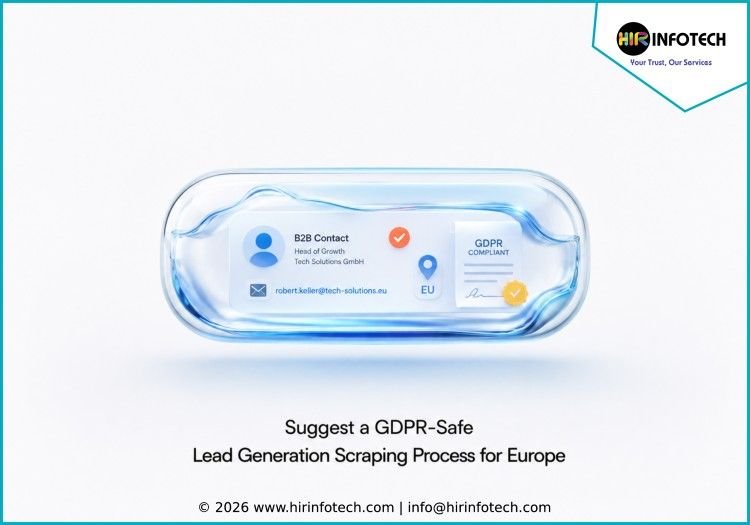
Suggest a GDPR-Safe Lead Generation Scraping Process for Europe

Suggest a GDPR-Safe Lead Generation Scraping Process for Europe Introduction European data protection regulators have made their position clear: “public does not automatically mean permission for scraping” . For B2B lead generation teams targeting Germany, France, the UK, and other European markets, this means building a compliance-first process from the ground up. This guide outlines a practical, GDPR-safe workflow that moves from raw scraping to compliant outreach — combining legal foundations with operational safeguards that have been tested against real enforcement actions. Understanding the Three Legal Layers That Govern Scraping in Europe Before building any process, you must understand the three overlapping legal frameworks that apply to scraping in the EU. Each layer creates distinct obligations, and none can be ignored . Layer 1: GDPR — Personal Data Protection The GDPR applies whenever you scrape personal data — names, email addresses, phone numbers, IP addresses, or any identifier linked to an identifiable person. The moment you scrape a business contact from LinkedIn or a company directory, you become a “data controller” with legal duties . Key obligations include establishing a lawful basis under Article 6, providing transparency notices under Article 14, practicing data minimization, and defining retention limits. Crucially, the fact that data is publicly accessible does not exempt it from GDPR. As the Dutch DPA chairman stated, “public does not automatically mean permission for scraping” . Layer 2: The EU Database Directive The Database Directive protects databases where the creator made a “substantial investment” in obtaining, verifying, or presenting data. Scraping a “substantial part” of such a database may infringe these rights . In practice, scraping a few hundred product prices from a large retailer is unlikely to qualify. But bulk-downloading an entire competitor’s catalog could cross the line. The key question is always proportionality. Layer 3: Terms of Service and Contract Law Many websites explicitly prohibit scraping in their Terms of Service. In Europe, violating ToS is a civil matter, not criminal, but it can still lead to injunctions and contract lawsuits. The landmark case is Ryanair v. PR Aviation, where the court enforced Ryanair’s ToS against a scraper even though database rights did not apply . For lead generation, this means always reviewing a site’s ToS before scraping. If it is a clickwrap agreement that explicitly prohibits scraping, proceed with extreme caution — or look for official API access instead. Step 1: Establish Your Lawful Basis (Legitimate Interest) The most common lawful basis for B2B lead generation scraping is legitimate interest under Article 6(1)(f) of the GDPR. Consent is almost never feasible for scraping at scale — you cannot ask millions of people for permission before collecting their publicly posted information . However, legitimate interest is not a free pass. You must document a three-part Legitimate Interest Assessment (LIA) before scraping : Practical Tip: Document your LIA as a one-page memo before any scraping project. Include what data you are collecting, why, and how you balanced interests. This documentation is your first line of defense if a regulator inquires . Step 2: Source Data from Legitimate, Publicly Accessible Sources Not all data sources carry the same compliance risk. The safest approach for GDPR-safe lead generation is sourcing from publicly registered business directories and professional registries. Compliant Sources for European Lead Data For European markets, legitimate sources include Germany’s Unternehmensregister (company register), France’s SIRENE database, the UK’s Companies House, and sector-specific professional directories across the EU . These sources contain business contact information that individuals reasonably expect to be public as part of their professional role. What to Avoid Avoid scraping personal email addresses (Gmail, Yahoo, Outlook.com) — these rarely qualify for legitimate interest. Avoid scraping social media profiles where individuals have stronger privacy expectations. And avoid any source that is clearly personal rather than professional in nature. For enterprise-scale lead generation, working with a specialized data provider can reduce compliance risk. Hir Infotech delivers fully GDPR-audited contact databases sourced from publicly registered trade directories, company registries, and professional networks — with lawful basis documentation included for every record . Step 3: Apply Data Minimization at the Scraper Level Data minimization is a legal requirement, not a best practice. You must configure your scraper to extract only the fields you actually need . If your goal is B2B outreach to procurement managers in Germany, you need: You do not need personal phone numbers, home addresses, education history, or social media profile content. Configure your scraper to ignore these fields entirely. Delete any irrelevant data immediately after extraction . Step 4: Implement Technical Safeguards During Extraction European Data Protection Authorities have published specific technical requirements for compliant scraping : The CNIL (French DPA), Dutch DPA, and EDPB all require these safeguards as part of any compliant scraping operation . Step 5: Comply with Article 14 — Transparency Within One Month Article 14 of the GDPR is the most overlooked requirement in lead generation scraping. It applies when you collect personal data indirectly — from public websites, LinkedIn, or data brokers . Under Article 14, you must notify individuals within one month of collection, telling them who you are, why you have their data, what data you collected, your lawful basis, their rights, and how to opt out. If you plan to contact them, this notice must be provided at the latest at first communication . Practical Article 14 Implementation For outbound email campaigns, include a short notice in your first message. A compliant template : PS — I am reaching out based on your role at {{Company}}. We use business contact data for B2B outreach under legitimate interests. Details + opt-out: {{PrivacyNoticeURL}}. Or with source attribution: You are receiving this because we found your business contact details from public web sources and/or data partners. Privacy + opt-out: {{PrivacyNoticeURL}}. Your full privacy notice must be accessible via the URL. It should include your identity, purpose, legal basis, data categories, retention period, and instructions for exercising rights . Step 6: Include a Clear Opt-Out in Every Message Every outreach message

Uncategorized

What Questions Should You Ask Before Hiring a B2B Lead Scraping Agency?

What Questions Should You Ask Before Hiring a B2B Lead Scraping Agency? Introduction Hiring a B2B lead scraping agency can accelerate your sales pipeline dramatically. But choosing the wrong partner comes with serious costs: wasted sales time on dead-end contacts, compliance violations that trigger GDPR fines, and months of bad data that erode team morale. Before signing any contract, you need specific answers about how the agency sources data, verifies accuracy, handles compliance, and measures success. This guide covers the critical questions to ask — based on real agency failures and regulatory enforcement actions. Question 1: What Is Your Industry Experience and How Do You Map to My Ideal Customer Profile? Industry expertise separates generic lead lists from targeted, conversion-ready prospects. An agency that understands your sector knows the right job titles, decision-making hierarchies, and relevant pain points . Ask for specific examples. For manufacturing, inquire about experience with longer sales cycles and multiple stakeholders. For SaaS, ask about navigating complex B2B buying committees. The agency should demonstrate familiarity with your Ideal Customer Profile factors — company size, budget range, decision-maker roles, and geographic markets . For multi-market targeting across the USA, Germany, the United Kingdom, France, and other locations, the agency must understand regional variations in job titles, business culture, and buying behavior. A procurement manager in Germany may have a different title and authority level than one in the UK. Question 2: How Do You Source, Verify, and Maintain Lead Data? Data quality directly impacts your outreach success. Studies show that up to 100,000 phone numbers are reassigned daily in the US alone, making regular verification essential . Ask the agency to explain their data sourcing methods. Are they scraping public directories, using third-party data providers, or relying on a proprietary database? How frequently do they refresh their datasets? What verification processes do they use — email validation services, phone number verification, or manual checks? The consequences of poor verification are severe. One B2B lead agency reported that a lower-cost provider delivered only 50 percent data accuracy, with only 12 percent of contacts having viable phone numbers. This forced sales development representatives to waste up to 88 percent of their prospecting efforts on bad data . Ask for bounce-rate guarantees. Reputable providers typically maintain bounce rates under 5 to 10 percent and should be willing to replace invalid contacts at no additional cost . Question 3: How Do You Ensure GDPR and CCPA Compliance for My Target Markets? Compliance is non-negotiable. GDPR applies whenever you scrape personal data of EU residents — including names, email addresses, phone numbers, and IP addresses — regardless of where your business is based . Three overlapping legal layers govern scraping in Europe. GDPR applies to any personal data collection. The EU Database Directive protects databases where the creator made a substantial investment in organizing data. Terms of Service violations can lead to contract lawsuits even if no criminal charges apply . Crucially, “publicly available” does not mean exempt from GDPR. The Dutch DPA chairman stated directly: “public does not automatically mean permission for scraping” . A LinkedIn profile with name and email is personal data regardless of being publicly accessible. Under Article 14 of GDPR, when you collect personal data indirectly — from public websites, LinkedIn, or data brokers — you must notify individuals within one month of collection, explaining your identity, purpose, legal basis, and their rights . Ask the agency: Do you provide documentation of your Legitimate Interests Assessment? How do you handle Article 14 notification obligations? Do you maintain suppression lists for individuals who opt out? What is your data retention policy? For European markets specifically — Germany, France, Netherlands, Switzerland, Spain, Italy — the agency should demonstrate documented GDPR protocols including data minimization, purpose limitation, and audit trails . Question 4: What Data Fields Do You Provide and Can You Customize Targeting? Generic lead lists waste time. You need data fields that match your sales process and enable personalized outreach. Essential fields include company name, industry classification, employee size, revenue range, location data (street, city, postal code, country), direct phone numbers, verified email addresses, contact person name and job title, and source URL for verification . For ABM targeting, you may need additional fields including technology stack indicators, recent funding or hiring signals, and LinkedIn company profiles. The agency should offer multi-level filtering capabilities — by industry, job title and seniority, company size or revenue, location down to city or postal code, and technology used . Pre-packaged lists rarely meet specific B2B targeting needs. Question 5: What Is Your Pricing Model and Are There Hidden Fees? Understand the total cost before committing. Common pricing models include per-record pricing (cost per lead or per thousand leads), subscription-based monthly fees for ongoing data delivery, project-based flat fees for custom datasets, and performance-based models tied to appointments or conversions . Ask about setup fees — some agencies charge for initial research and configuration. Inquire about minimum commitments, whether monthly or per project. Clarify if CRM integration, custom reporting, or data enrichment incur additional charges . Compare total cost of acquisition, not just per-lead price. A higher upfront cost often delivers better-qualified leads and stronger ROI than cheap, low-accuracy lists that waste sales time. Question 6: Can You Provide References or Case Studies from Similar Businesses? Past performance is the best predictor of future results. Request references from businesses similar to yours in size, industry, and target market. Ask for measurable outcomes. For example, one lead generation agency helped an information security company double its monthly sales-qualified leads through a 12-month account-based campaign . Another agency achieved 93 percent valid live contacts and 99 percent valid employee size listings using premium data sources . Contact provided references directly. Ask about accuracy rates, responsiveness to issues, and whether the agency met promised delivery timelines. Question 7: How Do You Integrate with Our CRM and Sales Stack? Leads have no value sitting in spreadsheets. The agency should seamlessly deliver data to your existing

Scroll to Top