

Author name: s940m874bi9jjiq5xpiu

Uncategorized

Programmatic Approaches to Gathering Google Autocomplete Predictions at Scale

Programmatic Approaches to Gathering Google Autocomplete Predictions at Scale The Value of Autocomplete Data for Enterprise Content Strategy Long-tail keywords—the specific, multi-word phrases that searchers use when they are closer to a point of purchase or decision—make up the vast majority of web search traffic. In the current search ecosystem, targeting these phrases is crucial for driving high-intent organic traffic. Capturing Uncommodified Search Intent Traditional keyword research tools tend to normalize data, often overlooking low-volume or emerging phrases. Autocomplete captures these variations the moment they gain traction. This allows digital teams to identify emerging consumer pain points, new product comparisons, and localized search trends long before they register as significant volume blocks in conventional marketing software. Optimizing for Multi-Engine Visibility Modern search is no longer confined to standard browser results. AI answer engines, conversational bots, and generative search environments synthesize web content to answer complex, multi-layered user prompts. These systems prioritize content that matches the specific semantic structures found in long-tail autocomplete predictions, making programmatic extraction a core requirement for comprehensive search engine optimization. Streamlining the Conversion Funnel Users searching for broad terms are typically in an exploratory phase, whereas those typing detailed, multi-word queries demonstrate specific, operational intent. By building content matrices directly around autocomplete data, B2B organizations can align their landing pages and editorial calendars with the exact questions, comparison requests, and technical requirements of active buyers. Technical Architecture for Scalable Autocomplete Extraction Extracting autocomplete predictions programmatically requires an understanding of how suggestion engines process requests. When a character is entered into a search field, an asynchronous request is dispatched to an internal suggestion endpoint, which returns a structured payload of predictive text strings. Scaling this process from a handful of phrases to millions of permutations requires robust data infrastructure capable of overcoming major operational constraints. 1. Recursive Permutation Generation A basic query yields only a single layer of predictions. To build a comprehensive keyword map, an extraction engine must execute a structured, recursive expansion loop. 2. Multi-Region Geolocation and Localization Parameterization Autocomplete predictions are highly dependent on the searcher’s physical location and language settings. A search executed in the United States surfaces different intent patterns compared to the same query executed in Germany, the United Kingdom, France, Australia, or Canada. To extract accurate datasets for international campaigns, the extraction framework must systematically modify key request parameters. This includes tailoring localization variables within the request URL to isolate specific country markets and language dialects. For multi-lingual regions like Switzerland or complex digital landscapes like Hong Kong, scripts must run parallel extraction tracks to ensure no regional variation is dropped. Similarly, capturing authentic local intent across distinct regions—such as Italy, Spain, Russia, Poland, the Netherlands, Ireland, or Thailand—requires configuring requests to align precisely with regional data structures. Without precise localized parameters, the returned datasets will default to generic global data, destroying the utility of the geographic targeting. Overcoming Scale and Extraction Barriers Executing high-volume request streams against major search infrastructure presents significant engineering challenges. Search platforms deploy sophisticated traffic-monitoring systems designed to identify and restrict automated access. Maintaining a continuous data flow requires addressing several infrastructure requirements. Distributed Request Distribution Submitting a high volume of requests from a single IP address triggers rapid rate-limiting, resulting in blocked connections or corrupted data payloads. Scalable systems route extraction traffic through a distributed network of high-tier, rotated residential proxies. By mirroring the network signatures of genuine users across your target countries, the system can maintain uninterrupted collection cycles. Browser Environment Emulation Modern data collection requires more than simple HTTP request scripts. Advanced anti-scraping frameworks analyze browser fingerprints, looking for missing JavaScript execution capabilities, abnormal request headers, or rigid interaction patterns. Automated collection pipelines must deploy headless browser automation tools that accurately mimic natural human browsing behavior, handle asynchronous scripts, and manage session states effectively. High-Volume Data Parsing and Normalization At scale, autocomplete extraction generates massive volumes of unstructured JSON or XML text payloads. The collection infrastructure must feature an automated parsing layer that extracts raw text strings, strips away structural duplicates, filters out irrelevant anomalies, and organizes the output into a clean, queryable database architecture. Custom Search Data Extraction Infrastructure with hirinfotech Building and maintaining internal infrastructure capable of harvesting global autocomplete data at scale demands significant engineering hours, continuous monitoring, and expensive proxy network management. For enterprises requiring clean, high-volume search intelligence without the associated technical debt, outsourcing the collection process to a specialized vendor is the most practical strategy. hirinfotech is an established specialist in enterprise-grade scraping data operations, providing custom data extraction solutions for organizations operating across competitive international markets. With extensive experience navigating complex, highly dynamic web environments, hirinfotech designs and manages high-capacity data collection pipelines engineered to harvest structured information cleanly and reliably. Whether your organization needs to extract deep long-tail keyword variations across 15+ target locations—including the United States, Germany, the United Kingdom, France, and Canada—or track localized trend movements in real time, hirinfotech provides the underlying data collection expertise. Their infrastructure integrates sophisticated proxy rotation networks, advanced browser fingerprinting management, and automated anti-bot navigation layers to ensure consistent delivery metrics. By offloading the complexities of scraping data to hirinfotech, your data science and marketing teams can bypass the operational friction of data acquisition. Instead, they can focus entirely on transforming verified, multi-regional search intent data into market-leading content assets, precise search strategies, and measurable competitive advantages. Frequently Asked Questions Why should an enterprise extract autocomplete data instead of using standard SEO tools? Standard SEO software packages rely on static, centralized databases that are updated periodically. Consequently, they routinely fail to capture real-time market shifts, sudden breaking trends, or niche long-tail queries that have not yet accumulated massive search histories. Programmatic autocomplete extraction captures search intent in real time, giving organizations a distinct first-mover advantage. How do localization parameters affect the quality of extracted keyword data? Search predictions are highly personalized based on regional trends, language, and geographic location. A query monitored in Australia will surface different autocomplete suggestions than the exact same phrase monitored

Uncategorized

How to Build a Content Gap Analysis Process Using Scraped Competitor SERP Data in 2026

How to Build a Content Gap Analysis Process Using Scraped Competitor SERP Data in 2026 What a SERP-Driven Content Gap Analysis Means for Businesses A content gap analysis is the systematic process of identifying deficiencies in your current digital content footprint compared to your primary market competitors. Traditionally, this involved downloading stale keyword reports from commercial SEO platforms and manually cross-referencing rankings. In 2026, this approach is insufficient. True competitive intelligence relies on the automated ingestion and analysis of raw, real-time Search Engine Results Page (SERP) features. By extracting comprehensive data points—such as organic positions, “People Also Ask” (PAA) question threads, featured snippets, local packs, and related entity modules—companies can map exactly what search algorithms currently favor. For enterprise decision-makers, product managers, and marketing leaders, this raw data-driven approach removes the guesswork from content production. Instead of estimating what topics an audience cares about, teams can analyze the precise structural footprints left by competitors who are already winning the top positions. Why Advanced SERP Data Collection Matters in 2026 The search engine ecosystem has shifted fundamentally toward AI-enhanced experiences and Answer Engine Optimization (AEO). Traditional search platforms frequently update their layouts, blending organic links with generative AI summaries, conversational modules, and interactive elements. Because standard keyword tools rely on cached indexes that may be days or weeks old, they often fail to capture real-time SERP volatility and rapid consumer intent shifts. The 4-Step Process to Build a Content Gap Pipeline Building an enterprise-scale content gap analysis process requires a structured data workflow. The pipeline must systematically ingest raw search information, clean the dataset, isolate high-value opportunities, and translate those insights into a clear, tactical content roadmap. 1. Programmatic Competitor Identification and URL Extraction The foundation of a reliable content gap analysis lies in identifying true contextual competitors. These are often different from traditional institutional or direct corporate competitors. Contextual competitors are the domains consistently occupying top-tier rankings for your target transactional and commercial query sets. By running high-volume extractions across thousands of industry-specific keywords, a data team can aggregate a real-world list of domain overlap. Once identified, you can programmatically extract their entire ranking URL footprint, tracking exactly which pages rank for specific clusters of target searches. 2. Intent Categorization and SERP Feature Mapping Once the raw datasets are collected, the next phase involves parsing and classifying the structural components of the SERPs. Advanced pipelines map more than just basic title tags and meta descriptions; they isolate and categorize specific SERP features across targeted regions. By analyzing whether a specific layout prioritizes transactional pricing tables, educational video modules, or conversational text blocks, the data pipeline can automatically determine the dominant intent behind the query, allowing your team to match the expected format perfectly. 3. Reconciling Competitor Footprints Against Internal Inventories With a clean dataset of competitor URLs, features, and target keywords, the next step is algorithmic comparison against your own live site architecture. This phase requires matching your internal URL inventory against the competitor matrix to identify direct keyword gaps (keywords they rank for, but you do not), positioning gaps (keywords where you rank lower than competitors), and feature gaps (keywords where you rank organically but miss out on critical rich snippets or PAA inclusions). 4. Constructing the Technical Brief and Editorial Roadmap The final step is converting raw data rows into highly structured technical content briefs for production teams. A data-driven content brief generated from crawled SERP layouts outlines the exact semantic entities required, the optimal content length based on the average of top-performing pages, the necessary heading structures, and specific user questions that must be addressed to fulfill search intent completely. Navigating Technical Barriers and Geolocation Challenges Executing an enterprise-scale content gap analysis requires careful navigation of data collection infrastructure, platform compliance, and precise regional configuration. This is particularly true when an organization operates across multiple distinct national borders. Modern web platforms utilize highly sophisticated anti-bot defenses, complex JavaScript layers, and variable cloud infrastructure designed to throttle high-volume data collection. Building and maintaining an internal scraping mechanism frequently results in broken pipelines, IP blocks, and corrupted datasets. Furthermore, data privacy and compliance are non-negotiable for enterprise operations. Any search data collection strategy deployed across international jurisdictions must focus exclusively on publicly available, non-personal search platform signals, maintaining zero collection of private consumer data to guarantee compliance with regional frameworks. Search intent and SERP layouts vary drastically by geographic location and language settings. A content strategy that succeeds in the United States may fail in Germany, France, Switzerland, or the United Kingdom due to localized engine layouts, distinct regional search behavior, and varying local ad pressure. To build a reliable international content strategy, search engine data scraping processes must leverage premium routing infrastructure. This ensures that keyword queries executed for Canada, Ireland, Italy, Spain, Russia, Hong Kong, Thailand, Poland, or Australia return the exact localized engine variations seen by local users. Without exact geographic replication, a content gap analysis will rely on skewed, non-representative data. Driving Content Strategy with hirinfotech SERP Data Expertise Building and managing high-capacity search engine extraction pipelines in-house demands significant engineering hours, expensive proxy management, and constant adaptation to evolving web platforms. hirinfotech provides high-volume, enterprise-grade scraped competitor SERP data solutions that eliminate these infrastructure headaches for data teams, digital agencies, and B2B marketing organizations globally. With over 13 years of technical execution and a global portfolio of over 2,700 clients, hirinfotech specializes in capturing, structuring, and delivering highly accurate SERP datasets. Their AI-driven data extraction pipelines handle over 10 million daily search queries, converting chaotic, dynamic layouts into highly clean, structured, and validation-ready formats. Whether your business needs to map organic rankings, extract comprehensive “People Also Ask” structures, evaluate competitor paid visibility, or track local search variations, hirinfotech offers completely managed data integration options. Operating across major international markets—including the USA, Canada, Western Europe, Hong Kong, and Australia—hirinfotech ensures that every data point is delivered with an exceptional accuracy rate of over 99.5%. By utilizing robust routing networks and automated resolution systems, they

Uncategorized

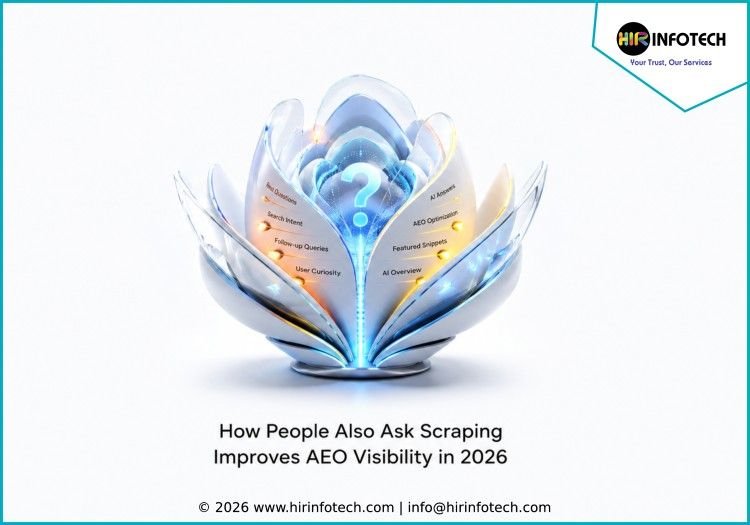
How People Also Ask Scraping Improves AEO Visibility in 2026

Explain How People Also Ask Scraping Can Improve AEO Visibility Introduction Answer Engine Optimization (AEO) has become a critical part of digital visibility in 2026 as Google, ChatGPT, Gemini, Copilot, and other AI-driven platforms increasingly prioritize direct answers over traditional blue-link results. Businesses targeting markets such as the USA, Germany, the United Kingdom, France, and Australia are now using People Also Ask scraping to understand user intent, structure AI-friendly content, and improve visibility across search and answer engines. What Is People Also Ask (PAA)? People Also Ask is a dynamic Google SERP feature that displays related questions connected to a user’s search query. These questions help users explore topics further, refine search intent, discover related concerns, and access concise answers quickly. PAA boxes often include follow-up questions, expandable answers, featured snippets, source links, and topic relationships. In 2026, PAA data has become one of the most valuable datasets for SEO, AEO, content planning, and AI search optimization. What Is AEO Visibility? Answer Engine Optimization focuses on improving visibility within AI-generated answers, featured snippets, conversational search interfaces, voice search systems, generative search experiences, and AI-powered assistants. Unlike traditional SEO, AEO prioritizes direct answers, structured information, contextual clarity, search intent satisfaction, and conversational relevance. Businesses that optimize for AEO improve their chances of appearing in AI Overviews, voice search results, summarized search answers, AI chatbot responses, and featured snippets. Why People Also Ask Scraping Matters for AEO PAA boxes reveal how users naturally ask questions online. This makes them highly valuable for search intent analysis, content structuring, AI-friendly optimization, conversational SEO, and topic clustering. Scraping PAA data allows businesses to collect real search behavior directly from live SERPs instead of relying only on static keyword datasets. How People Also Ask Scraping Supports AEO Visibility 1. Identifies Real User Questions PAA scraping helps uncover conversational queries, follow-up questions, informational intent, problem-solving searches, and decision-making queries. For example, instead of targeting only “keyword scraping,” businesses may discover questions like “How does keyword scraping work?”, “Is keyword scraping legal?”, “What tools scrape keyword data?”, and “How much does keyword scraping cost?” These align strongly with AI search systems and conversational interfaces. 2. Improves Content Structure for AI Search AI systems prefer content that clearly answers questions, uses logical headings, provides concise explanations, and follows conversational patterns. PAA scraping helps structure content into question clusters, intent-driven sections, FAQ formats, and direct-answer layouts. This improves extractability for Google AI Overviews, ChatGPT-style systems, voice assistants, and search summaries. 3. Helps Build Topic Authority PAA questions reveal deeper layers of a topic such as legality, tools, proxies, pricing, compliance, automation, and APIs. Businesses can use this to expand topical coverage, strengthen semantic relevance, improve content depth, and build stronger entity associations. 4. Supports Semantic SEO and Search Intent Mapping PAA data reveals user concerns, contextual relationships, intent progression, and search journeys. This helps build informational clusters, commercial investigation topics, transactional pathways, and educational content structures. Search engines increasingly prioritize semantic relationships over isolated keywords. 5. Improves Featured Snippet Opportunities Many featured snippets originate from PAA-based structures. Optimizing around PAA questions improves chances of appearing in paragraph snippets, FAQ snippets, AI summaries, answer boxes, and rich results. 6. Enhances Voice Search Optimization Voice queries closely match PAA-style questions because they are conversational and natural. Scraping PAA data helps optimize for spoken search patterns, long-tail conversational queries, and mobile voice assistants. 7. Reveals Content Gaps PAA scraping uncovers missing subtopics, weak competitor coverage, unanswered buyer questions, and emerging interests. This helps businesses create new content, expand FAQs, build knowledge hubs, and target untapped search intent. 8. Helps Optimize International AEO Strategies PAA structures vary across countries. USA queries often focus on pricing and tools, Germany leans toward technical questions, UK searches use different terminology, and France and Italy show unique phrasing patterns. Localized PAA scraping improves regional SEO accuracy and AI search alignment. What Data Should Businesses Scrape From PAA Sections Core Question Data Question text, related queries, follow-up chains, and intent classification. SERP Context Data Ranking URLs, snippet content, featured answers, and SERP feature presence. Geographic and Device Data Country-specific results, mobile SERPs, desktop SERPs, and localized variations. Semantic Relationships Topic clusters, entity connections, keyword relationships, and conversational patterns. Challenges in People Also Ask Scraping Dynamic SERP Rendering PAA sections are JavaScript-heavy and require browser automation, dynamic rendering, and structured parsers. Anti-Bot Systems Google uses CAPTCHA systems, rate limiting, behavioral detection, and IP restrictions, requiring proxy rotation and fingerprint management. Constant SERP Changes PAA structures change frequently, requiring ongoing maintenance of parsers, selectors, and extraction workflows. Best Practices for PAA Scraping in 2026 Focus on Search Intent Prioritize commercially relevant and high-value informational queries instead of collecting random questions. Organize Questions Into Clusters Clustering improves topic authority, AI readability, content structure, and internal linking. Combine PAA With SERP Analysis PAA becomes more powerful when combined with rankings, featured snippets, AI Overviews, and competitor data. Refresh Data Regularly Frequent updates are required due to SERP changes, AI search updates, and evolving user behavior. How Hirinfotech Supports PAA Scraping and AEO Data Workflows Hirinfotech supports scalable scraping workflows for SEO automation, search intelligence, and Answer Engine Optimization initiatives. Their systems support dynamic SERP extraction, question clustering, intent classification, AI Overview tracking, semantic mapping, geo-targeted analysis, and FAQ dataset generation. Businesses across the USA, Germany, the UK, France, Italy, Canada, and Australia use such workflows to build structured conversational search datasets for AI-driven SEO and AEO strategies. Frequently Asked Questions What is People Also Ask scraping? It is the extraction of related questions and answers from Google SERPs to analyze intent and content opportunities. Why is PAA data important for AEO? Because it reflects how users naturally ask questions, making it ideal for AI-driven search optimization. Can PAA scraping improve featured snippets? Yes, structured answers based on PAA questions often improve snippet visibility. Does PAA data vary by country? Yes, question formats and intent vary significantly across regions. What businesses benefit from PAA scraping? SEO agencies, SaaS companies, ecommerce brands, publishers, and

Uncategorized

Web Scraping Strategy for SEO Keyword Research in the USA and UK in 2026

Suggest a Web Scraping Strategy for SEO Keyword Research in the USA and UK Introduction SEO keyword research in 2026 requires far more than exporting keyword lists from traditional SEO tools. Businesses targeting competitive markets like the USA and the United Kingdom increasingly rely on web scraping strategies to collect real-time search intelligence, competitor data, SERP features, and localized keyword insights. A structured keyword scraping strategy helps organizations build scalable SEO workflows that support search visibility, content planning, and AI-driven optimization. Why Web Scraping Matters for SEO Keyword Research Search engines now generate highly dynamic results influenced by AI-generated summaries, personalized search behavior, geographic targeting, device type, search intent signals, and SERP feature variations. Web scraping allows businesses to collectLive SERP rankingsRelated searchesCompetitor visibilityPeople Also Ask dataAI Overview appearancesLong-tail keyword variationsRegional search trends This improves SEO decision-making and keyword targeting accuracy. Understanding the USA and UK SEO Landscape Although both markets are English-speaking, search behavior differs significantly. USA Search Behavior The USA market is highly competitive, mobile-driven, and commercially focused. Common traits includeHigh-volume commercial keywordsStrong local SEO intentLarge-scale content productionFrequent SERP changes Industries like SaaS, ecommerce, healthcare, legal, and finance rely heavily on continuous keyword tracking. UK Search Behavior The UK market uses different terminology, spelling variations, and localized intent patterns. Examples include“Solicitor” vs “attorney”“Holiday” vs “vacation”“Car hire” vs “car rental” Because of these differences, the USA and UK must be treated as separate SEO ecosystems. Step 1: Define the Goals of Your SEO Keyword Scraping Strategy Common Objectives SEO keyword scraping may supportOrganic SEO campaignsContent gap analysisCompetitor trackingAI keyword clusteringLocal SEO researchPPC planningSERP feature monitoringEcommerce optimization Clear objectives determine data needs, frequency, and infrastructure requirements. Step 2: Build Country-Specific Seed Keyword Lists USA Keyword Discovery Focus onHigh-volume commercial searchesCity and state-level queriesIndustry-specific termsConversational search phrases UK Keyword Discovery Focus onBritish spelling variationsRegional terminologyUK-specific commercial phrasesLocalized search intent Accurate seed lists improve downstream keyword quality. Step 3: Scrape Core SERP Data Essential SERP Data Organic rankingsRanking URLsMeta titlesMeta descriptionsHeading structuresSERP featuresAI Overview visibilityRelated searchesPeople Also Ask This data reveals competitor positioning, content gaps, and search intent. Track SERP Features Separately Important SERP features includeFeatured snippetsAI-generated summariesVideo resultsShopping resultsKnowledge panelsLocal packs These features strongly impact visibility and CTR. Step 4: Implement Geo-Targeted Scraping Infrastructure Use Country-Specific Proxies Accurate SEO scraping requiresUSA-based proxiesUK-based proxiesIP rotationGeo-targeted routing This improves SERP accuracy and reduces anti-bot issues. Separate Mobile and Desktop Scraping Mobile and desktop results differ significantly. Businesses should trackMobile SERPsDesktop SERPsDevice-specific features Step 5: Scrape Search Intent Data Intent Categories InformationalTransactionalCommercial investigationNavigationalLocal intent Intent classification helps improve content strategy, conversion targeting, and keyword clustering. Step 6: Collect Long-Tail and Semantic Keywords Related Searches Used to identifySemantic relationshipsTopic clustersSearch journeysContent expansion opportunities People Also Ask Data Helps identifyUser questionsFAQ opportunitiesConversational search patternsAI-friendly content structures Step 7: Monitor Competitor Visibility Competitor Rankings TrackMarket leadersKeyword overlapRanking volatilityEmerging competitors Competitor Content Structures AnalyzeHeadingsContent depthKeyword usageSemantic optimization Step 8: Build a Structured SEO Keyword Database A structured database should includeKeywordCountryDeviceSearch intentRanking URLSERP featuresCompetitor domainsSearch trendsLast updated timestamp This improves automation, reporting, and AI-driven SEO analysis. Common Challenges in SEO Keyword Scraping Search Engine Anti-Bot Systems Challenges includeCAPTCHA systemsRate limitingDynamic renderingIP blocking Data Freshness Issues SERPs change frequently due to competition and AI search systems. Duplicate and Low-Quality Keywords Poor filtering can lead to irrelevant or redundant data. Best Practices for USA and UK SEO Keyword Scraping Treat USA and UK Separately Maintain separate datasets for each country due to different search behavior. Prioritize High-Value Keywords Focus on revenue-driving and high-intent keywords instead of all data. Use Automation Carefully EnsureData validationError monitoringInfrastructure stabilityQuality control How Hirinfotech Supports SEO Keyword Research Scraping Workflows Hirinfotech supports scalable web scraping strategies for SEO keyword research in competitive markets like the USA and UK. Their solutions includeSERP data collectionGeo-targeted keyword extractionCompetitor monitoringSearch intent classificationAI Overview trackingRelated keyword discoveryStructured database creation This helps businesses manage large-scale SEO operations while reducing infrastructure complexity and improving data accuracy for AI-driven and traditional SEO workflows. Frequently Asked Questions Why is web scraping useful for SEO keyword research It provides real-time SERP data, competitor insights, and search intent signals. Should USA and UK be treated separately Yes, because search behavior and terminology differ significantly. What data should be scraped Rankings, SERP features, intent data, competitor URLs, and related searches. Why are localized proxies important They ensure accurate regional SERP results and reduce blocking risks. How often should data be updated Weekly or daily in competitive industries. Can Hirinfotech support scraping projects Yes, it supports scalable SEO keyword scraping workflows for international markets. Conclusion A strong web scraping strategy for SEO keyword research in the USA and UK requires structured workflows, localized data collection, SERP analysis, and scalable infrastructure. Businesses that implement these systems gain better visibility into search behavior, competitor activity, and content opportunities. In 2026, structured keyword intelligence is essential for SEO success in competitive global markets.

Uncategorized

How to Create a Multilingual Keyword Scraping Plan for Germany, France, and Italy in 2026

Create a Multilingual Keyword Scraping Plan for Germany, France, and Italy Introduction Multilingual SEO has become significantly more complex in 2026 due to localized search behavior, AI-generated SERPs, and language-specific search intent patterns. Businesses targeting Germany, France, and Italy need structured keyword scraping strategies that account for regional terminology, localization differences, and country-specific search engine behavior. A well-planned multilingual keyword scraping workflow helps organizations build more accurate SEO, PPC, and content intelligence systems across European markets. Why Multilingual Keyword Scraping Matters in 2026 International SEO is no longer about simply translating keywords. Search behavior varies across countries due to language structure, cultural context, buying behavior, regional terminology, local market maturity, and device preferences. German users often search using long compound phrasesFrench search behavior includes localized commercial modifiersItalian search intent varies by region and industry Without localized keyword scraping, businesses risk targeting irrelevant terms, misunderstanding search intent, building weak SEO strategies, and missing high-conversion opportunities Step 1: Define the Scope of Your Keyword Scraping Project Determine Your Primary Objectives Multilingual keyword scraping may supportInternational SEO campaignsLocal SEO expansionPPC targetingEcommerce optimizationAI-driven content clusteringCompetitor analysisSearch intent modeling Identify Target Markets Each country must be treated as a separate search ecosystem GermanyFranceItaly Important factors include local dialects, native-language queries, SERP differences, search platform variations, and mobile behavior patterns Step 2: Build Country-Specific Keyword Seed Lists Germany Keyword Considerations German keywords often include compound nouns, technical terms, and long commercial phrases. Key focus areas include semantic variations, compound keyword parsing, and technical search intent classification France Keyword Considerations French search behavior emphasizes natural phrasing, regional differences, and commercial modifiers. Important factors include accent variations, formal vs informal phrasing, and ecommerce terminology differences Italy Keyword Considerations Italian search behavior reflects conversational phrasing, regional variations, and mobile-first usage patterns. Important elements include regional modifiers, informal queries, and transactional intent variations Step 3: Scrape Core SERP Data Essential SERP Data to Collect Organic rankingsRanking URLsMeta titlesMeta descriptionsFeatured snippetsAI OverviewsPeople Also AskRelated searches This helps understand search intent, competitor strategy, content structure, and click potential Track Country-Specific SERP Variations SERPs differ across Germany, France, and Italy even for identical keywords. Businesses must capture country-level rankings, device-specific results, language-based SERP features, and regional competitors Step 4: Implement Geo-Targeted Scraping Infrastructure Use Localized Proxy Networks Geo-targeted scraping requires country-based proxies, IP rotation, session management, and localized routing This is essential for accurate data from Google SERPs, Maps, local packs, and mobile results Separate Data by Market Each country dataset should includeCountry fieldsLanguage labelsRegional metadataDevice segmentationIntent classification Step 5: Scrape Search Intent Signals Intent Categories to Track InformationalCommercial investigationTransactionalNavigationalLocal intent Intent varies significantly across regions. German users often prefer technical queries, French users focus on branded terms, and Italian users lean toward conversational searches Step 6: Collect Semantic and AI-Driven Search Data Related Searches Used for identifying semantic clusters, topic relationships, and long-tail opportunities People Also Ask Data Supports FAQ creation, voice search optimization, and AI answer engine visibility Step 7: Monitor Competitor Visibility Scrape Competitor Rankings Track market leaders, keyword overlap, content gaps, and SERP volatility across each country Analyze Competitor Content Structures Study headings, content depth, schema usage, and semantic optimization to improve multilingual SEO strategies Step 8: Build a Structured Keyword Database A scalable multilingual keyword database should include keywords, language, country, search intent, ranking URLs, SERP features, competitor domains, search trends, and device segmentation This enables SEO automation, AI-driven clustering, reporting systems, and scalable international SEO workflows Common Challenges in Multilingual Keyword Scraping Translation Errors Direct translation often leads to unnatural keywords, low search volume terms, and incorrect intent mapping Regional Keyword Variations Search behavior differs between regions such as France vs Switzerland or Germany vs Austria Anti-Bot Systems Large-scale scraping faces CAPTCHA, rate limits, and proxy bans requiring stable infrastructure Best Practices for Multilingual Keyword Scraping Use Native-Language Seed Data Start with real local search terms instead of translated English keywords Separate Mobile and Desktop SERPs Mobile and desktop rankings differ significantly across markets Continuously Refresh Data Search results change rapidly due to AI SERPs, competition, and market trends How Hirinfotech Supports Multilingual Keyword Scraping Workflows Hirinfotech supports scalable multilingual keyword scraping workflows across international markets including Germany, France, Italy, Spain, Switzerland, and other global regions. Their solutions help businesses with geo-targeted SERP collection, localized keyword extraction, search intent analysis, semantic clustering, competitor monitoring, and structured database creation This supports international SEO campaigns, multilingual content strategies, and cross-market search intelligence systems while reducing infrastructure complexity and maintenance overhead Frequently Asked Questions Why is multilingual keyword scraping important for SEO Because search behavior varies significantly across languages, regions, and cultures Can translated keywords be used for SEO Direct translations are not reliable and often fail to reflect real search intent What SERP data should be collected Rankings, meta data, SERP features, related searches, PAA, and competitor URLs Why are localized proxies important They ensure accurate country-specific SERP results and reduce geo-targeting errors How often should multilingual keyword data be updated Weekly or daily updates are recommended in competitive industries Can Hirinfotech support multilingual scraping projects Yes, it provides scalable workflows for international SEO and SERP intelligence Conclusion A multilingual keyword scraping plan for Germany, France, and Italy requires structured workflows that account for regional search behavior, localized SERP differences, and language-specific intent patterns. Businesses that implement scalable multilingual scraping strategies gain stronger international SEO performance, better competitor insights, and improved AI-driven content optimization.

Uncategorized

What Data Should You Scrape to Build an SEO Keyword Database in 2026?

What Data Should I Scrape to Build an SEO Keyword Database? Introduction Building an SEO keyword database in 2026 requires far more than collecting search terms and volumes. Businesses across markets like the USA, Germany, the United Kingdom, Canada, and Australia rely on structured search intelligence for SEO strategy, AI content planning, and competitor analysis. The quality of a keyword database depends on the relevance, freshness, and depth of the data collected. Why SEO Keyword Databases Matter in 2026 Search behavior has changed due to AI search, conversational queries, and localized SERPs. Static keyword lists are no longer enough. Keyword databases help businesses identify high-intent opportunities, analyze competitor visibility, detect emerging trends, improve content planning, monitor SERP volatility, support PPC campaigns, and build AI-ready SEO systems. Core Data You Should Scrape for an SEO Keyword Database Search Keywords The foundation of any keyword database includes seed keywords, long-tail keywords, question-based queries, commercial intent keywords, local search terms, transactional keywords, and competitor keywords. Modern datasets also include conversational AI queries, voice search variations, multilingual keywords, and region-specific terminology. SERP Data You Should Collect Organic Rankings Track ranking URLs, position changes, domain visibility, and historical ranking shifts to understand competitor dominance, keyword difficulty, and SERP volatility. Meta Titles and Descriptions Metadata helps analyze competitor content positioning, CTR optimization, and search intent targeting strategies. Heading Structures Scraping H1, H2, H3 tags, FAQ sections, and content blocks helps identify topic depth, semantic relevance, and content hierarchy. Search Intent Data Intent Classification Keywords should be categorized into informational, transactional, navigational, commercial investigation, and local intent. This improves content planning, conversion targeting, and keyword clustering. SERP Features Scrape featured snippets, AI Overviews, People Also Ask, local packs, video results, shopping listings, knowledge panels, and image packs. These elements influence visibility and click-through rates. Competitor Data Competitor Domains Track ranking competitors, keyword overlap, and content gaps to identify market opportunities. Competitor URLs Analyze content structure, page formatting, internal linking, and topical depth from competitor pages. Search Volume and Trend Data Search Volume Signals Use trend data, relative demand scores, and third-party estimates to prioritize keyword opportunities. Seasonality Trends Track seasonal fluctuations, regional demand changes, and declining keyword interest over time. Local SEO Data Geographic SERP Variations Scrape country-level rankings, city-level SERPs, and local pack visibility since results vary significantly by region. Device-Based Results Track mobile and desktop SERPs because rankings differ across devices. AI and Semantic Data Related Searches Collect related queries, synonym clusters, and query expansions for semantic SEO and topic clustering. People Also Ask Scrape user questions to support FAQ creation, voice search optimization, and AI-driven content strategies. Technical SEO Data URL Structures Analyze slugs, folder hierarchies, and content architecture to understand SEO structuring patterns. Structured Data Scrape schema markup such as FAQ schema, product schema, article schema, and local business schema to evaluate competitor optimization levels. Data Quality Considerations Ensure data accuracy by validating duplicates, parsing errors, geo-targeting accuracy, language detection, and intent classification. Poor-quality data reduces SEO effectiveness and AI automation performance. Common Mistakes Collecting Too Much Low-Value Data Scraping irrelevant or repetitive keywords reduces database efficiency. Ignoring Search Intent Keyword volume alone is not enough for modern SEO strategy. Not Updating Data Regularly SERPs change frequently due to AI search systems, ranking volatility, and competitor activity. How Hirinfotech Supports Keyword Database Development Hirinfotech supports scalable keyword scraping workflows for building structured SEO keyword databases across global markets. It helps businesses collect SERP data, extract search intent, monitor competitors, gather geo-targeted keywords, and build semantic clustering systems across multiple countries and languages. This is especially useful for SEO agencies and enterprises managing large-scale search intelligence operations. Best Practices Focus on Search Intent Prioritize keywords based on user intent and business goals rather than volume alone. Build Structured Data Models Organize data into fields like keyword, intent, country, device, ranking URL, SERP features, and competitor data. Use Incremental Updates Update high-volatility keywords frequently and stable keywords less often to reduce cost and improve efficiency. Frequently Asked Questions What is the most important data in a keyword database? Search intent, SERP rankings, competitor data, and semantic relationships are the most important. Should SERP features be included? Yes, because they significantly affect visibility and click-through rates. Why is geo-targeted data important? Because search results vary across countries, cities, and languages. How often should keyword databases be updated? Weekly or daily updates are recommended in competitive industries. Can keyword databases support AI SEO? Yes, structured keyword data is essential for AI-driven SEO workflows. Conclusion An SEO keyword database in 2026 must include structured SERP data, intent classification, competitor intelligence, semantic relationships, and localized insights. Businesses that maintain high-quality, well-structured datasets gain a strong advantage in SEO, PPC, and AI-driven search optimization.

Scroll to Top