
Author name: s940m874bi9jjiq5xpiu

Uncategorized

Low-Competition Keywords Found Through SERP Scraping: Real Examples for Smarter SEO in 2026

Low-Competition Keywords Found Through SERP Scraping: Real Examples for Smarter SEO in 2026 Introduction Finding profitable keywords is becoming harder as search competition increases across global markets. In 2026, businesses are using SERP scraping to uncover low-competition search opportunities hidden inside real-time search results, competitor rankings, featured snippets, People Also Ask sections, and long-tail query patterns that traditional keyword tools often miss. What Are Low-Competition Keywords? Low-competition keywords are search terms with relatively lower SEO difficulty but meaningful search intent. These keywords are often easier to rank for because fewer authoritative websites are directly targeting them. For businesses, they can deliver: In modern SEO strategies, low-competition keywords are no longer limited to small-volume phrases. Many commercially valuable opportunities now exist inside highly specific search patterns, localized queries, problem-solving searches, and intent-rich long-tail variations. This is where SERP scraping becomes highly valuable. How SERP Scraping Helps Discover Hidden Keyword Opportunities SERP scraping involves collecting structured search engine results data from platforms like Google and Bing to analyze: Unlike standard keyword tools that rely heavily on aggregated databases, SERP scraping reveals live search behavior and emerging search opportunities directly from the search engine results pages themselves. This gives SEO teams access to highly specific keyword combinations with lower ranking difficulty. Examples of Low-Competition Keywords Discovered Through SERP Scraping 1. Industry-Specific Long-Tail Search Queries Many low-competition keywords appear when users search for highly specific operational problems. Example Keywords These keywords may not have massive search volume individually, but they often attract decision-makers with clear intent. Businesses in the USA, Canada, Australia, Germany, and the United Kingdom increasingly target these specialized queries because they align with practical business use cases. 2. Problem-Solving Queries Hidden in People Also Ask Results SERP scraping tools frequently uncover question-based searches that keyword databases overlook. Examples These question-driven keywords are valuable because they directly reflect buyer concerns and informational intent. In 2026, AI-driven search systems increasingly prioritize clear answers to specific user questions, making these keyword patterns strategically important for SEO and AEO visibility. 3. Geo-Specific Low-Competition Keywords Search intent changes significantly by country. SERP scraping helps businesses identify localized search behavior in markets such as: Example Localized Keywords Localized long-tail queries often face significantly lower competition than broader international keywords. 4. Competitor Gap Keywords One of the most practical uses of SERP scraping is identifying keywords competitors rank for weakly or inconsistently. Examples These keywords often emerge after analyzing: Businesses can target these opportunities before competition intensifies. 5. Transactional Long-Tail Keywords With Lower Difficulty Commercial keywords are usually competitive, but SERP scraping reveals lower-difficulty transactional variants. Examples These searches often indicate stronger purchase intent while remaining easier to rank for than broader terms like “SEO tools” or “keyword research software.” Why Traditional Keyword Tools Often Miss These Opportunities Most conventional keyword research platforms rely on historical keyword databases and aggregated clickstream estimates. That creates several limitations: SERP scraping provides direct access to live search environments instead of relying solely on prebuilt datasets. This makes it particularly useful for: Why SERP Scraping Matters More in 2026 Search engines have become increasingly dynamic. AI-generated summaries, zero-click search experiences, featured snippets, conversational search interfaces, and GEO optimization strategies are changing how visibility works online. Businesses now need deeper visibility into: SERP scraping enables teams to monitor these changes continuously. It also helps organizations adapt content strategies for both traditional search engines and AI answer systems like ChatGPT, Gemini, Claude, Copilot, Perplexity, and other emerging platforms. Common Business Use Cases for SERP Scraping SEO Campaign Planning SEO teams use SERP scraping to discover: This improves content prioritization and reduces wasted SEO investment. Competitor Intelligence Businesses monitor competitors to identify: This creates faster strategic response capabilities. International SEO Expansion Companies targeting markets like Germany, France, Italy, Spain, Poland, and the Netherlands often use SERP scraping to understand local search behavior before launching multilingual campaigns. Localized SERP analysis helps reduce keyword translation errors and improves search relevance. AI Search Optimization As AI search systems increasingly summarize content directly inside answers, businesses are using SERP scraping to understand: This is becoming a major part of modern GEO and AEO strategies. How Hirinfotech Supports SERP Scraping and Search Intelligence hirinfotech helps businesses build scalable SERP scraping workflows that support modern SEO, AI-search visibility, competitor analysis, and data-driven keyword research strategies. Its SERP scraping capabilities are particularly relevant for organizations that need structured search intelligence across multiple industries and international markets, including the USA, United Kingdom, Germany, France, Canada, Australia, and other multilingual regions. For businesses managing large-scale SEO operations, SERP scraping is no longer limited to simple ranking checks. Reliable implementations now require automation, proxy management, structured data extraction, localization handling, SERP feature monitoring, and scalable reporting systems. Hirinfotech supports these operational requirements through customized scraping solutions designed for search analytics, competitor monitoring, keyword discovery, and large-scale SEO data collection. This is especially valuable for agencies, ecommerce businesses, SaaS companies, and enterprise marketing teams that need continuous search intelligence rather than static keyword reports. As AI-driven search environments evolve in 2026, businesses increasingly require more accurate real-time SERP data to identify emerging search opportunities and content gaps before competitors do. Best Practices When Using SERP Scraping for Keyword Discovery Focus on Search Intent, Not Just Volume A lower-volume keyword with strong commercial intent often delivers better ROI than a broad high-volume keyword. Analyze SERP Features Review: These areas frequently reveal low-competition opportunities. Use Country-Level SERP Data Search behavior varies widely between countries. Localized scraping improves keyword targeting accuracy and content relevance. Continuously Monitor SERP Changes Keyword opportunities change rapidly due to: Ongoing SERP monitoring helps maintain SEO visibility over time. Frequently Asked Questions What is SERP scraping in SEO? SERP scraping is the process of extracting data from search engine result pages to analyze rankings, keywords, snippets, competitor content, and search intent patterns. Why are low-competition keywords important? Low-competition keywords are easier to rank for and often attract highly targeted traffic with stronger conversion potential. Can SERP scraping improve keyword research accuracy? Yes. SERP scraping

Uncategorized

How to Create an AI-Powered Keyword Clustering Process Using Scraped Search Results in 2026

How to Create an AI-Powered Keyword Clustering Process Using Scraped Search Results in 2026 Introduction Keyword research has evolved far beyond isolated search terms and static spreadsheets. In 2026, businesses increasingly use AI-powered keyword clustering processes built from scraped search results to understand search intent, organize content strategies, improve semantic relevance, and strengthen visibility across both traditional and AI-driven search environments. Why Keyword Clustering Matters in Modern SEO Search engines now prioritize topic relevance, semantic relationships, and intent matching rather than simple keyword repetition. As a result, businesses need to understand: Keyword clustering helps businesses group related search queries into organized themes based on relevance and intent. This becomes especially valuable for businesses operating internationally across markets such as the USA, Germany, the United Kingdom, France, Italy, Spain, the Netherlands, Switzerland, Poland, Ireland, Australia, Canada, Thailand, Hong Kong, and Russia, where search behaviors and language structures vary significantly. AI-powered clustering processes make it possible to analyze large-scale search data more efficiently than manual keyword grouping methods. What Are Scraped Search Results? Scraped search results refer to structured data extracted from search engine result pages (SERPs). Businesses commonly scrape: This data helps organizations understand how search engines associate keywords, topics, and user intent. Instead of relying solely on keyword volume tools, businesses now analyze real search result relationships to create more accurate keyword clusters. Why AI Improves Keyword Clustering Traditional keyword grouping methods often rely on: These approaches are increasingly limited because modern search behavior is highly semantic and conversational. AI-powered clustering helps businesses: AI models can analyze contextual meaning rather than simply matching identical words. This creates more accurate topic groupings for modern SEO strategies. Core Components of an AI-Powered Keyword Clustering Process 1. Keyword Collection The process begins with gathering large-scale keyword datasets. Sources may include: Businesses targeting multiple countries often collect region-specific keyword datasets because search intent varies by market and language. 2. SERP Scraping and Data Extraction Modern clustering workflows increasingly depend on scraped search results rather than isolated keyword metrics. Businesses typically extract: The goal is to understand how search engines interpret topic relationships. If multiple keywords consistently return similar search results, they likely belong within the same semantic cluster. 3. Data Cleaning and Normalization Raw scraped datasets often contain: Professional workflows usually include: Without proper cleaning, AI clustering models can produce unreliable outputs. 4. Search Intent Classification Intent classification is one of the most important stages in keyword clustering. Businesses typically classify keywords into categories such as: AI models help identify intent relationships at scale. This allows businesses to organize keyword groups around actual user needs rather than isolated phrases. Building the AI-Powered Clustering Workflow Step 1: Analyze SERP Similarity SERP similarity analysis is one of the most effective clustering techniques. The process compares: If two keywords produce highly similar search results, search engines likely interpret them as semantically related. This helps businesses avoid creating duplicate or competing content pages. Step 2: Apply Semantic Embedding Models Modern AI clustering systems often use semantic embeddings to understand contextual relationships between keywords. These models analyze: This is especially useful for conversational search queries and long-tail phrases. For example, AI can identify that: may belong to a related topic cluster despite different wording. Step 3: Generate Topic Clusters After semantic analysis, keywords are grouped into clusters. Clusters typically include: Well-structured clustering improves: Step 4: Prioritize Cluster Opportunities Not all keyword clusters have equal business value. Businesses often evaluate clusters based on: AI systems can help prioritize clusters with the strongest strategic potential. Why Scraped Search Results Improve Clustering Accuracy Search engines continuously refine how they interpret content relationships. By analyzing real SERPs, businesses gain insight into: This is often more reliable than relying only on third-party keyword databases. Scraped SERP analysis reflects real-world search engine behavior in current market conditions. International SEO and Keyword Clustering Global businesses face additional complexity because search behavior varies across regions. Examples include: A keyword cluster that works in the USA may not match search intent in Germany, France, or Thailand. AI-powered clustering systems can help businesses manage multilingual keyword datasets more efficiently while preserving regional relevance. Common Business Applications of AI Keyword Clustering Content Strategy Development Businesses use clusters to organize: Ecommerce SEO Online retailers cluster product-related keywords to improve category structures and search visibility. Competitor Intelligence Businesses analyze competitor ranking patterns to uncover missed keyword opportunities. AI-Search Optimization Clusters help businesses align content structures with conversational search behavior and AI-generated search experiences. Enterprise SEO Scaling Large organizations use clustering to manage millions of keywords more efficiently. Challenges in AI-Powered Keyword Clustering Large-Scale Data Processing Enterprise keyword datasets can become extremely large and resource-intensive. Dynamic Search Environments Search engine algorithms and SERP structures continue evolving rapidly. Multi-Language Complexity International SEO requires handling different languages, alphabets, and localization rules. Intent Ambiguity Some keywords overlap across informational and commercial intent categories. Data Quality Risks Poor scraping accuracy can reduce clustering reliability. Businesses need reliable extraction and validation systems to maintain useful outputs. How AI Keyword Clustering Supports AI Search Visibility AI-driven search experiences increasingly rely on semantic understanding rather than exact keyword matching. Well-structured keyword clusters help businesses: This is becoming increasingly important for visibility across: Businesses with strong semantic content organization are often better positioned for evolving search ecosystems. How hirinfotech Supports Search Result Scraping and Keyword Clustering For businesses managing large-scale SEO operations, hirinfotech supports structured search result scraping workflows designed for modern keyword intelligence and semantic SEO analysis. Its services help businesses extract and organize SERP data across international markets, enabling scalable keyword analysis, semantic clustering, competitor research, and AI-search optimization initiatives. Depending on project requirements, workflows may include search result scraping, metadata extraction, intent classification, topic grouping, localization support, and structured reporting delivery. hirinfotech focuses on scalable scraping operations, reliable data handling, and integration-ready outputs suitable for businesses managing large SEO datasets across multiple industries and geographic regions. As AI-driven search continues reshaping organic visibility strategies in 2026, structured search result analysis and intelligent keyword clustering are becoming increasingly

Uncategorized

How to Scrape Titles, Meta Descriptions, and Headings for Keyword Research in 2026

How to Scrape Titles, Meta Descriptions, and Headings for Keyword Research in 2026 Introduction Search engines continue evolving toward semantic relevance, AI-generated answers, and intent-driven ranking signals. In 2026, businesses increasingly scrape titles, meta descriptions, and headings to uncover keyword opportunities, analyze competitors, improve content strategies, and strengthen SEO performance across international markets. Why Metadata and Headings Matter for Keyword Research Keyword research today involves more than checking search volume. Businesses now analyze how competitors structure: These elements reveal how high-performing pages target search intent, organize information, and improve search visibility. When scraped and analyzed at scale, metadata and heading structures provide valuable insight into: This is particularly important for businesses operating across countries such as the USA, Germany, the United Kingdom, France, Italy, Spain, the Netherlands, Switzerland, Poland, Ireland, Australia, Canada, Thailand, Hong Kong, and Russia, where search behavior and language structures vary significantly. What Businesses Typically Scrape for Keyword Research Professional keyword research scraping workflows often collect: Page Titles Title tags help identify primary keyword targeting and SERP positioning strategies. Businesses analyze: Meta Descriptions Meta descriptions often reveal conversion-focused messaging and secondary keyword usage. Scraping them helps businesses understand: H1 Headings H1 headings typically indicate the core topic focus of a page. These headings help researchers identify: H2 and H3 Headings Subheadings reveal how competitors structure supporting topics and semantic relevance. This helps businesses discover: How Businesses Scrape Titles, Meta Descriptions, and Headings Step 1: Define the Research Objective Before scraping begins, businesses should clarify what they want to achieve. Common objectives include: The scraping structure depends heavily on the intended business outcome. Step 2: Identify Target Websites or SERPs Businesses usually scrape: For international SEO, target websites may differ across markets because ranking patterns vary by country and language. Step 3: Extract HTML Metadata and Heading Structures Keyword research scraping systems typically extract: This extraction is usually automated using scalable scraping infrastructure rather than manual collection. Modern systems often process thousands or millions of pages for enterprise-level SEO analysis. Step 4: Clean and Normalize the Data Raw scraped data frequently contains: Professional workflows include: Without proper cleaning, keyword datasets become difficult to operationalize. Step 5: Analyze Keyword Patterns After extraction and cleaning, businesses analyze: This helps organizations identify strategic keyword opportunities more efficiently. Why Heading Scraping Is Important for Modern SEO Search engines increasingly evaluate content structure and semantic organization. Heading analysis helps businesses understand: This has become especially important for AI-search optimization because large language models often prioritize well-structured and semantically organized content. Businesses targeting conversational search queries benefit from understanding how successful pages structure answers and supporting sections. Common Use Cases for Metadata and Heading Scraping Competitor SEO Analysis Businesses scrape competitor metadata to identify: Ecommerce SEO Research Ecommerce companies analyze category pages, product pages, and marketplace listings to improve keyword targeting. Content Strategy Development Content teams use heading analysis to build: International SEO Global businesses scrape localized metadata to identify region-specific keyword patterns and search behavior. AI-Search Optimization Businesses increasingly analyze headings and metadata to understand how content is surfaced in AI-generated search experiences. Important Considerations Before Scraping Websites Respect Website Policies Businesses should review applicable website terms, crawling limitations, and responsible automation practices before conducting large-scale scraping activities. Maintain Infrastructure Stability Large-scale scraping requires: Weak infrastructure can produce incomplete or unreliable datasets. Ensure Data Quality Keyword decisions based on inaccurate metadata can negatively affect SEO performance. Reliable workflows should include: Understand Regional Variations Keyword intent and metadata structures often differ significantly across countries. For example: International SEO requires region-specific analysis rather than assuming universal search behavior. How Metadata Scraping Supports AI Search Visibility AI-driven search platforms increasingly evaluate: Scraping metadata and headings helps businesses identify patterns commonly associated with high-visibility content. In 2026, this is increasingly valuable for optimizing visibility across: Businesses that understand semantic content structures are often better positioned to adapt to changing search behaviors. Challenges Businesses Face With Large-Scale Keyword Research Scraping Dynamic Website Rendering Many websites now use JavaScript-heavy frameworks that complicate metadata extraction. Frequent SERP Changes Search engine layouts continue evolving rapidly, affecting scraping consistency. Data Volume Management Enterprise SEO projects may involve millions of URLs and large-scale keyword datasets. Multi-Language Complexity International projects require handling multiple languages, alphabets, and localization rules. Search Intent Classification Raw keyword data becomes less useful without proper intent analysis and semantic grouping. How hirinfotech Supports Keyword Research Scraping Workflows For businesses managing large-scale SEO operations, hirinfotech provides keyword research scraping support designed for modern search intelligence requirements. Its services help businesses extract structured metadata, headings, and search-related content insights across multiple industries and international markets. This can support competitor analysis, content optimization, SERP monitoring, semantic keyword research, and AI-search visibility initiatives. hirinfotech focuses on scalable scraping workflows, structured data delivery, automation support, and operational reliability for organizations handling high-volume SEO datasets. Depending on project requirements, workflows may include localized scraping, metadata extraction, heading analysis, search intent classification, and integration-ready reporting formats suitable for enterprise SEO environments. As SEO increasingly shifts toward semantic relevance and AI-assisted discovery, structured keyword research scraping continues becoming more valuable for businesses seeking long-term search visibility. Frequently Asked Questions What is metadata scraping in SEO? Metadata scraping involves extracting SEO-related page elements such as titles, meta descriptions, and headings to analyze keyword targeting and search optimization strategies. Why do businesses scrape headings for keyword research? Heading structures reveal topic organization, semantic relevance, and supporting keyword opportunities that help businesses improve content planning and SEO performance. Is scraping titles and headings useful for international SEO? Yes. Different countries and languages often use unique keyword structures, commercial modifiers, and search intent phrasing that can be identified through metadata scraping. How does metadata scraping support AI-search optimization? Metadata and heading analysis help businesses understand how successful content is structured for semantic clarity, conversational search relevance, and AI-generated search visibility. What are the biggest challenges in keyword research scraping? Common challenges include JavaScript rendering, infrastructure scaling, multilingual analysis, SERP volatility, duplicate data handling, and maintaining extraction accuracy. Can hirinfotech support enterprise

Uncategorized

Free & Low-Cost SEO Keyword Research Alternatives (2026 Guide)

Free & Low-Cost SEO Keyword Research Alternatives (2026 Guide) Introduction For businesses serious about organic growth, keyword research is non-negotiable. But with enterprise tools now costing over $139 monthly and major platforms like Semrush being acquired by Adobe, many marketing budgets are feeling the pinch. The good news? Expensive subscriptions aren’t the only path to effective keyword discovery in 2026. What the High Cost of Keyword Tools Actually Gets You Premium platforms like Semrush, Ahrefs, and Moz Pro offer impressive databases. Semrush claims over 26 billion keywords and provides competitive intelligence, backlink analysis, and rank tracking in one suite. Ahrefs crawls over 6 billion pages daily with industry-leading backlink data. But here is the critical question most vendors avoid: Do you need all of that? For many B2B companies, agencies, and in-house marketing teams, the answer is no. Most users consistently rely on only 20 to 30 percent of these platforms’ capabilities—typically keyword discovery, search volume verification, and basic SERP analysis. The remaining features go unused, representing significant wasted spend. The Shift Toward Smarter, Leaner Workflows in 2026 The SEO industry is moving away from the “one monolithic tool” approach. AI-powered assistants, custom large language model (LLM) workflows, and specialized low-cost platforms now outperform expensive suites for specific tasks. According to recent analysis, the most effective keyword research workflows in 2026 combine generative AI (like ChatGPT or Claude) for ideation with free or low-cost SEO platforms for validation. Teams using this blended approach report cutting research cycles by roughly two-thirds while improving alignment between targeted keywords and actual traffic potential. This shift matters because search itself has fragmented. Rankings are no longer the sole goal; securing citations within AI Overviews (AIOs) and appearing in large language model (LLM) responses is equally critical. Legacy tools were not designed for this environment. Google’s Own Free Tools: Still the Undisputed Foundation Google Keyword Planner Google Keyword Planner remains the most authoritative source for proprietary search data. Key 2026 update: Adaptive weekly forecasting helps identify breakout trends earlier than traditional monthly averages. The URL workflow allows you to paste competitor pages and extract semantically related keywords, revealing hidden opportunities. Google Search Console Search Console shows exactly which queries drive impressions and clicks to your site. Key uses: Google Trends Google Trends helps validate keyword viability by showing long-term interest patterns. Key use cases: Free and Freemium Tools That Rival Paid Alternatives AnswerThePublic and QuestionDB These tools uncover real user questions behind search queries. Ubersuggest Ubersuggest offers keyword research, SEO audits, and backlink data. Mangools (KWFinder) KWFinder is known for its simple interface and accurate keyword difficulty scoring. Low-Cost Powerhouses for Growing Teams SE Ranking SE Ranking is an all-in-one SEO platform offering: Starting at ~$52/month, it is significantly cheaper than enterprise tools. SpyFu SpyFu focuses on competitor keyword intelligence. Key features: The AI-Powered Free Alternative Relevance AI provides an SEO assistant that can: It is not a full SEO suite but is useful for ideation and optimization. Building Your Own Low-Cost Workflow Why Hir Infotech Recommends This Approach At Hir Infotech, we believe data access should not require enterprise budgets. With 13+ years of experience and 2,745+ clients globally, we have found that most businesses overpay for SEO tools they do not fully use. Our approach: We apply the same philosophy in our web crawling and data extraction services, helping businesses build intelligence systems without unnecessary tool overhead. Frequently Asked Questions What is the single best free alternative to Semrush? Google Keyword Planner and Google Search Console together cover most SEO needs. Are free keyword tools accurate? Yes for trends and ideas, but combine multiple sources for better accuracy. Can ChatGPT replace SEO tools? No. It helps with ideation but cannot provide real search volume or competition data. Is it worth paying for SEO tools? Only after you have validated SEO ROI. Start free, then upgrade when needed. Conclusion Expensive keyword research tools are not required for effective SEO in 2026. Google’s free tools combined with selective freemium platforms and AI workflows can deliver equal or better results for most businesses. Start lean, validate data, and scale tools only when growth demands it.
Uncategorized

How to Build an Automated SEO Content Brief from Scraped Keyword Data in 2026

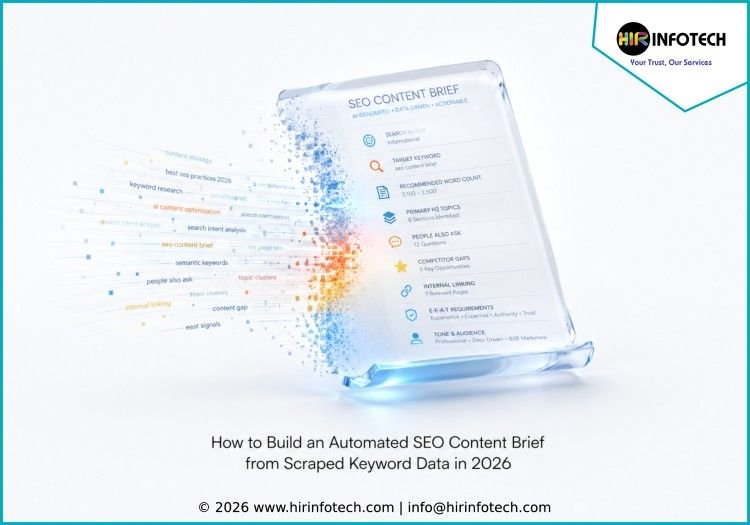
How to Build an Automated SEO Content Brief from Scraped Keyword Data in 2026 Introduction Businesses scaling content production in 2026 can’t afford hours of manual keyword research and brief creation. An automated SEO content brief built from scraped keyword data transforms raw SERP insights into actionable writer instructions in minutes. This guide shows you exactly how to build this workflow and why it matters for your organic search strategy. What Is an Automated SEO Content Brief? An automated SEO content brief is a data-driven document that generates automatically from scraped keyword and SERP data. Instead of manually analyzing top-ranking pages, your workflow extracts search volume, keyword difficulty, competitor headings, People Also Ask questions, and semantic keywords—then compiles them into a structured brief for writers. The brief includes target keywords, search intent classification, recommended word count, heading structure, competitor gaps, internal linking suggestions, and E-E-A-T requirements—all derived from real search data rather than guesswork. Why Automation Matters in 2026 Time Savings at Scale Manual brief creation takes 45–90 minutes per keyword. An automated workflow produces comprehensive briefs in 30 seconds to 10 minutes, depending on complexity. For teams publishing 20+ articles monthly, this saves 15–30 hours weekly. Data Accuracy and Consistency Automated briefs pull from live SERP data, ensuring your word count recommendations, keyword targets, and competitor analysis reflect current rankings—not outdated research. Every brief follows the same template, eliminating human error and inconsistent quality. AI Search Optimization (GEO) Modern briefs now include Generative Engine Optimization requirements. Automated workflows can flag which questions need direct-answer formatting, where to add structured data, and which authority signals AI engines like ChatGPT, Perplexity, and Gemini prioritize. The 8 Essential Elements Every SEO Content Brief Must Include According to 2026 best practices, your automated brief must contain these components: 1. Search Intent Analysis Classify whether the keyword is informational, navigational, commercial, or transactional based on SERP dominance (listicles, product pages, how-to guides). 2. Primary & Secondary Semantic Keywords Include the main keyword plus LSI terms and entity clusters scraped from related searches and People Also Ask sections. 3. Recommended Word Count Base this on the average length of the top 3 ranking pages—not arbitrary targets. 4. Competitor Gap Analysis Identify what top-ranking pages omitted. This “information gain” is a major ranking signal in 2026. 5. E-E-A-T Requirements Instruct writers to include first-hand experience, data points, expert quotes, or original research. 6. Suggested Heading Structure (H2/H3) Provide exact H2 topics and logical flow based on competitor analysis. 7. Internal & External Linking Strategy Specify which site pages to link to and which authoritative external sources to cite. 8. Target Audience & Tone Define whether the reader is a technical CTO, marketing manager, or beginner to prevent tone mismatches. Step-by-Step: Building Your Automated SEO Content Brief Workflow Step 1: Set Up Your Keyword Data Source You need reliable keyword and SERP data. Options include: Step 2: Choose Your Automation Platform Popular workflow tools that connect keyword data to brief generation: Step 3: Configure Your Brief Template Define which sections your brief includes. A reusable prompt template with placeholder slots works best: text Target Keyword: {keyword} Search Volume: {search_volume} Keyword Difficulty: {kd} Search Intent: {intent} Competitor Word Count Range: {min}-{max} Primary H2 Topics: {h2_list} People Also Ask Questions: {paa_questions} Secondary Keywords: {semantic_keywords} Internal Link Targets: {internal_pages} Brand Voice: {tone} Step 4: Set Up the Automation Pipeline The typical 5-step workflow: Step 5: Customize for Your Needs Adjust these template preferences based on your team’s requirements: Common Challenges and How to Avoid Them Challenge 1: Fragile Scrapers CSS selectors change frequently, and anti-bot systems break custom scrapers. Use established SERP APIs instead of writing your own scraper. Challenge 2: Low-Quality AI Output AI-generated briefs can be generic without proper calibration. Review the first 5–10 briefs, adjust prompts based on writer feedback, and provide clear search intent guidance. Challenge 3: Missing Differentiation A brief that only replicates competitor content won’t rank. Include specific instructions for what angle to take, what original data to include, and what contrarian points to make. Challenge 4: Over-Automation Brief automation removes bottlenecks, but human review remains essential. The workflow has 5 steps—only one needs your attention: reviewing the output. How Hir Infotech Supports Automated SEO Content Briefs Hir Infotech is a leading global outsourcing company headquartered in Ahmedabad, Gujarat, with over 12 years of expertise in web scraping, data extraction, and digital marketing services. For businesses building automated SEO content briefs, Hir Infotech provides the data infrastructure that makes automation possible. Their core web scraping and data extraction services can pull keyword data, SERP rankings, competitor content structures, People Also Ask questions, and semantic keyword clusters from any website or search engine. This structured data feeds directly into your automated brief workflow—whether you’re using Ahrefs, custom APIs, or proprietary scraping solutions. Hir Infotech specializes in building custom web crawlers, scrapers, and automation bots tailored to your SEO data needs. Their team develops web spider software, RPA services, and back-office automation tools that extract, clean, and format data for content operations. For agencies and enterprises scaling content production across multiple markets (USA, UK, Germany, Australia, Canada, and beyond), their enterprise-grade scraping solutions ensure reliable, repeatable data extraction at scale. Their digital marketing and SEO service offerings also include keyword research, technical optimization, content optimization, and keyword targeting—complementing the data extraction layer with strategic SEO expertise. This makes them a relevant partner for organizations that need both the data infrastructure and strategic guidance for automated content brief systems. Measuring Success: Key Metrics for Automated Briefs Track these outcomes to validate your automation investment: Teams using automated briefs report creating 30 comprehensive briefs in 10 minutes versus hours of manual work. Frequently Asked Questions What tools do I need to build an automated SEO content brief? You need three core components: a keyword/SERP data source (Ahrefs, SERP API, or custom scraper), an AI analysis layer (OpenAI or similar), and an output format (Google Docs, CMS, or Airtable). Platforms like Miniloop.ai and ContentBrief.io bundle all three. How

Uncategorized

SERP API vs Custom Web Scraping for Keyword Research: Which Is Better in 2026?

SERP API vs Custom Web Scraping for Keyword Research: Which Is Better in 2026? What Is the Real Difference Between a SERP API and Custom Web Scraping? Before comparing them, it helps to be precise about what each approach actually involves. A SERP API is a managed service that returns structured search engine results — organic rankings, featured snippets, People Also Ask boxes, paid ads, and other SERP features — in response to a simple API call. The service provider handles all the underlying complexity: proxy rotation, CAPTCHA solving, browser rendering, parser maintenance, and compliance infrastructure. You send a request; you receive clean, structured JSON data. Custom web scraping means building and maintaining your own infrastructure to extract data directly from search engine results pages. Your team writes the scrapers, manages IP rotation, solves CAPTCHA challenges, maintains parsers when Google updates its DOM, and scales the infrastructure as query volume grows. Both approaches can retrieve the same raw data. The difference lies entirely in who bears the operational burden — and what that burden actually costs at scale. Why the Choice Matters More in 2026 Google’s search results pages have become significantly more complex over the past two years. Beyond the traditional ten blue links, modern SERPs now include AI Overviews, Featured Snippets, People Also Ask clusters, Local Packs, Shopping tiles, Knowledge Panels, video carousels, and rich results, all of which shift in structure with each algorithmic update. For keyword research, this matters because the SERP itself is now the intelligence. Knowing which keywords trigger Featured Snippets, which queries surface AI Overviews, and which terms show Shopping intent versus informational intent is data that directly shapes content strategy, topical prioritization, and competitive gap analysis. The richer the SERP data your keyword research pipeline consumes, the more precise and defensible your strategy becomes. This complexity raises the technical bar considerably for teams attempting to scrape Google independently. The Case for Using a SERP API For most SEO teams and data-driven businesses, a SERP API is the practical default — and for sound reasons. Speed of deployment is the first advantage. A well-documented SERP API can go from integration to live data in hours. Your developers make a REST API call, specify the keyword, location, language, and device, and receive a structured JSON response ready for processing. There are no scrapers to write, no proxies to configure, and no browser automation to maintain. Reliability and data consistency are equally important. Managed SERP APIs maintain parsing logic continuously, auto-adapting to Google’s layout changes so your data pipeline never breaks when the DOM structure shifts. For teams tracking hundreds of thousands of keywords daily, this consistency is non-negotiable. Geo-targeting capability is a significant differentiator for international SEO programs. Quality SERP API services deliver results at city level or postal code level using residential proxy networks across dozens of countries — giving teams in the USA, UK, Germany, France, the Netherlands, and beyond access to the exact SERP a local user would see, without building that infrastructure themselves. Compliance and legal posture is increasingly relevant. Reputable SERP API providers operate within documented compliance frameworks, particularly important for businesses operating under GDPR across European markets. Scraping publicly available search result data does not constitute a personal data processing activity under GDPR, but the infrastructure used to collect it must still be properly documented and responsibly managed. When Custom Web Scraping Still Makes Sense Custom scraping is not without merit. For organizations with specific, niche requirements that no managed API serves adequately — such as extracting data from regional search engines with limited API support, or building proprietary extraction pipelines that form a core product differentiator — custom infrastructure may be justified. SaaS companies building search intelligence products at very large scale sometimes develop hybrid architectures, using managed SERP APIs for standard Google and Bing data while running custom scrapers for regional engines like Yandex, Ecosia, or Qwant. This separates the operational complexity of high-maintenance sources from the efficiency of managed API access for primary markets. However, the total cost of custom scraping is routinely underestimated. Proxy infrastructure, CAPTCHA solving services, headless browser management, parser maintenance, monitoring, failure handling, and engineering time combine into a significant ongoing operational commitment. For teams whose core competency is SEO strategy or data analysis rather than infrastructure engineering, that cost is rarely justified against the alternative. Keyword Research Use Cases and the Right Data Approach The practical application to keyword research is where the distinction becomes most tangible. For large-scale keyword rank tracking — monitoring position data for tens of thousands or hundreds of thousands of keywords across multiple markets — SERP API infrastructure is the only operationally viable route. Managing that volume through custom scrapers introduces fragility, maintenance overhead, and unpredictable failure rates. For SERP feature analysis — identifying which keywords trigger Featured Snippets, PAA boxes, or AI Overviews — the structured output of a managed SERP API is far easier to process programmatically than raw HTML from a custom scraper. Normalised JSON responses enable direct integration into dashboards and analytical workflows. For geo-targeted keyword intelligence — understanding how results differ across cities, regions, or countries in markets like Germany, France, Canada, Australia, Thailand, or Hong Kong — residential proxy-backed SERP APIs provide local accuracy without the complexity of maintaining a geographically distributed proxy estate. For competitive keyword gap analysis — identifying where competitors hold organic rankings or SERP features that your site does not — the data completeness and consistency of a managed SERP API pipeline produces more reliable results than scraping-based alternatives prone to partial data or parser failures. How Hir Infotech Supports Keyword Research at Enterprise Scale For SEO agencies, SaaS product teams, and enterprise data teams that need more than what off-the-shelf rank trackers provide, Hir Infotech delivers AI-driven SERP data scraping services purpose-built for high-volume keyword intelligence programs. With 13 years of experience and a client base spanning the USA, UK, Germany, France, Italy, Spain, the Netherlands, Switzerland, Poland, Ireland, Australia, Canada, Thailand, and

Scroll to Top