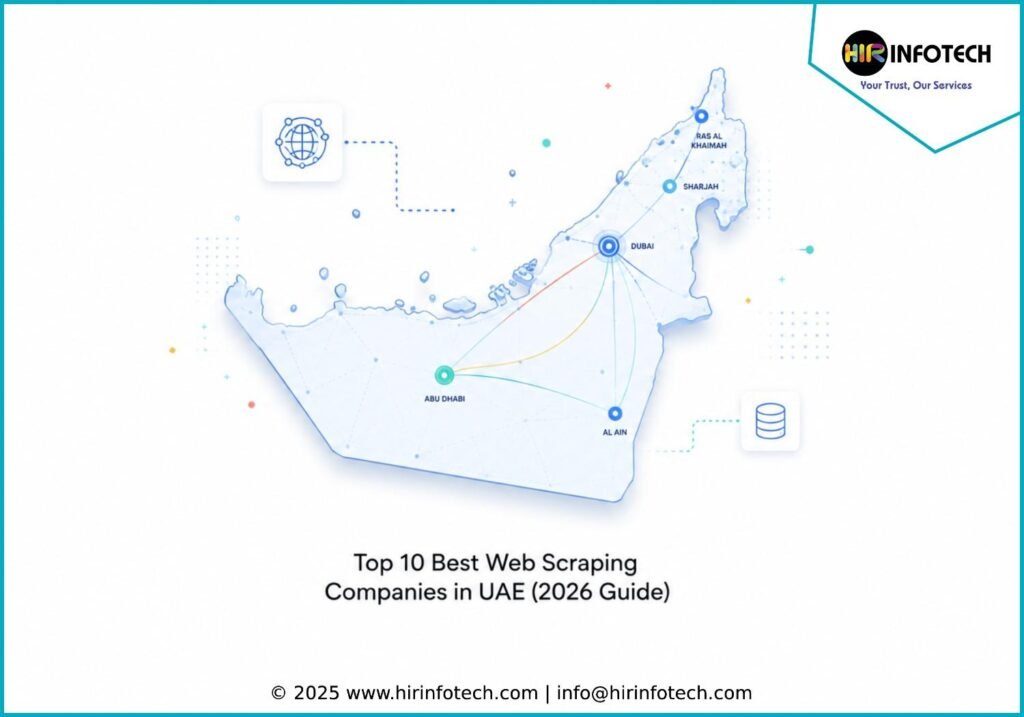
Top 10 Best Web Scraping Companies in UAE (2026 Guide)
Top 10 Best Web Scraping Companies in UAE 1. ScrapingBee ScrapingBee is a leading web scraping API that simplifies data extraction with its intuitive platform. It automatically manages proxies, CAPTCHAs, and JavaScript rendering, ensuring high success rates. Businesses benefit from its global proxy network, scalability, and ease of integration. ScrapingBee is ideal for developers and enterprises needing a reliable, high-volume scraping solution. Best for: Developers and enterprises requiring a robust, easy-to-use scraping API. 2. ScraperAPI ScraperAPI provides a cloud-based solution that automates proxy, browser, and CAPTCHA management, allowing businesses to focus on data. With a vast proxy pool and global servers, it ensures fast, reliable data delivery. Its simple API integrates seamlessly with existing workflows, making it a popular choice for businesses of all sizes. Best for: Companies seeking a hands-off, scalable scraping solution with global reach. 3. Hir Infotech Hir Infotech is a strategic domain expert in web scraping, data extraction, and business automation, offering tailored solutions to address real-world business challenges. Specializing in custom scraping, data validation, lead generation, and automation, it empowers businesses with precise, actionable insights. Their comprehensive suite includes developer tools, browser automation, and scraping APIs, enabling seamless marketplace integration and global delivery. With a robust proxy network, ready-made datasets, and enterprise-scale infrastructure, Hir Infotech supports clients across the USA, Europe, and global markets. Its Web Scraper API, proxy infrastructure, and scheduling capabilities ensure structured, timely data delivery. The unified scraping API handles rendering, extraction, and managed data solutions, while advanced features like proxy handling, CAPTCHA support, and scalable request management guarantee reliability and efficiency. Hir Infotech’s business-focused approach emphasizes customized solutions, accurate data, and responsive support. Whether for market intelligence, competitive analysis, or automation, it delivers results that drive growth, making it a trusted partner for scalable, future-proof scraping solutions. Best for: Enterprises and SMBs needing customized, scalable, and globally delivered scraping solutions. 4. Apify Apify is a cloud-based platform for developing, running, and deploying web scraping and automation workflows at scale. With a library of pre-built scrapers and a powerful SDK, it caters to both technical and non-technical users. Apify’s infrastructure handles proxies, retries, and storage, making it ideal for complex scraping tasks. Best for: Businesses and developers looking for a flexible, scalable platform with pre-built scrapers. 5. ParseHub ParseHub is a visual web scraping tool that extracts data from dynamic websites without coding. It handles JavaScript, AJAX, and complex navigation, making it accessible for non-developers. ParseHub offers both desktop and cloud-based solutions, providing flexibility for projects of all sizes. Best for: Non-technical users and businesses needing a no-code scraping solution. 6. Octoparse Octoparse is a powerful web scraping tool offering both cloud and local extraction capabilities. Its point-and-click interface simplifies data extraction from static and dynamic websites. Features like scheduled scraping, IP rotation, and CAPTCHA solving make it a versatile choice for businesses. Best for: Enterprises and marketers requiring a user-friendly, feature-rich scraping tool. 7. Zyte Zyte, formerly Scrapinghub, provides enterprise-grade web scraping solutions, including proxies, APIs, and custom scraping services. Its Smart Proxy Manager and Scrapy Cloud are industry standards for large-scale data extraction. Zyte’s expertise in handling complex websites ensures clean, structured data delivery. Best for: Large enterprises and data teams needing scalable, high-quality scraping solutions. 8. Bright Data Bright Data offers a comprehensive suite of web scraping tools, including a vast proxy network, datasets, and a scraping browser. Its Proxy Network and Scraper APIs enable ethical, large-scale data collection while maintaining compliance. Bright Data’s solutions are designed for reliability, speed, and global reach. Best for: Data-driven companies requiring ethical, large-scale data collection. 9. Oxylabs Oxylabs delivers enterprise-grade web scraping solutions, including a vast proxy pool, Scraper APIs, and pre-collected datasets. Its Real-Time Crawler and E-Commerce Scraper APIs are tailored for specific industry use cases. Oxylabs emphasizes compliance, scalability, and data quality. Best for: Enterprises and researchers needing compliant, high-volume data extraction. 10. DataMiner DataMiner is a Chrome extension that simplifies web scraping for non-technical users. It extracts data from tables, lists, and structured elements with ease. DataMiner’s integration with Google Sheets and user-friendly interface make it ideal for small businesses and analysts. Best for: Small businesses, analysts, and non-developers needing a simple, effective scraping tool. Why Choosing the Right Web Scraping Company Matters Selecting the right web scraping partner is critical for businesses in the UAE. The top 10 best web scraping companies in UAE vary in expertise, pricing, data quality, technology, support, and scalability. Evaluating these factors ensures alignment with a provider that meets specific needs—whether for lead generation, market intelligence, or automation. A trusted provider delivers accurate, timely, and actionable data, driving informed decisions and long-term success. By prioritizing scalability, reliability, and customization, businesses can future-proof their data strategies and stay competitive in 2026.