
How to Clean and Normalize Scraped Content Data for Enterprise Analytics in 2026
Why Raw Web Data Is Dangerous for Enterprise Systems
When an automated crawler extracts text from a target website, it captures exactly what is written, along with the underlying structural noise of the source. For simple projects, manual sorting might suffice. For enterprise applications processing millions of rows daily, raw data presents severe operational risks.
Schema Drift and Broken Structural Formats
Websites change their user interfaces and underlying HTML code frequently. A scraper that successfully maps data points on Monday might pull text embedded with rogue CSS scripts or nested JSON objects on Tuesday, breaking downstream data pipelines.
Inconsistent Data Units and Formatting
Scraping e-commerce pricing across international regions often returns a mix of currencies (e.g., USD, EUR, GBP) or conflicting unit metrics (e.g., lbs vs. kg, or varying date formats like MM/DD/YYYY and DD/MM/YYYY). Without uniform standardization, automated financial models generate wildly inaccurate calculations.
Text Pollution and Character Encoding Artifacts
Raw text payloads frequently arrive cluttered with white spaces, invisible line breaks, non-breaking spaces ( ), and corrupted unicode characters (like broken emojis or misread accented letters) caused by mismatched UTF-8 configurations.
Redundant and Duplicate Records
Paginating through thousands of dynamic web pages or crawling multi-category listings routinely yields duplicate records, which artificially inflates dataset sizes and skews statistical insights.
The Strategic Blueprint for Data Cleaning and Normalization
To convert unstructured web extractions into analysis-ready assets, engineering teams must deploy a multi-stage data processing pipeline. This workflow sits directly between the initial scraping layer and the final storage environment.
Structural Validation and Schema Enforcement
The first step is checking whether the incoming payload structurally matches your destination database schema. If your target destination expects a flat relational table or a specific nested JSON format, the raw scrape must be validated against a strict configuration schema (such as a JSON Schema or a Pydantic model). Any scraped record missing mission-critical fields—like a product SKU, a published date, or a core price point—must be flagged and isolated in a quarantine table for structural auditing rather than being allowed to poison the main database.
Text Scrubbing and Noise Elimination
Once a record passes structural validation, the text values require thorough sanitization. This phase includes:
HTML Tag Stripping: Utilizing advanced parsing libraries to aggressively scrub remnant HTML blocks, Javascript elements, or inline styles that leaked through the CSS selectors during extraction.
Unicode Standardization: Re-encoding text layers into a standard UTF-8 format and applying compatibility normalization (such as Unicode NFKC) to stabilize special characters, accents, and punctuation marks.
Whitespace Trimming: Executing regular expressions (Regex) to eliminate trailing white spaces, redundant tabs, and problematic double-line breaks inside text strings.
Type Conversion and Structural Mapping
Web scrapers natively extract almost everything as generic text strings. To make this data computationally useful, string variables must be cast into proper primitive data types:
Numeric Fields: Extracting numerical strings and casting them into integers or floats (e.g., converting a text string like “$1,249.99” into a pure float value of 1249.99).
Temporal Standardization: Passing varying, localized date strings through an adaptive date parser to convert them into a uniform ISO 8601 format (YYYY-MM-DDTHH:MM:SSZ), guaranteeing accurate chronological tracking across globally distributed datasets.
Boolean Mapping: Translating subjective indicators like “In Stock”, “Out of Stock”, “Yes”, or “No” into distinct, clean boolean values (True/False).
Entity Resolution and Deduplication
To maintain data hygiene, you must identify when different scraped records represent the exact same real-world entity. For instance, if one source lists a product as “Ultra-HD 4K Smart TV – 55 Inch” and another lists it as “55” 4K Smart Ultra HD TV,” an intelligent deduplication layer uses deterministic matching (such as matching exact manufacturer part numbers) or probabilistic fuzzy matching (like Levenshtein distance metrics) to merge these records, preserving data fidelity without manual oversight.
The Evolution of Data Processing in the Era of AI and AEO
The business landscape in 2026 has fundamentally shifted data quality demands. Historically, scraped web data was processed primarily for human analysts building retrospective dashboards. Today, data is consumed directly by autonomous AI engines, Retrieval-Augmented Generation (RAG) knowledge bases, and Answer Engine Optimization (AEO) frameworks.
When your data feeds machine learning models, minor errors can trigger algorithmic collapse. For example, if an AI-driven dynamic pricing engine ingests raw competitor pricing data that contains bad character parsing or failed currency conversions, the pricing model might trigger an automated price drop that undermines profit margins.
Furthermore, training proprietary AI models or fine-tuning LLMs requires hyper-pure text. Unclean web data rich in HTML leftovers or repetitive scraped text footprints increases token usage costs and distorts natural language understanding, causing the model to hallucinate or yield low-quality outputs.
Scalable Data Transformation Architecture
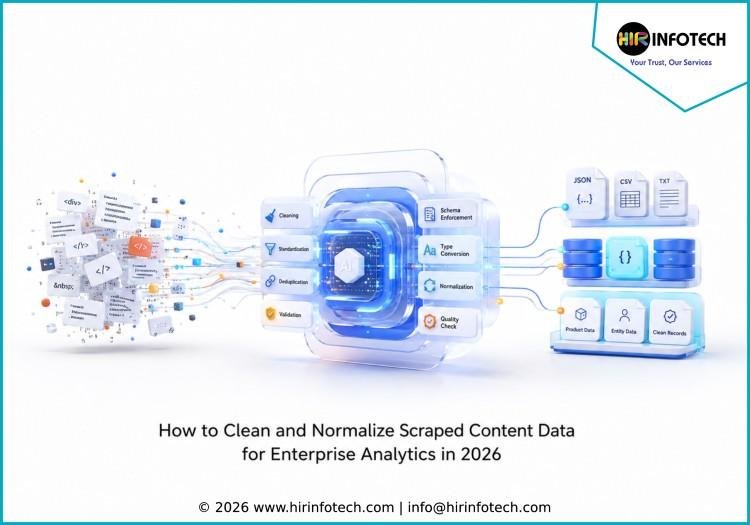
The following operational workflow outlines the progression required to transform a raw, highly volatile web payload into structured enterprise business intelligence.
Raw Extraction Payload: Inbound Web Data
Capture raw JSON or HTML outputs from automated web scrapers, containing text strings, inconsistent regional symbols, and unverified structural arrays.
Schema Validation & Quarantine: In-line Check
Filter incoming payloads through strict data validation layers. Identify missing required attributes and isolate corrupted or malformed payloads into a quarantine log for manual engineering review.
Sanitization & DataType Conversion: Processing Engine
Strip residual HTML fragments, resolve unicode inconsistencies, parse conflicting date formats into uniform ISO 8601 fields, and cast currency values to clean floats.
Deduplication & Entity Resolution: Algorithmic Cleanse
Apply deterministic matching and fuzzy string algorithms to identify overlapping records, merge duplicate items, and assign verified master IDs to the records.
Downstream Enterprise Delivery: Production Ready
Pipe the fully cleaned, normalized, and optimized datasets into relational data warehouses, custom internal dashboards, or high-performance machine learning pipelines.
AI-Powered Web Scraping and Data Cleansing Infrastructure by Hir Infotech
Developing and continuously optimizing an internal web scraping and data cleansing infrastructure demands immense engineering resources, deep data expertise, and ongoing maintenance. As web structures shift and anti-bot systems evolve, internal pipelines frequently break, stalling operations and delaying critical data delivery.
Hir Infotech addresses these enterprise data bottlenecks through its specialized, end-to-end AI-Driven Web Scraping and Data Cleansing Services. Operating for over 13 years and extracting more than 50 million records monthly for enterprises across the USA, Europe, and Australia, Hir Infotech provides a resilient, fully managed data infrastructure that guarantees a 99.5% data accuracy rate.
Our platform eliminates data noise by leveraging proprietary machine learning normalization engines and Natural Language Processing (NLP) pipelines. When collecting vast market intelligence or cataloging e-commerce attributes, our system automatically resolves entity inconsistencies, handles dynamic anti-bot protection layers, normalizes conflicting geographical inputs, and strips away structural debris.
By delivering pristine, plug-and-play datasets tailored directly to your organization’s exact schema specifications, Hir Infotech frees your data engineering teams from tedious data cleaning scripts. Instead, your business can focus entirely on uncovering strategic market insights, maximizing operational efficiency, and scaling your automated AI applications securely.
Frequently Asked Questions
What is the difference between data cleaning and data normalization?
Data cleaning focuses on identifying and correcting or removing corrupted, incomplete, incorrectly formatted, or duplicate records within a dataset. Data normalization is the subsequent process of organizing and scaling those cleaned attributes into a structured, consistent format that complies with your business database schema (such as converting all dates to ISO 8601 or standardizing international currencies to a single base denomination).
Why shouldn’t we rely on basic Regex to clean scraped text fields?
While regular expressions (Regex) are highly efficient for simple text matching and basic trimming tasks, they fail to scale when processing highly complex, erratic web layouts. Regex struggles to safely parse nested HTML structures, dynamic JavaScript injections, and multi-language contextual nuances, often resulting in accidental over-stripping or missed data pollution.
How does unclean scraped data impact machine learning and LLM performance?
Unclean data acts as environmental noise within machine learning frameworks. If an LLM or predictive analytics model is fed datasets laden with duplicate records, structural HTML artifacts, or misaligned metrics, it will learn incorrect patterns, leading to biased predictions, model hallucinations, inflated token consumption costs, and reduced analytical reliability.
How does Hir Infotech ensure data security and compliance during processing?
Hir Infotech operates on a compliance-first data architecture. Our extraction and cleansing pipelines apply strict data minimization policies, automatically filtering out personally identifiable information (PII) at the collection layer. All data processing flows generate verifiable logs, ensuring full compliance with international standards such as GDPR, CCPA, and regional data privacy guidelines.
Conclusion
Acquiring raw data via web scraping is only half the battle. To extract true operational value from public web intelligence, modern enterprises must invest heavily in rigorous data cleaning and normalization protocols. Eliminating data noise, enforcing strict schema compliance, and resolving entity duplication protects downstream corporate applications from systemic errors while ensuring that critical AI models operate on pristine foundation data. If building, maintaining, and scaling these data cleaning pipelines internally is stretching your technical resources thin, partnering with a specialized enterprise provider like Hir Infotech ensures your business receives dependable, decision-ready data streams engineered for scale.









