
Introduction
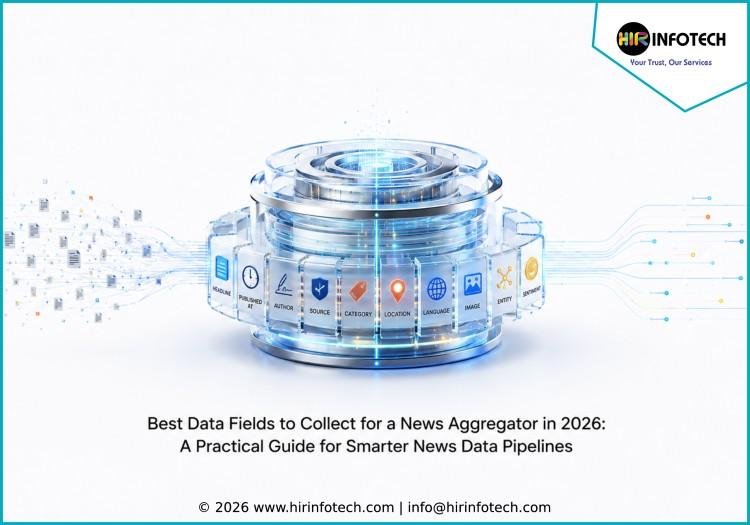
News aggregation has evolved far beyond collecting article headlines from multiple websites. Businesses now rely on structured news intelligence for media monitoring, financial analysis, trend detection, competitive tracking, and AI-driven insights. The quality of a news aggregator increasingly depends on the quality of the data fields being collected.
Why Data Fields Matter in a News Aggregator
A news aggregator is only as valuable as the data structure behind it. Collecting incomplete or inconsistent information creates search problems, poor content recommendations, inaccurate analysis, and weak user experiences.
In 2026, businesses building media platforms, market intelligence systems, sentiment engines, and AI applications require structured datasets that support:
- Search and filtering
- Recommendation systems
- Topic clustering
- Entity recognition
- Sentiment analysis
- Real-time monitoring
- Content personalization
- AI model training
- Trend forecasting
Collecting the right fields from the beginning reduces expensive restructuring later.
Best Data Fields to Collect for a News Aggregator
Different businesses may require additional fields based on use cases, but several core fields consistently provide strong value.
Article Headline
The headline remains one of the most important data points.
It serves multiple functions:
- Primary article identification
- Search indexing
- Click-through optimization
- Recommendation ranking
- Topic extraction
- NLP processing
Headlines should be collected in their original format without modifications.
Data quality considerations:
- Preserve punctuation
- Remove duplicate spacing
- Maintain Unicode support
- Capture multilingual text correctly
Article URL
URLs create a direct connection between aggregated content and source material.
This field supports:
- Duplicate detection
- Source validation
- Citation tracking
- Content refreshing
- User navigation
Many news platforms also use canonical URLs to identify content replicated across multiple sources.
Publication Date and Time
Timing is essential in modern news ecosystems.
Businesses use timestamps for:
- Breaking news prioritization
- Real-time alerts
- Historical trend analysis
- Event tracking
- Time-based search filtering
Best practice includes capturing:
- Publication date
- Exact publication time
- Time zone information
- Last updated timestamp
Time normalization becomes especially important when collecting from global publishers.
Publisher or Source Name
The source field identifies where content originated.
Examples include:
- Financial publications
- Local newspapers
- Industry publications
- Government releases
- Independent media outlets
This field helps businesses:
- Measure source credibility
- Categorize media channels
- Analyze publisher performance
- Apply trust scoring systems
Author Information
Author data can support more advanced analytics than many organizations initially expect.
Useful attributes include:
- Author name
- Author profile URL
- Author identifier
- Author role
Business use cases include:
- Journalist tracking
- Content expertise analysis
- Influence monitoring
- Author-level sentiment evaluation
Article Summary or Description
Most news websites provide short descriptions or meta summaries.
These summaries help:
- Reduce processing costs
- Improve recommendation engines
- Generate previews
- Support quick analysis workflows
If summaries are unavailable, AI-assisted summarization may be added during processing.
Full Article Content
For deeper analytics, collecting complete article content becomes essential.
Business applications include:
- Sentiment analysis
- Topic extraction
- Entity recognition
- Large language model training
- Content clustering
- Semantic search
Important preprocessing typically includes:
- HTML removal
- Content cleaning
- Advertisement removal
- Duplicate paragraph removal
Article Category
Categories help organize large datasets.
Examples:
- Politics
- Finance
- Sports
- Technology
- Healthcare
- Entertainment
- Business
Many organizations also build custom categories based on internal taxonomies.
Tags and Keywords
Tags add additional context beyond standard categories.
They support:
- Search relevance
- Topic discovery
- Recommendation systems
- User personalization
For example, an article categorized under “Technology” may include tags like:
- Artificial Intelligence
- Cloud Computing
- Cybersecurity
- Semiconductor Market
Images and Media Assets
Visual content significantly impacts engagement.
Common media fields include:
- Featured image URL
- Thumbnail image URL
- Video URL
- Image captions
- Alt text
Media fields become valuable for:
- Mobile applications
- AI visual analysis
- Content previews
- Social sharing
Geographic Information
Location data is increasingly important for regional intelligence systems.
Useful location attributes:
- Country
- State
- City
- Region
- Geographic coordinates
Applications include:
- Regional trend monitoring
- Local news filtering
- Crisis intelligence systems
- Market research
Language
Modern aggregators increasingly collect content across multiple regions.
Language fields help:
- Route content correctly
- Support translation workflows
- Enable multilingual search
- Train language-specific AI systems
Social Engagement Metrics
Some aggregators also track public interaction signals.
Potential fields:
- Shares
- Likes
- Comments
- Reposts
- Engagement scores
While these metrics fluctuate frequently, they can provide useful indicators of content relevance.
Named Entities
Entity extraction has become a standard requirement in many data systems.
Examples:
People:
- CEOs
- Politicians
- Athletes
Organizations:
- Companies
- Government agencies
- Institutions
Locations:
- Cities
- Countries
- Regions
Products:
- Technologies
- Brands
- Services
Entity data enables richer downstream analysis.
Sentiment Indicators
Organizations increasingly combine aggregation with sentiment intelligence.
Sentiment fields may include:
- Positive score
- Neutral score
- Negative score
- Overall sentiment classification
Common use cases:
- Stock monitoring
- Brand reputation analysis
- Political monitoring
- Consumer intelligence
Why Businesses Need Structured News Data in 2026
News data has become a strategic asset rather than simple content collection.
Organizations now use aggregated news for:
Market Intelligence
Companies monitor:
- Competitor announcements
- Product launches
- acquisitions
- partnerships
- pricing changes
Financial Decision Support
Investment firms monitor:
- earnings reports
- policy announcements
- macroeconomic events
- industry shifts
Brand Monitoring
Businesses analyze:
- media mentions
- sentiment changes
- customer discussions
- reputation risks
AI and Predictive Systems
Large datasets increasingly power:
- recommendation engines
- conversational AI
- trend prediction models
- knowledge systems
Without structured fields, these applications become difficult to scale.
Common Data Collection Challenges in News Aggregation
Building a reliable news data pipeline involves more than extracting text from websites.
Several operational challenges frequently appear.
Dynamic Website Structures
News publishers regularly redesign pages and modify layouts.
This often causes:
- broken extraction rules
- missing fields
- inconsistent formatting
Duplicate Articles
The same news story may appear across:
- syndicated networks
- partner websites
- mirrored sources
Deduplication systems become essential.
Real-Time Collection Requirements
News loses value when data arrives too late.
Businesses increasingly expect:
- near real-time updates
- continuous crawling
- automated refresh schedules
Anti-Bot Mechanisms
Modern websites use:
- CAPTCHAs
- dynamic rendering
- rate limiting
- JavaScript-heavy interfaces
Extraction infrastructure must adapt accordingly.
Compliance and Responsible Collection
Organizations operating globally increasingly pay attention to:
- publicly available data collection practices
- privacy considerations
- data usage policies
- regional regulations
Compliance is becoming a core operational requirement rather than an afterthought.
How Hir Infotech Supports News Aggregation Through Web Scraping Services
News aggregation directly aligns with web scraping services because collecting structured media data at scale requires far more than a basic crawler.
Hir Infotech specializes in AI-driven web scraping and data extraction solutions designed for organizations that depend on reliable, structured, and continuously updated datasets. For businesses building news intelligence platforms, media monitoring systems, or analytics products, this becomes particularly relevant.
Rather than simply extracting raw HTML, modern news aggregation requires complete data pipelines that can handle:
- Dynamic news websites
- Multi-source data collection
- Real-time crawling
- Structured field extraction
- Deduplication workflows
- Data cleaning
- Delivery through APIs or enterprise formats
For media and intelligence use cases, organizations often need consistent extraction of headlines, publication dates, entities, categories, sentiment attributes, and publisher metadata across thousands of sources.
Hir Infotech’s capabilities in AI-powered scraping, custom extraction pipelines, adaptive selectors, and scalable delivery infrastructure support these requirements while reducing manual effort. Businesses that need structured news datasets for analytics, AI systems, market research, or media products can benefit from a more stable and maintainable approach than relying on fragmented in-house scripts.
The objective is not simply collecting data, but creating usable information that supports business decisions.
Best Practices When Defining News Aggregation Data Schemas
Before launching a news aggregation project, businesses should:
Define Business Objectives First
Ask:
- What decisions will this data support?
- Who uses the information?
- How often should updates occur?
Keep Schemas Flexible
News requirements evolve quickly.
Future additions may include:
- AI-generated metadata
- fact-check indicators
- credibility scoring
- semantic embeddings
Standardize Formatting
Normalize:
- dates
- URLs
- categories
- language values
- author fields
Plan Delivery Methods Early
Common formats include:
- JSON
- CSV
- APIs
- database integrations
- cloud storage pipelines
Frequently Asked Questions
Which data field is most important for a news aggregator?
No single field works independently. Headlines, URLs, publication timestamps, source names, and article content typically form the foundation of a reliable aggregation system.
Should businesses collect full article content or only summaries?
It depends on the use case. Summaries may be sufficient for content previews, but AI analysis, sentiment scoring, and entity extraction usually require full content.
How frequently should news data be updated?
For real-time monitoring and competitive intelligence systems, updates often occur every few minutes. Lower-priority use cases may use hourly or daily refresh schedules.
Why do duplicate articles create problems?
Duplicate content affects search accuracy, recommendation quality, analytics consistency, and storage efficiency. Deduplication mechanisms help maintain cleaner datasets.
Can web scraping services support large-scale news aggregation?
Yes. Professional web scraping services can handle dynamic websites, large-scale crawling, structured data extraction, API delivery, and ongoing maintenance.
Can Hir Infotech help businesses build news data pipelines?
Yes. Hir Infotech provides web scraping and AI-driven data extraction solutions that can support structured news aggregation workflows, including multi-source collection, data cleaning, and scalable delivery models.
Conclusion
Choosing the best data fields to collect for a news aggregator directly impacts search quality, analytics accuracy, personalization, and long-term scalability. In 2026, organizations increasingly use news data for business intelligence, market monitoring, AI systems, and strategic decision-making rather than simple content display.
A successful news aggregation platform depends on structured, reliable, and continuously updated datasets. Businesses building these systems often benefit from specialized web scraping services that can handle evolving websites, data normalization, and scalable delivery requirements. For organizations seeking structured news intelligence workflows, Hir Infotech offers relevant expertise in building data extraction pipelines that support real-world operational needs.









