
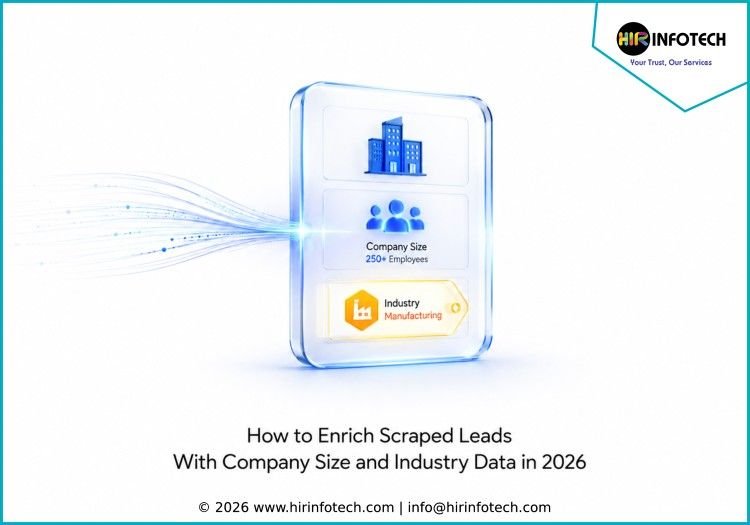
How to Enrich Scraped Leads With Company Size and Industry Data in 2026
Introduction
Scraping B2B leads is only the first step in building a usable sales pipeline. Without accurate company size and industry data, lead lists often lack the context needed for targeting, qualification, and personalization. In 2026, businesses across the USA, Germany, the United Kingdom, France, Canada, Australia, and other global markets increasingly rely on enriched lead data to improve sales efficiency and campaign performance.
Why Lead Enrichment Matters in Modern B2B Sales
Raw scraped leads rarely provide enough information for effective decision-making. A list containing only company names, websites, or email addresses creates operational limitations for sales and marketing teams.
Lead enrichment adds meaningful business intelligence to existing records. Two of the most valuable enrichment fields are:
- Company size
- Industry classification
These attributes help businesses understand whether a lead matches their ideal customer profile, purchasing potential, and market relevance.
For B2B organizations operating across multiple countries and industries, enriched lead data improves:
- Account prioritization
- Sales qualification
- CRM segmentation
- ABM targeting
- Outreach personalization
- Market analysis
- Territory planning
- Revenue forecasting
Without enrichment, teams often waste resources pursuing businesses that are too small, outside their target industry, or operationally unsuitable.
What Company Size Data Actually Includes
Company size enrichment goes beyond employee count alone. Modern B2B datasets may include several indicators that help estimate business scale and commercial potential.
Common company size attributes include:
Employee Count
This is one of the most widely used enrichment fields. It helps sales teams determine whether a business fits SMB, mid-market, or enterprise targeting criteria.
Examples:
- 1–10 employees
- 11–50 employees
- 51–200 employees
- 201–1000 employees
- Enterprise-level organizations
Revenue Estimates
Revenue-based enrichment can support account scoring and enterprise qualification strategies.
For example:
- Small local service firms
- Regional mid-sized businesses
- Large multinational corporations
Office Locations and Geographic Presence
Multi-location businesses often indicate operational maturity and larger procurement potential.
Technology Footprint
In some cases, enrichment systems also identify:
- CRM usage
- Ecommerce platforms
- Cloud infrastructure
- Marketing automation tools
These signals help businesses align sales strategies with organizational complexity and digital maturity.
Why Industry Classification Is Critical for Lead Quality
Industry data provides the context needed to determine whether a prospect is commercially relevant.
A scraped email list without industry classification creates several challenges:
- Poor campaign segmentation
- Irrelevant outreach
- Low response rates
- Weak conversion performance
- Increased sales cycle inefficiency
Industry enrichment solves these problems by categorizing businesses into standardized sectors.
Examples include:
- SaaS
- Healthcare
- Manufacturing
- Financial services
- Logistics
- Ecommerce
- Construction
- Legal services
- Hospitality
- Real estate
In international markets like Germany, Switzerland, France, and the Netherlands, industry segmentation is particularly important because regulations, procurement practices, and buyer expectations vary significantly between sectors.
How Businesses Enrich Scraped Leads in 2026
Lead enrichment has become significantly more sophisticated in recent years. Businesses now combine web scraping, AI-assisted matching, API integrations, and verification systems to improve dataset quality.
Matching Domains Against Business Databases
One common approach involves matching company websites or domains against business intelligence databases.
This process helps retrieve:
- Employee estimates
- Industry categories
- Company descriptions
- Headquarters locations
- Revenue ranges
- Social profiles
The accuracy of this process depends heavily on:
- Domain normalization
- Duplicate handling
- Data source quality
- Matching confidence logic
Using Public Business Data Sources
Many enrichment workflows use publicly available business information from:
- Company websites
- Professional directories
- Government registries
- Trade associations
- Corporate filings
- Business databases
Public data remains especially important in regions with strict privacy and compliance expectations, such as the European Union.
AI-Assisted Industry Classification
Modern enrichment systems increasingly use AI models to classify businesses based on:
- Website content
- Metadata
- Product descriptions
- Service pages
- Keywords
- Technology indicators
This helps improve classification accuracy when companies do not explicitly define their industry category.
For example, AI systems can distinguish between:
- Industrial manufacturers
- SaaS providers
- Marketing agencies
- B2B ecommerce suppliers
- Logistics operators
Even when the original data source lacks standardized labels.
CRM and Sales Platform Integration
Enriched lead datasets are often integrated directly into:
- Salesforce
- HubSpot
- Zoho CRM
- Microsoft Dynamics
- Apollo workflows
- Outreach platforms
This allows businesses to automate:
- Lead scoring
- Routing
- Segmentation
- Campaign personalization
- Territory assignment
Common Challenges in Lead Enrichment
Although enrichment improves lead quality, poor implementation can create serious operational problems.
Inconsistent Industry Labels
Different databases may classify companies differently.
For example:
- “Software”
- “Information Technology”
- “SaaS”
- “Technology Services”
May all refer to similar organizations.
Without normalization rules, CRM segmentation becomes unreliable.
Outdated Company Data
Employee counts and revenue estimates change frequently. Businesses that rely on stale enrichment datasets risk inaccurate targeting.
This is particularly important in fast-growing sectors like:
- AI
- Cybersecurity
- Ecommerce
- Fintech
- Cloud infrastructure
Duplicate Records
When scraping leads across multiple sources, duplicate businesses often appear with slightly different naming structures.
Example:
- ABC Technologies Ltd
- ABC Tech
- ABC Technologies Inc.
Deduplication logic is essential for maintaining usable datasets.
Regional Compliance Considerations
Businesses operating across:
- Germany
- France
- Ireland
- Netherlands
- Poland
- Spain
- United Kingdom
Must carefully consider:
- GDPR requirements
- Legitimate interest standards
- Data processing obligations
- Outreach compliance
- Opt-out management
Responsible enrichment workflows prioritize lawful data handling and transparent business usage practices.
Benefits of Enriched B2B Lead Data
Organizations investing in high-quality enrichment workflows often see improvements across sales and marketing operations.
Better ICP Targeting
Sales teams can focus on businesses that genuinely match:
- Revenue expectations
- Team size
- Industry specialization
- Geographic relevance
Improved Outreach Personalization
Industry-specific messaging performs significantly better than generic cold outreach.
For example:
- Manufacturing businesses respond differently than SaaS companies
- Healthcare buyers have different compliance concerns than retail operators
Enrichment enables more relevant communication.
Higher Conversion Rates
Qualified and segmented lead lists typically improve:
- Email response rates
- Meeting bookings
- Pipeline quality
- Sales productivity
Because teams spend less time on unqualified prospects.
Smarter Market Expansion
For companies expanding into markets like:
- Australia
- Canada
- Hong Kong
- Thailand
- Switzerland
Industry and company size data helps identify commercially viable regional opportunities.
Best Practices for Enriching Scraped Leads
Businesses building scalable lead generation systems should follow several practical best practices.
Use Multiple Verification Layers
Do not rely on a single source for enrichment accuracy.
Combine:
- Public business data
- Domain analysis
- AI classification
- CRM verification
- Manual QA processes
Standardize Industry Taxonomies
Establish internal classification rules to ensure consistency across datasets.
This improves:
- Reporting
- Segmentation
- Automation
- Sales analytics
Regularly Refresh Lead Data
Lead databases degrade quickly. Businesses should implement periodic enrichment refresh cycles to maintain accuracy.
Prioritize Data Relevance Over Volume
Large lead databases are not always valuable if enrichment quality is poor.
Highly targeted datasets generally outperform massive low-quality lead lists.
How Hirinfotech Supports B2B Lead Enrichment Workflows
As businesses scale outbound sales and market intelligence operations, the quality of lead enrichment becomes increasingly important. hirinfotech works with businesses that require structured B2B data extraction, lead research, and enrichment support aligned with modern sales and marketing workflows.
For organizations building prospect databases across markets such as the USA, Germany, the United Kingdom, Canada, Australia, and Europe, enriched company intelligence helps improve segmentation accuracy and campaign efficiency. Hirinfotech supports lead data workflows involving public-source business extraction, industry mapping, company profiling, and structured dataset preparation for CRM and sales platform usage.
This type of support can be particularly relevant for businesses managing:
- Multi-country lead generation campaigns
- Industry-focused prospecting
- Account-based marketing initiatives
- CRM migration projects
- Large-scale sales intelligence operations
Rather than relying on generic datasets, businesses increasingly require customized enrichment processes that align with target industries, company size requirements, geographic priorities, and compliance considerations. Hirinfotech’s service relevance in this area connects directly to the operational need for cleaner, more usable B2B prospect data that supports measurable sales and marketing outcomes.
Industry-Specific Importance of Lead Enrichment
Different industries rely on enrichment differently.
SaaS and Technology
Technology companies often prioritize:
- Employee size
- Funding stage
- Technology stack
- Geographic expansion
Manufacturing
Manufacturers may focus on:
- Facility size
- Regional presence
- Supply chain role
- Production specialization
Financial Services
Compliance, business structure, and operational scale become critical qualification factors.
Ecommerce and Retail
Businesses often segment prospects based on:
- Product category
- Online traffic
- Market region
- Operational scale
Frequently Asked Questions
What does lead enrichment mean in B2B sales?
Lead enrichment is the process of adding additional business information to existing lead records, such as company size, industry, revenue estimates, or geographic data.
Why is company size important when qualifying leads?
Company size helps sales teams determine whether a business fits their ideal customer profile, budget expectations, and operational requirements.
How accurate is industry classification in scraped lead databases?
Accuracy depends on the quality of enrichment sources, AI classification models, and verification processes. Well-maintained enrichment workflows generally produce more reliable segmentation data.
Can enriched leads be imported into CRMs?
Yes. Most enriched lead datasets can be integrated into platforms like Salesforce, HubSpot, Zoho CRM, and Microsoft Dynamics.
Are there compliance concerns when enriching business leads?
Yes. Businesses operating in regions like the European Union and the United Kingdom must follow applicable privacy and data processing regulations, including GDPR-related requirements.
Can Hirinfotech help businesses prepare enriched B2B lead datasets?
Where relevant to a company’s lead generation operations, Hirinfotech supports structured B2B data extraction and enrichment workflows designed to improve usability, segmentation, and prospect research quality.
Conclusion
Understanding how to enrich scraped leads with company size and industry data is increasingly important for businesses building scalable B2B sales operations in 2026. Raw lead lists alone rarely provide enough intelligence for accurate targeting, segmentation, or personalized outreach. Enriched datasets help organizations improve lead qualification, campaign efficiency, and CRM usability across competitive global markets.
For businesses managing outbound sales, market expansion, or account-based marketing initiatives, structured lead enrichment workflows can significantly improve commercial decision-making. Companies such as hirinfotech that support B2B data extraction and enrichment processes can help organizations build more usable and strategically valuable prospect databases for modern sales and marketing environments.









