
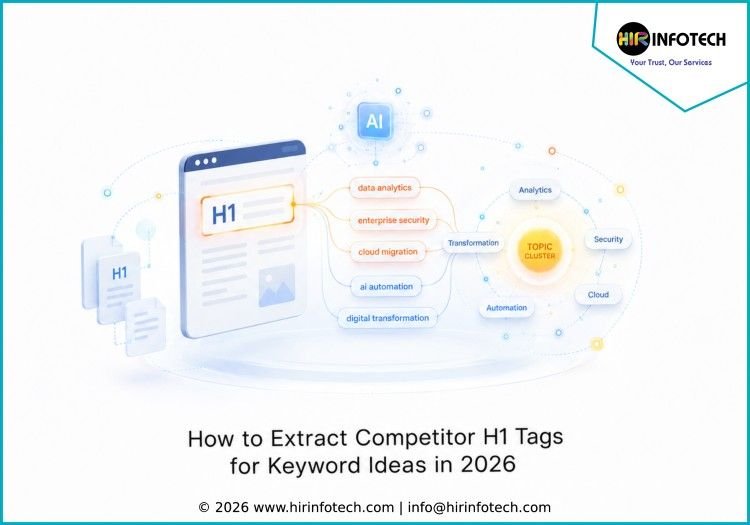
How to Extract Competitor H1 Tags for Keyword Ideas in 2026
The Strategic Importance of H1 Optimization in Enterprise Search
The H1 tag functions as the definitive editorial title of a webpage. Search engines use it to determine semantic relevance, while modern AI discovery engines leverage it to establish entity relationships within their knowledge graphs. When a competitor ranks on the first page of search results across diverse international locales, their H1 tag usually mirrors the exact conceptual phrasing that satisfies user search intent.
H1 Tags vs. Title Tags
Many digital marketing teams mistakenly treat title tags and H1 tags interchangeably. While both are critical on-page ranking signals, they serve distinct strategic functions:
- Title Tag (<title>): Optimized primarily for the Search Engine Results Page (SERP). It is engineered to maximize Click-Through Rate (CTR) within search layouts and frequently contains brand names or truncated geographic modifiers.
- H1 Tag (<h1>): Optimized for on-page engagement and thematic depth. It acts as the anchor point for user retention. If an H1 tag fails to quickly validate the searcher’s intent, bounce rates increase, signaling a poor user experience to search algorithms.
Extracting H1 tags across thousands of competing URLs reveals the precise phrasing, keyword modifiers, and semantic structures that retain traffic after the initial click.
3 Core Methods to Extract Competitor H1 Tags
Depending on your organization’s technical stack and scale requirements, competitor heading data can be collected using manual inspections, automated scraping tools, or custom engineering workflows.
Method 1: Visual Scrapers and Auditing Tools
For targeted, ad-hoc analysis of local competitors or a small group of enterprise rivals, no-code data extraction tools offer a balanced approach to speed and simplicity.
- Screaming Frog SEO Spider: A standard tool for technical site audits. By entering a competitor’s root domain and configuring an Extraction rule using the XPath expression //h1, you can pull every H1 tag across their entire site architecture in minutes.
- No-Code Web Scrapers: Visual utilities allow users to click on heading elements within a browser interface to automatically generate a repeatable extraction blueprint for paginated content hubs.
- Browser Extensions: Best suited for page-by-page assessments, these plugins surface page hierarchy instantly, allowing quick validation of a single landing page’s optimization structure.
Method 2: Programmatic Scraping via Python and Parsel
When mapping keyword groups across international markets like Spain, Switzerland, Poland, or Russia, enterprise teams require programmatic solutions. Building a lightweight, asynchronous Python script enables automated retrieval of headings across thousands of URLs.
Below is a production-grade Python script leveraging httpx for handling network traffic and parsel for lightning-fast XPath evaluation of DOM structures:
Python
import httpx
from parsel import Selector
import csv
from typing import List, Dict
def extract_competitor_headings(urls: List[str]) -> List[Dict[str, str]]:
extracted_data = []
# Configure robust headers to emulate legitimate browser traffic
headers = {
“User-Agent”: “Mozilla/5.0 (Windows NT 10.0; Win64; x64) AppleWebKit/537.36 (KHTML, Gecko) Chrome/122.0.0.0 Safari/537.36”,
“Accept-Language”: “en-US,en;q=0.9”,
“Accept”: “text/html,application/xhtml+xml,application/xml;q=0.9,image/avif,webp,*/*;q=0.8”
}
with httpx.Client(headers=headers, timeout=10.0, follow_redirects=True) as client:
for url in urls:
try:
response = client.get(url)
if response.status_code == 200:
selector = Selector(text=response.text)
# Extract text from all H1 elements on the page
h1_elements = selector.xpath(“//h1//text()”).getall()
# Clean whitespaces and filter out empty strings
clean_h1s = [h1.strip() for h1 in h1_elements if h1.strip()]
# Store multiple H1 structures if found (flagging potential optimization errors)
primary_h1 = clean_h1s[0] if clean_h1s else “N/A”
all_h1s_joined = ” | “.join(clean_h1s) if clean_h1s else “N/A”
extracted_data.append({
“URL”: url,
“Primary_H1”: primary_h1,
“All_H1s”: all_h1s_joined
})
else:
extracted_data.append({“URL”: url, “Primary_H1″: f”Error: Status {response.status_code}”, “All_H1s”: “N/A”})
except Exception as e:
extracted_data.append({“URL”: url, “Primary_H1″: f”Exception: {str(e)}”, “All_H1s”: “N/A”})
return extracted_data
# Example implementation workflow
if __name__ == “__main__”:
target_urls = [
“https://example-competitor.com/blog/enterprise-cloud-security”,
“https://example-competitor.com/solutions/data-analytics-platform”
]
results = extract_competitor_headings(target_urls)
# Export structured output directly to a CSV file for analytical processing
with open(“competitor_h1_intelligence.csv”, mode=”w”, newline=””, encoding=”utf-8″) as file:
writer = csv.DictWriter(file, fieldnames=[“URL”, “Primary_H1”, “All_H1s”])
writer.writeheader()
writer.writerows(results)
Method 3: Enterprise Cloud Data Extraction Infrastructure
When executing large-scale domain extractions across multiple regions, local execution faces challenges like IP rate-limiting, CAPTCHAs, and heavy client-side JavaScript rendering. For high-volume operations, marketing analytics teams rely on enterprise web scraping platforms. These services manage residential proxy rotation, defeat browser fingerprinting, and render headless browser instances automatically, ensuring consistent data collection across regional domains like .de, .co.uk, .fr, and .ch.
Transforming Extracted H1 Tags into High-Value Keywords
Raw HTML headings provide a foundation, but their value comes from systematic data processing. Once your competitor H1 dataset is exported into an analytical workspace, apply these four processing steps to surface actionable keyword insights.
1. Isolate Core Commercial Seed Keywords
Most high-ranking business pages place their primary commercial entity or service description at the front of the H1 tag. Use text-splitting functions to separate these terms. For example, if an extracted H1 is “Data Integration Services for Global Supply Chains,” the core seed phrase is “Data Integration Services.” Compiling these phrases across multiple competitors highlights the specific industry terminology your market segment relies on to attract high-intent users.
2. Identify High-Converting Long-Tail Modifiers
Look for programmatic modifiers within competitor headings that indicate specific buyer mindsets, industries, or execution models. Common structural formats include industry-specific verticalization (e.g., “…for Enterprise Retail”), core feature differentiation (e.g., “…with Real-Time GPS Tracking”), or current operational intent (e.g., “…How to Deploy in 2026”). Documenting these modifiers provides direct input for scaling your long-tail content strategy and capturing transactional, low-competition search queries.
3. Conduct Content Gap and Semantic Analysis
Cross-reference your existing catalog of H1 tags against your aggregated competitor database. Look for structural gaps where competitors use clearer terms to explain similar capabilities. If competitors consistently lead their top-of-funnel pages with phrase variations like “Automated Regulatory Compliance Tracking” while your current landing pages use vague messaging like “Smart Compliance Made Simple,” your content strategy is missing critical search value. Updating your headings to align with industry terms improves visibility across classic algorithms and GenAI retrieval models.
4. Group Headings into Topic Clusters
Group your extracted H1 data into thematic categories based on user intent. This clustering helps map out a comprehensive content architecture. Informational hubs track headings structured around “How-To,” “Ultimate Guide,” or structural educational topics. Transactional landing pages isolate headings focused on software demos, service deployments, or trial options, while comparison frameworks capture headings designed around platform evaluations, alternatives, and feature matrices.
Scaled Data Extraction Services with HirInfotech
Manually coordinating large-scale data extraction across fifteen distinct geographic territories can create significant resource bottlenecks. For organizations looking to transform competitive data tracking into an ongoing intelligence asset, partnering with a specialized engineering provider streamlines the data pipeline.
HirInfotech builds robust web scraping architectures, custom data pipelines, and automated monitoring solutions that transform raw public web infrastructure into structured operational intelligence. Whether your goal is to extract heading hierarchies across enterprise domains, monitor international search engines for messaging updates, or integrate competitor product catalogs directly into your internal databases, our team delivers reliable web data extraction services at scale.
By leveraging advanced anti-bot evasion, localized proxy deployment across North America, Europe, and Asia-Pacific, and automated data QA workflows, HirInfotech ensures your competitive intelligence strategy remains uninterrupted, accurate, and fully actionable for enterprise decision-making.
Best Practices for Compliance and Data Quality
When deploying automated extraction tools against external sites, adhere to enterprise data collection best practices to maintain quality and operational safety:
- Respect Robots.txt and Server Loads: Configure your automated data collection tools to respect targeted site crawler boundaries and set reasonable request cadences to prevent straining host servers.
- Employ Residential Proxy Routing: When tracking global markets, use localized proxies. Extracting web data for sites in Germany, France, or Hong Kong requires localized routing to capture the exact geotargeted content variance served to users within those jurisdictions.
- Audit Data Integrity Regularly: Web formatting changes over time. Periodically audit your extraction strings and XPath configurations to ensure structural changes on competitor domains don’t compromise your analytics pipelines.
- Enforce Multi-H1 Detection Logic: Maintain scripts that flag when a competitor uses multiple H1 elements on a single page. This helps your content production teams avoid structural errors on your own digital properties.
Frequently Asked Questions
Why should I extract competitor H1 tags instead of just using standard keyword tools?
Standard keyword tools rely on aggregated historical database data, which can lag behind real-time market shifts. Extracting H1 tags shows exactly how top-ranking competitors format their live user-facing copy, exposing current long-tail variations, intent clustering, and localized positioning strategies that databases often miss.
How do modern AI search engines treat H1 tags during content retrieval?
AI answer engines and generative search frameworks use semantic analysis to map entities and answer user prompts. Because an H1 tag represents the definitive core topic of a document, these systems rely heavily on it to verify whether a webpage directly answers specific, complex B2B queries.
Is scraping public competitor H1 tags legally compliant for B2B enterprises?
Yes, extracting publicly accessible data from websites, such as HTML heading tags, is a standard industry practice for competitive analysis. However, organizations should ensure their extraction tools do not disrupt the target site’s server performance by managing request frequencies responsibly.
How does geographic location impact the H1 tags my competitors display?
Many international enterprises deploy dynamic localization or distinct regional folders (e.g., /en-ca/ or /de/) to target specific markets. Using localized proxies during the data extraction process ensures you capture the exact H1 configurations presented to buyers in target countries like Canada, Germany, or the UK.
Conclusion
Extracting competitor H1 tags provides an objective, data-driven look at the search positioning strategies driving your market. By analyzing how top competitors structure their core headings, you can bypass the limitations of legacy keyword tools and build a content blueprint based on proven search performance. Implementing automated data pipelines allows marketing and data teams to track shifting intent signals, optimize on-page architectures, and maintain an edge in search visibility. If you are ready to scale your competitive data collection, eliminate manual tracking, or build customized scraping infrastructure across global domains, contact HirInfotech to explore our enterprise web data extraction services.









