
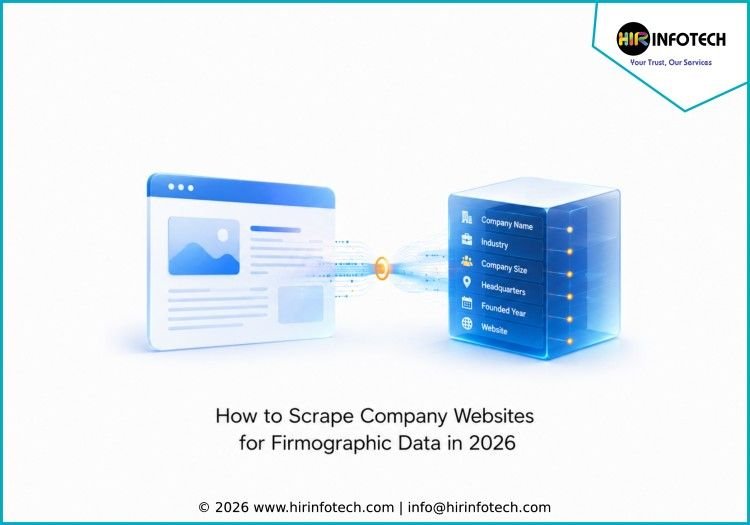
How to Scrape Company Websites for Firmographic Data in 2026
Introduction
Firmographic data has become a critical asset for B2B sales, marketing, and market intelligence teams in 2026. Businesses across the USA, Germany, the United Kingdom, France, Italy, Spain, the Netherlands, Switzerland, Poland, Ireland, Australia, Canada, Thailand, Hong Kong, and other global markets increasingly rely on company website scraping to build accurate prospect databases, improve segmentation, and support data-driven outreach strategies.
What Is Firmographic Data?
Firmographic data refers to descriptive business information used to categorize and evaluate companies for B2B targeting and analysis. It serves a similar purpose to demographic data in consumer marketing but focuses on organizations instead of individuals.
Common firmographic data points include:
- Company name
- Industry category
- Business size
- Employee count
- Revenue range
- Headquarters location
- Number of offices
- Technology stack
- Contact information
- Business model
- Service offerings
- Geographic presence
- Social media links
- Certifications or compliance indicators
Sales and marketing teams use this information to identify ideal customer profiles, prioritize accounts, personalize outreach, and improve lead qualification.
Why Businesses Scrape Company Websites for Firmographic Data
Public company websites remain one of the most reliable sources of business intelligence. Unlike outdated lead lists or generic directories, official websites often contain current operational and positioning information directly maintained by the business itself.
In 2026, businesses use website scraping for firmographic intelligence to support:
Account-Based Marketing (ABM)
B2B marketing teams use firmographic datasets to identify target accounts that match specific criteria such as company size, industry, geographic region, or operational maturity.
Sales Prospecting
Sales teams build prospect lists using structured company information gathered from websites, directories, and public business pages.
Market Expansion Research
Businesses entering new regions such as Germany, Canada, or Australia often scrape public company data to analyze local market opportunities and competitor landscapes.
Competitive Intelligence
Companies monitor competitor positioning, service offerings, partnerships, hiring activity, and geographic expansion through structured website data extraction.
Vendor and Partnership Discovery
Procurement and partnership teams use firmographic intelligence to identify suitable vendors, distributors, suppliers, or channel partners.
How Website Scraping for Firmographic Data Works
The process typically combines automated crawling, structured extraction logic, data normalization, and validation workflows.
Step 1: Identifying Target Sources
The first step involves defining which company websites or public business directories should be scraped.
Common sources include:
- Official company websites
- Business directories
- Industry associations
- Local chamber listings
- Public startup databases
- B2B marketplaces
- Technology partner ecosystems
- Event exhibitor pages
The target source depends heavily on the business objective and industry focus.
Step 2: Crawling Website Pages
Web crawlers systematically visit website pages and identify sections containing business-relevant information.
Typical target pages include:
- About Us
- Contact
- Services
- Team pages
- Careers
- Locations
- Case studies
- Blog sections
- Investor relations pages
Modern scraping systems can also detect structured schema markup, metadata, and embedded business information.
Step 3: Extracting Firmographic Data
Once pages are identified, extraction logic captures specific data fields.
This often includes:
- Company descriptions
- Industry labels
- Office locations
- Employee estimates
- Email patterns
- Technology platforms
- CRM-related indicators
- Operational scale indicators
Advanced systems use AI-assisted parsing and NLP models to classify and organize unstructured company information.
Step 4: Data Cleaning and Normalization
Raw scraped data is rarely ready for direct business use.
Normalization typically includes:
- Standardizing company names
- Removing duplicate records
- Formatting locations consistently
- Categorizing industries
- Validating website domains
- Filtering inactive businesses
- Detecting invalid entries
Data quality directly affects sales and marketing performance, making this step essential.
Step 5: Data Enrichment and Validation
Many organizations enrich scraped firmographic records using external validation workflows or additional public sources.
This may involve:
- Technology stack detection
- Business classification mapping
- Revenue estimation
- Domain verification
- Linked business profiles
- CRM compatibility formatting
High-quality enrichment improves segmentation and targeting accuracy.
Key Challenges in Scraping Company Websites
While firmographic scraping offers strong business value, it also introduces operational and compliance challenges.
Website Structure Variability
Every website is built differently. Some use static HTML, while others rely heavily on JavaScript frameworks or dynamically loaded content.
Scraping systems must handle:
- Pagination
- Dynamic rendering
- Anti-bot protections
- Hidden data layers
- Inconsistent page layouts
- Localization differences
International websites across Europe or Asia may also present multilingual formatting complexities.
Data Accuracy Problems
Public business information is not always complete or updated.
Common issues include:
- Outdated office locations
- Inactive websites
- Missing employee counts
- Generic email addresses
- Incorrect categorization
Without validation pipelines, scraped datasets can quickly lose value.
Compliance and Legal Considerations
Businesses scraping company websites in regions such as the European Union must pay close attention to regulatory expectations.
Relevant considerations may include:
- GDPR compliance
- Public data usage limitations
- Terms of service restrictions
- Data retention policies
- Responsible crawling practices
- Personal data handling rules
In 2026, responsible data acquisition practices are increasingly important for enterprise buyers and compliance teams.
Infrastructure Scalability
Large-scale scraping projects often require:
- Rotating IP infrastructure
- Proxy management
- Queue systems
- Error handling
- Retry management
- Distributed crawling
- Cloud-based processing
Poor infrastructure planning can result in blocked requests, incomplete datasets, or unstable extraction performance.
Best Practices for Scraping Firmographic Data in 2026
Businesses that rely on scraped company intelligence are increasingly prioritizing quality, compliance, and operational reliability over simple data volume.
Focus on Publicly Available Business Information
Responsible scraping projects focus on publicly accessible business-level information rather than sensitive personal data.
This reduces compliance risk while improving enterprise usability.
Use Structured Extraction Logic
Reliable extraction frameworks should use:
- Field mapping
- Pattern recognition
- Schema detection
- AI-assisted classification
- Error validation rules
Structured extraction improves long-term scalability and consistency.
Validate Data Continuously
Firmographic datasets become outdated quickly.
Modern workflows increasingly include:
- Scheduled recrawling
- Automated verification
- Bounce detection
- Domain health checks
- Duplicate suppression
- CRM synchronization
Continuous validation improves lead quality and campaign performance.
Segment Data Based on Business Goals
Different teams require different firmographic attributes.
For example:
- Sales teams may prioritize employee count and decision-maker signals
- Marketing teams may focus on industry segmentation
- Operations teams may need geographic presence data
- Product teams may analyze technology stack adoption
Data collection should align with practical business use cases.
Maintain Regional Compliance Awareness
Businesses operating across the USA, Germany, France, the United Kingdom, Switzerland, Canada, Australia, and other regions should account for location-specific compliance expectations.
Cross-border data workflows often require additional governance and internal review processes.
Industry Use Cases for Firmographic Website Scraping
SaaS and Technology Companies
Technology providers use firmographic intelligence to identify companies based on software adoption, growth stage, funding activity, or infrastructure maturity.
Recruitment and Staffing Firms
Recruiters scrape company data to identify expanding businesses, hiring trends, and potential client accounts.
Manufacturing and Industrial Businesses
Manufacturers often use business intelligence datasets to identify distributors, suppliers, and regional buyers.
Financial and Consulting Services
Professional services firms use firmographic datasets for account targeting, market analysis, and partnership discovery.
E-commerce and Retail Technology Providers
Retail-focused technology businesses analyze company websites to identify operational scale, logistics maturity, and platform usage.
How HirInfotech Supports Firmographic Data Collection Projects
hirinfotech provides web scraping and data extraction services that support businesses looking to build structured B2B datasets from public web sources. For organizations working on lead generation, market research, sales intelligence, or operational targeting, firmographic data extraction often requires more than basic scraping scripts.
Projects typically involve large-scale crawling, structured data extraction, validation workflows, deduplication, and integration-ready formatting. Businesses operating across regions such as the USA, Germany, the United Kingdom, France, Spain, the Netherlands, Switzerland, Canada, Australia, and Hong Kong may also require scalable infrastructure capable of handling multilingual and region-specific business sources.
HirInfotech’s service capabilities are relevant for companies that need:
- Public business data extraction
- Custom web scraping workflows
- B2B lead database development
- Data normalization and cleansing
- Directory and marketplace scraping
- Structured export formats for CRM systems
- Scalable crawling support
- Automated data collection pipelines
For businesses evaluating firmographic intelligence initiatives in 2026, the ability to combine reliable extraction methods with data quality management and operational scalability has become increasingly important.
Choosing the Right Firmographic Data Scraping Approach
Not every business requires the same level of scraping infrastructure or enrichment depth.
When evaluating a firmographic data strategy, businesses should consider:
Data Freshness Requirements
Some industries require near real-time updates, while others can operate effectively with periodic refresh cycles.
Geographic Coverage
International scraping projects may require localization support, multilingual parsing, and regional compliance handling.
CRM and Workflow Integration
The value of firmographic data improves significantly when integrated into existing sales and marketing systems.
Data Accuracy Expectations
Enterprise teams increasingly prioritize validated and structured datasets over raw scraped volume.
Long-Term Scalability
Businesses planning ongoing lead intelligence operations should evaluate whether their scraping workflows can scale efficiently as requirements grow.
Frequently Asked Questions
Is it legal to scrape company websites for firmographic data?
Scraping publicly available business information may be permissible in many jurisdictions, but businesses should evaluate applicable regulations, website terms, and data protection requirements, especially in regions governed by GDPR or similar frameworks.
What types of firmographic data can be collected from company websites?
Businesses commonly extract company names, industries, locations, services, technology stacks, employee estimates, contact pages, and operational details from public company websites.
Why is firmographic data important for B2B lead generation?
Firmographic data helps businesses identify ideal customer profiles, improve segmentation, prioritize accounts, and personalize outreach efforts more effectively.
Can scraped firmographic data be integrated into CRMs?
Yes. Most structured datasets can be formatted for integration into platforms such as Salesforce, HubSpot, Microsoft Dynamics, or custom sales intelligence systems.
What are the biggest challenges in company website scraping?
The main challenges include changing website structures, anti-bot protections, data validation, compliance management, and maintaining dataset accuracy over time.
How can HirInfotech help with firmographic data scraping?
hirinfotech supports businesses with web scraping, structured data extraction, data cleansing, and scalable firmographic data collection workflows for B2B intelligence projects.
Conclusion
Learning how to scrape company websites for firmographic data has become increasingly important for businesses focused on B2B sales intelligence, market expansion, and account targeting in 2026. High-quality firmographic datasets can improve prospecting accuracy, segmentation, and strategic decision-making when collected responsibly and maintained properly.
As organizations across the USA, Europe, Canada, Australia, and Asia continue investing in data-driven growth strategies, scalable and compliant web scraping workflows are becoming a core operational capability. Businesses evaluating long-term firmographic data initiatives often benefit from working with experienced providers such as hirinfotech that understand structured extraction, data quality management, and scalable business intelligence workflows.









