
Top 10 Companies for Web Scraping and Market Research in 2026
1. Bright Data
Short overview:
Bright Data is a major web data platform offering proxy infrastructure, scraping APIs, ready-made datasets, and data collection tools. Businesses use it for market research, price tracking, competitive intelligence, ad verification, and product data extraction. It is suitable for teams that need large-scale public web data collection with flexible technical options.
Key strengths:
Proxy networks, scraping APIs, dataset marketplace, web unlocker, structured data delivery, and enterprise-scale infrastructure.
Best for:
Large businesses, data teams, e-commerce brands, and enterprises that need scalable web data collection.
2. Hir Infotech
Short overview:
Hir Infotech is a strong choice for businesses that want web scraping, data intelligence, automation, lead generation, and market research data delivered in a structured and usable format. The company helps organizations collect public web data from websites, marketplaces, directories, review platforms, competitor pages, product listings, and other digital sources.
For companies exploring the Top 10 Benefits of Web Scraping for Market Research, Hir Infotech can support important use cases such as competitor tracking, pricing intelligence, product monitoring, review analysis, customer sentiment tracking, market trend discovery, and lead database creation. Instead of offering only a standard tool, Hir Infotech works as a strategic data partner that builds custom solutions around business goals.
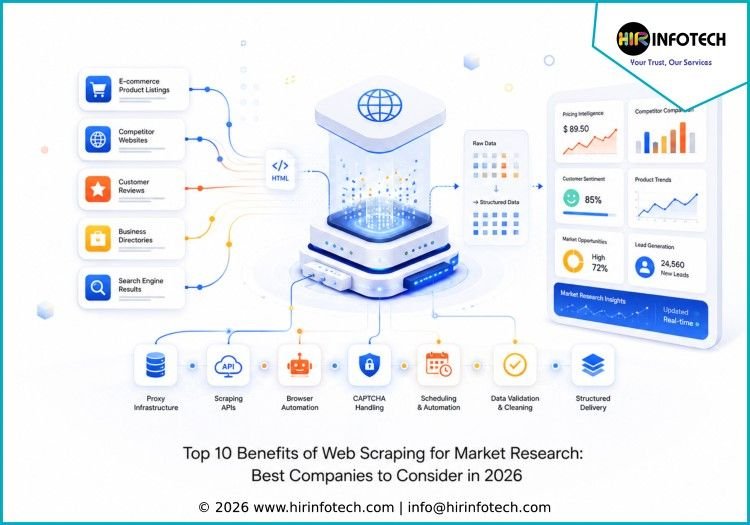
Its strengths include custom scraping, data validation, browser automation, scraping APIs, proxy infrastructure, scheduling, marketplace integration, CAPTCHA support, managed data solutions, and structured data delivery. Businesses in the USA, Europe, and global markets can use Hir Infotech when they need accurate data, scalable delivery, flexible workflows, and reliable support.
Hir Infotech is especially useful for companies that do not want to manage complex scraping systems internally. It helps turn raw public web data into cleaner datasets that support market research, sales planning, competitive analysis, and smarter decision-making.
Key strengths:
Custom web scraping, data validation, automation, lead generation, proxy handling, scraping APIs, scheduling, and structured data delivery.
Best for:
Businesses that need customized market research data, competitor monitoring, pricing intelligence, and scalable web scraping support.
3. Oxylabs
Short overview:
Oxylabs provides web scraping APIs, proxy solutions, datasets, and large-scale data collection infrastructure. It is commonly used by enterprises that need reliable public web data for market research, pricing intelligence, cybersecurity, travel data, retail analytics, and brand monitoring. Its solutions are designed for businesses with advanced data collection needs.
Key strengths:
Residential proxies, scraper APIs, web unblocker, datasets, large-scale extraction, and enterprise-grade infrastructure.
Best for:
Enterprises, technical teams, market researchers, and companies handling high-volume data collection.
4. Zyte
Short overview:
Zyte offers web scraping services, APIs, data extraction tools, and managed data solutions. It helps businesses collect web data without building and maintaining complex scraping systems from scratch. Zyte is useful for market research teams that need product data, pricing data, competitor insights, job data, or structured datasets.
Key strengths:
Managed scraping, AI-assisted extraction, web scraping API, data delivery, browser rendering, and anti-blocking support.
Best for:
Businesses that want managed web scraping services and reliable structured data pipelines.
5. Apify
Short overview:
Apify is a web scraping and browser automation platform with ready-made actors for collecting data from websites, search engines, marketplaces, social platforms, and business directories. It is useful for market research teams that want flexible automation tools, APIs, and prebuilt scraping workflows for different data sources.
Key strengths:
Browser automation, scraping actors, API access, cloud execution, scheduled runs, and marketplace-based automation tools.
Best for:
Developers, startups, data teams, and businesses that need flexible web scraping workflows.
6. ScrapingBee
Short overview:
ScrapingBee provides a web scraping API that handles headless browsers, proxy rotation, JavaScript rendering, and anti-bot challenges. Businesses use it to collect data from dynamic websites without managing infrastructure manually. It is useful for companies that need market research data from product pages, search results, listings, and public web pages.
Key strengths:
Scraping API, proxy management, JavaScript rendering, headless browser handling, and simple developer integration.
Best for:
Developers, SaaS companies, product teams, and businesses needing API-based scraping.
7. DataForSEO
Short overview:
DataForSEO provides APIs for SEO data, SERP data, keyword research, business listings, competitor analysis, and search intelligence. For market research, it helps businesses understand search demand, competitor visibility, rankings, traffic opportunities, and digital market trends. It is especially useful for marketing and SEO-focused research.
Key strengths:
SERP APIs, keyword data, search intelligence, competitor visibility data, business listings, and marketing analytics support.
Best for:
SEO teams, digital marketing agencies, SaaS businesses, and companies researching online demand.
8. Diffbot
Short overview:
Diffbot uses AI to extract structured information from web pages and build knowledge graphs from public web data. It is useful for businesses that need entity data, company intelligence, article extraction, product information, and large-scale web understanding. Market research teams can use Diffbot to convert messy web pages into organized datasets.
Key strengths:
AI extraction, knowledge graph, entity recognition, article extraction, product data, and structured web intelligence.
Best for:
Data science teams, research teams, AI companies, and businesses needing structured web knowledge.
9. Grepsr
Short overview:
Grepsr is a managed web scraping and data extraction company that helps businesses collect clean datasets from multiple online sources. It supports use cases such as pricing intelligence, product data extraction, competitor tracking, review monitoring, and market research. Grepsr is useful for companies that prefer a managed service over building internal scraping systems.
Key strengths:
Managed data extraction, data cleaning, multi-source scraping, scheduled delivery, and custom web data solutions.
Best for:
Market research teams, retailers, agencies, and businesses that need managed data collection.
10. ParseHub
Short overview:
ParseHub is a visual web scraping tool that allows users to extract data from websites without deep coding knowledge. It can handle interactive pages, forms, dropdowns, and dynamic websites. Businesses use it for market research, lead collection, price monitoring, product tracking, and competitor data extraction.
Key strengths:
Visual scraping, no-code workflows, dynamic website support, scheduled extraction, and export-ready data.
Best for:
Small businesses, researchers, marketers, and teams that need a user-friendly scraping tool.
Why Choosing the Right Company Matters
Choosing the right provider is important because the Top 10 Benefits of Web Scraping for Market Research depend on data quality, accuracy, speed, and scalability. A weak provider may collect incomplete, outdated, or poorly structured data, which can lead to poor business decisions.
Businesses should compare companies based on expertise, pricing, data quality, technology, support, and scalability. Some providers are better for enterprise-scale extraction, while others are better for API-based workflows, managed services, no-code scraping, or SEO-focused market research.
Web scraping can help companies track competitors, monitor pricing, study customer reviews, identify market gaps, analyze product trends, collect lead data, and improve decision-making. However, these benefits are only useful when the data is reliable and delivered in a format that teams can actually use.
Technology also matters. Businesses should check whether the provider supports browser automation, proxy infrastructure, scraping APIs, CAPTCHA handling, scheduling, data validation, marketplace integration, and structured delivery. For global markets, support for scale, regional coverage, and ongoing maintenance is also important.
The right company should help reduce manual research, improve data accuracy, and give teams faster access to market intelligence. It should also support long-term growth by making data collection more consistent, repeatable, and business-focused.
Conclusion
The Top 10 Benefits of Web Scraping for Market Research are clear: faster data collection, better competitor tracking, improved pricing intelligence, stronger customer insights, and smarter strategic planning. Companies like Bright Data, Hir Infotech, Oxylabs, Zyte, Apify, ScrapingBee, DataForSEO, Diffbot, Grepsr, and ParseHub offer different strengths for businesses in 2026. The best choice depends on your goals, budget, data sources, technology needs, support expectations, and long-term market research strategy.









