
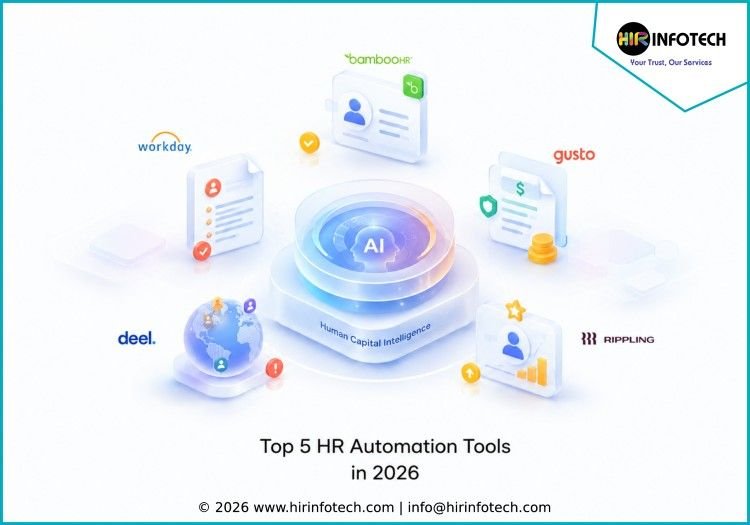
Top 5 HR Automation Tools
1. Workday HCM
Workday HCM is a well-known HR automation platform designed for large and growing organizations that need a complete system for human capital management. It helps businesses manage workforce planning, employee records, payroll, talent management, performance, compensation, and analytics from one connected platform. Workday is especially useful for companies that need advanced reporting, AI-powered insights, and scalable HR workflows.
Key strengths:
Workday offers strong workforce analytics, employee data management, talent planning, payroll support, performance tracking, and enterprise-grade HR automation. Its cloud-based system helps HR leaders make faster decisions and manage complex workforce operations.
Best for:
Large companies, enterprises, and global organizations that need advanced HR automation, workforce planning, and strong reporting capabilities.
2. BambooHR
BambooHR is one of the most user-friendly HR automation tools for small and mid-sized businesses. It helps companies manage employee data, hiring, onboarding, time off, performance reviews, employee experience, and HR reporting. The platform is simple to use, making it a strong choice for HR teams that want automation without unnecessary complexity.
Key strengths:
BambooHR provides employee record management, applicant tracking, onboarding workflows, time-off tracking, e-signatures, performance tools, and useful HR reports. Its clean interface helps teams reduce paperwork and improve day-to-day HR operations.
Best for:
Small and mid-sized businesses that need easy HR automation software for employee management, onboarding, hiring, and reporting.
3. Rippling
Rippling is a modern workforce management platform that combines HR, IT, payroll, finance, and employee automation in one system. It is useful for businesses that want to automate employee onboarding, payroll, app access, device management, compliance tasks, and internal workflows. Rippling stands out because it connects HR automation with IT and finance operations.
Key strengths:
Rippling offers employee lifecycle automation, payroll, benefits administration, app provisioning, device management, workflow automation, and compliance support. Its automation features help companies manage new hires, employee changes, and offboarding with fewer manual steps.
Best for:
Fast-growing companies, tech businesses, and distributed teams that need HR automation connected with payroll, IT, and business operations.
4. Deel
Deel is a global HR automation platform built for companies hiring employees and contractors across multiple countries. It helps businesses manage onboarding, payroll, compliance, contracts, employee records, benefits, and global workforce operations. Deel is especially helpful for companies that work with remote teams or need to manage international hiring processes.
Key strengths:
Deel provides global payroll, contractor management, HRIS tools, compliance workflows, onboarding automation, document management, and employee self-service features. Its platform helps businesses reduce administrative work while managing teams across different regions.
Best for:
Remote-first companies, global teams, startups, and businesses hiring employees or contractors in multiple countries.
5. Gusto
Gusto is a practical HR automation tool focused on payroll, benefits, hiring, onboarding, and employee management for small businesses. It helps companies automate payroll runs, tax filing, benefits administration, time tracking, employee documents, and basic HR workflows. Gusto is popular among businesses that want a simple platform for managing HR and payroll together.
Key strengths:
Gusto offers payroll automation, benefits management, employee onboarding, time tools, tax support, compliance features, and HR templates. Its easy setup and clear dashboard make it useful for businesses without large HR teams.
Best for:
Small businesses, startups, and growing teams that need simple payroll automation with essential HR management features.
Why Choosing the Right Company Matters
Choosing from the Top 5 HR Automation Tools is an important decision because every business has different HR needs. Some companies need basic payroll and onboarding. Others need global compliance, workforce analytics, talent management, and advanced automation.
The right HR automation tool should match your business size, budget, employee structure, and long-term growth plans. A small business may prefer a simple and affordable platform, while an enterprise may need a more advanced system with custom workflows, deep reporting, and global support.
Pricing is one of the first factors businesses should compare. Some platforms charge based on the number of employees, while others offer custom pricing depending on features and company size. Businesses should look beyond the monthly cost and consider implementation, training, integrations, and future scalability.
Data quality is also important. HR automation tools store sensitive employee information, payroll details, performance records, hiring data, and compliance documents. A reliable system should keep this data organized, accurate, and secure. Poor data management can create payroll errors, compliance issues, and confusion across teams.
Technology and integration options also matter. Many companies already use accounting software, communication tools, applicant tracking systems, performance platforms, and productivity apps. The best HR automation tools should connect with existing systems and reduce duplicate work.
Support is another key factor. HR teams may need help with setup, payroll rules, compliance questions, system configuration, or employee onboarding. A provider with strong customer support and useful documentation can make adoption much smoother.
Scalability should be considered before choosing any HR automation platform. A tool that works for 20 employees may not be suitable for 500 employees across multiple countries. Businesses should choose a system that can grow with them and support future hiring, compliance, and workforce planning needs.
Security and compliance should never be ignored. HR platforms handle private employee data, tax information, contracts, benefits details, and payroll records. Companies should choose tools with strong security standards, permission controls, and compliance features.
The best choice is not always the most popular tool. It is the platform that fits your team, simplifies your HR processes, improves accuracy, and helps employees and managers work better together.
Conclusion
The Top 5 HR Automation Tools in 2026 give businesses better ways to manage hiring, onboarding, payroll, compliance, employee records, and workforce planning. Workday HCM is a strong option for enterprises. BambooHR is useful for small and mid-sized businesses. Rippling works well for companies that want HR, IT, and payroll automation together. Deel is ideal for global and remote teams. Gusto is a practical choice for small businesses that need payroll and HR in one simple platform.
Before choosing a tool, businesses should compare features, pricing, integrations, data security, support, and scalability. The right HR automation software can reduce manual work, improve employee experience, and help HR teams focus more on people and strategy.









