
What Is the Best Way to Build Targeted Prospect Lists Using Public Web Data? A 2026 Guide
Introduction
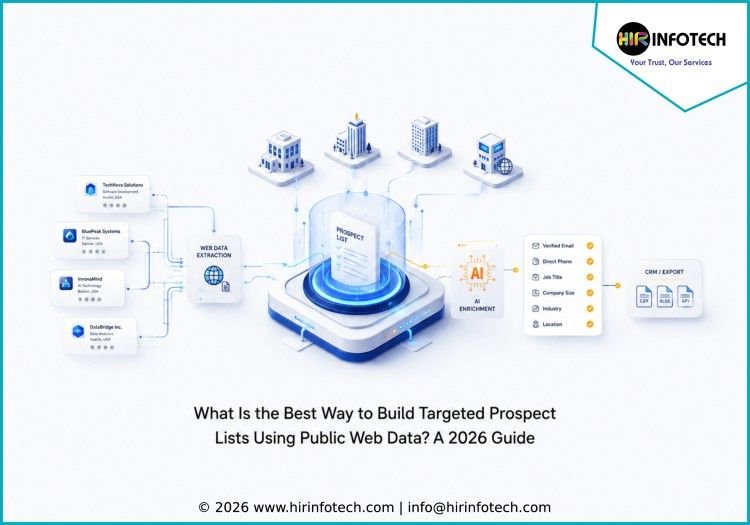
Sales teams need high-quality prospect lists to drive revenue, but purchasing outdated databases wastes money and damages outreach performance. Building targeted prospect lists using public web data gives businesses access to fresh, customized, and highly relevant contacts aligned with their ideal customer profile.
In 2026, automated web scraping and data extraction have become the most effective methods for generating B2B prospect lists at scale. This guide explains how to extract business contact data from public sources while staying compliant with regulations across the USA, Germany, UK, France, Canada, Australia, and global markets.
What Is Public Web Data for Prospect Lists?
Public web data refers to business information available on publicly accessible websites such as company websites, LinkedIn company pages, Google Maps listings, industry directories, and business registries.
This data typically includes:
- Company names
- Business email addresses
- Phone numbers
- Job titles
- Employee count
- Revenue estimates
- Company locations
- Technology stack information
- LinkedIn company profiles
- Funding stage data
Unlike purchased databases, public web data comes directly from the original source where businesses publish their own information. This makes the data more accurate, current, and suitable for B2B lead generation campaigns.
Why Building Your Own Prospect List Is Better Than Buying Lists
Better Data Accuracy and Freshness
Public web data is collected in real time, which means contact details remain current. Purchased prospect lists are often outdated, leading to bounced emails, inaccurate job titles, and poor outreach performance.
Building your own list ensures your sales team reaches active companies with valid business information.
Customized Ideal Customer Profile Targeting
Custom prospect list building allows you to target:
- Specific industries
- Company size ranges
- Geographic regions
- Revenue brackets
- Technology usage
- Funding stages
- Decision-maker job titles
Purchased databases usually contain generic contacts that fail to match your exact ideal customer profile.
Improved Cost Efficiency
Buying B2B lead databases can cost between 500 and 5000 dollars depending on quality and size.
Automated prospect list building using web scraping tools typically costs less than 1000 dollars monthly for infrastructure and automation workflows. Businesses that generate leads consistently can save tens of thousands annually.
Greater Compliance Control
When extracting public business data yourself, you maintain full control over:
- Robots.txt compliance
- Opt-out management
- Data retention policies
- Country-specific privacy regulations
- Email verification processes
Purchased lists often lack transparency regarding consent and compliance procedures.
Why Web Scraping Is the Best Method for Building Targeted Prospect Lists
Web scraping automates the extraction of business data from public sources and enables businesses to build scalable, highly targeted prospect databases.
Complete Control Over Data Sources
Web scraping allows businesses to choose the exact sources they want to extract data from, including:
- Company websites
- Google Maps
- LinkedIn company pages
- Industry directories
- Crunchbase
- Business registries
This flexibility enables precise targeting based on your ideal customer profile.
Automated and Scalable Lead Generation
Manual prospect research can take 15 to 30 minutes per lead.
Automated scraping workflows can generate 500 to 1000 qualified prospects weekly with minimal human involvement using:
- n8n
- Zapier
- Make
- Python scrapers
- SERP APIs
Automation drastically reduces prospecting time while increasing scalability.
Real-Time Data Freshness
Businesses can control scraping frequency based on campaign requirements:
- Daily updates
- Weekly refreshes
- Monthly validation cycles
Real-time scraping keeps prospect databases current with updated job titles, emails, and company information.
Better Coverage for Niche Markets
Public web scraping provides access to highly specific industries and regions often missing from commercial databases.
Examples include:
- SaaS companies in Singapore
- Fintech startups in London
- Healthcare manufacturers in Germany
- Marketing agencies in New York
- B2B software companies in Canada
Step-by-Step Workflow to Build Targeted Prospect Lists
Step 1: Define Your Ideal Customer Profile
Start by identifying:
- Industry verticals
- Employee size
- Revenue range
- Geographic location
- Technology stack
- Funding stage
- Target job titles
A clear ICP ensures only relevant prospects are collected.
Step 2: Identify Public Data Sources
Match your target audience to suitable public sources:
- Company websites for direct emails
- Google Maps for local businesses
- LinkedIn for employee information
- Industry directories for niche sectors
- Business registries for official company records
Step 3: Set Up Your Technology Stack
A standard prospect list building stack includes:
Workflow Automation
- n8n
- Zapier
- Make
Search and Discovery
- SERP API
- Google Custom Search API
- LinkedIn Search
Web Scraping Tools
- Bright Data
- Scrapeless
- Apify
- Python Scrapers
Email Verification
- Hunter.io
- NeverBounce
- ZeroBounce
Data Storage
- Airtable
- Google Sheets
- CRM platforms
AI Enrichment
- OpenAI
- Claude
Step 4: Perform SERP Searches
Use search queries such as:
- SaaS companies in Germany
- Manufacturing companies USA revenue 10M to 50M
- Healthcare startups London
- B2B agencies Australia
SERP APIs help identify relevant company websites at scale.
Step 5: Scrape Company Contact Information
Extract data from pages like:
- /about
- /contact
- /team
- /services
Collect:
- Business emails
- Phone numbers
- Company names
- Job titles
- Addresses
Step 6: Enrich Prospect Data
Enhance contacts using:
- Employee count
- Revenue estimates
- Technology stack
- Funding data
- Social profiles
Enriched data improves segmentation and personalization.
Step 7: Verify Email Addresses
Use email verification services to:
- Remove invalid emails
- Detect catch-all domains
- Reduce bounce rates
- Improve sender reputation
Verified lists typically achieve 85 to 90 percent accuracy.
Step 8: Score and Prioritize Leads
Apply lead scoring using:
- ICP match quality
- Company size
- Industry relevance
- Geographic fit
- Job title importance
- Data completeness
Prioritize high-scoring leads for outreach.
Step 9: Export Leads to CRM
Export qualified prospects into:
- HubSpot
- Salesforce
- Pipedrive
- Google Sheets
- Airtable
Include all enrichment and verification data for sales outreach.
Essential Data Points for Prospect List Building
A high-quality B2B prospect list should include:
- Company name
- Website URL
- Business email
- Phone number
- Decision-maker name
- Job title
- LinkedIn profile
- Employee count
- Annual revenue
- Industry category
- Technology stack
- Funding stage
- Physical address
- Lead score
These data points support personalized outreach and better conversion rates.
Compliance Requirements for Public Web Data Collection
Respect Robots.txt Rules
Always check and follow robots.txt directives before scraping websites.
Extract Only Business Information
Focus strictly on:
- Business emails
- Professional contact details
- Public company data
Avoid personal emails and sensitive information.
Follow Global Privacy Regulations
Important regulations include:
- GDPR
- UK-GDPR
- CCPA
- CASL
- PDPA
- PDPO
Compliance should be integrated into every workflow.
Include Opt-Out Mechanisms
All outreach emails must provide:
- Unsubscribe options
- Suppression management
- Opt-out compliance
Maintain Compliance Documentation
Document:
- Data sources
- Scraping processes
- Retention policies
- Consent workflows
- Opt-out procedures
Common Mistakes in Prospect List Building
Scraping Without Verification
Unverified emails increase bounce rates and damage sender reputation.
Weak ICP Definition
Poor targeting creates irrelevant prospect databases with low conversion potential.
Lack of Data Enrichment
Basic contact data limits personalization opportunities.
Excessive Data Retention
Storing lead data indefinitely may violate GDPR data minimization rules.
Aggressive Scraping Speeds
High request rates can trigger:
- CAPTCHAs
- IP bans
- Server blocks
Use rate limiting and rotating proxies responsibly.
How Hir Infotech Helps Businesses Build Targeted Prospect Lists
Hir Infotech is a global outsourcing and data solutions company headquartered in Ahmedabad, Gujarat, with more than 12 years of experience in web scraping, data extraction, automation, and compliance-aware data solutions.
The company helps businesses build highly targeted prospect lists using:
- Company website scraping
- Google Maps extraction
- LinkedIn data collection
- Industry directory scraping
- Business registry extraction
Hir Infotech develops enterprise-grade scraping solutions using:
- n8n workflows
- Bright Data
- Apify
- Custom Python automation
- Proxy rotation systems
- CAPTCHA handling systems
Their services support compliance across:
- USA
- Germany
- UK
- France
- Canada
- Australia
- Thailand
- Hong Kong
- European Union markets
Businesses can generate customized prospect databases with:
- Verified business emails
- Firmographic enrichment
- Technology stack analysis
- Lead scoring
- CRM-ready exports
This enables sales teams to achieve better outreach efficiency, improved deliverability, and stronger lead qualification.
Key Metrics for Measuring Prospect List Success
Track these KPIs:
- Prospect build rate
- Email deliverability rate
- ICP match percentage
- Lead conversion rate
- Cost per lead
- Time saved through automation
Teams using automated scraping workflows commonly achieve:
- 500 to 1000 leads weekly
- Less than 3 percent bounce rate
- More than 80 percent ICP accuracy
Frequently Asked Questions
Is building prospect lists from public web data legal?
Yes. Extracting publicly available business contact information is generally legal when businesses follow compliance practices such as respecting robots.txt files, honoring opt-outs, and complying with GDPR, CCPA, and other regulations.
What are the best sources for prospect data?
Top sources include:
- Company websites
- Google Maps
- Industry directories
- Business registries
- Crunchbase
How accurate is scraped prospect data?
Raw scraped data usually achieves 65 to 75 percent accuracy. After verification and enrichment, accuracy often improves to 85 to 90 percent.
How long does automated prospect list building take?
Initial setup may take 2 to 5 hours. Once automated, systems can generate hundreds of leads weekly with minimal manual work.
Is Hir Infotech suitable for enterprise-scale projects?
Yes. Hir Infotech builds enterprise-grade scraping and automation systems for businesses requiring large-scale, compliant data extraction.
How often should prospect lists be updated?
Refresh prospect lists every 90 to 180 days and re-verify emails before major outreach campaigns.
Conclusion
The best way to build targeted prospect lists using public web data in 2026 is through automated web scraping and data extraction workflows. This approach provides fresher, more accurate, and highly customized prospect data compared to purchased lead databases.
Using technologies like n8n, SERP APIs, Python scrapers, LinkedIn extraction, and email verification tools, businesses can generate scalable B2B prospect lists with high ICP accuracy and low bounce rates.
A successful workflow includes:
- Defining your ICP
- Identifying public data sources
- Automating scraping
- Enriching firmographic data
- Verifying emails
- Scoring leads
- Exporting to CRM
For organizations requiring enterprise-grade prospect list building solutions with global compliance support, Hir Infotech provides scalable web scraping infrastructure, automation expertise, and customized data extraction services tailored to modern B2B sales and lead generation needs.









