
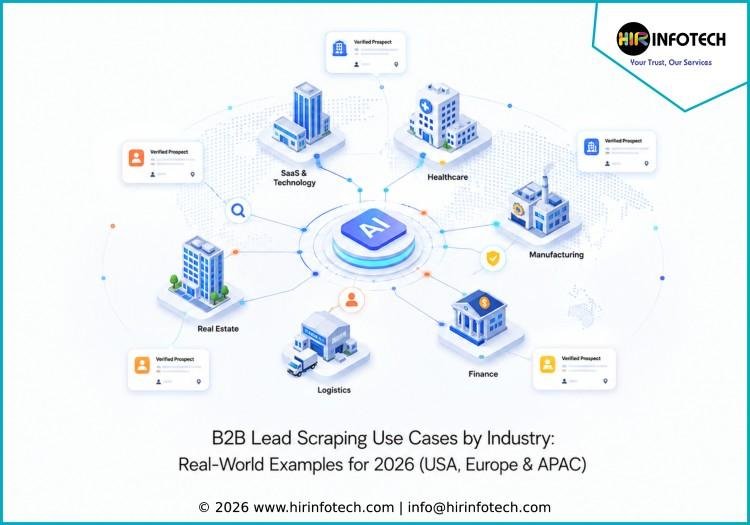
B2B Lead Scraping Use Cases by Industry: Real-World Examples for 2026 (USA, Europe & APAC)
Introduction
B2B lead scraping has become a core growth engine for modern sales and marketing teams across global markets like the USA, UK, Germany, and APAC regions. As competition intensifies in 2026, businesses increasingly rely on structured, real-time lead data to identify buyers faster, improve outreach accuracy, and scale revenue pipelines efficiently.
What Is B2B Lead Scraping and Why It Matters in 2026
B2B lead scraping is the process of extracting publicly available business data from online sources such as company directories, search engines, professional networks, and industry listings. This data typically includes company names, decision-maker contacts, job titles, email patterns, industry classifications, and geographic details.
In 2026, the importance of lead scraping has increased significantly due to:
- Rapid digital transformation across industries
- Saturated outbound sales channels
- Higher expectations for personalization in B2B outreach
- The need for real-time, verified business intelligence
- Expansion of global markets requiring cross-border prospecting
Modern sales teams no longer rely solely on static databases. Instead, they use continuously updated scraped data to build dynamic prospecting pipelines tailored to specific industries and regions.
Why Industries Rely on B2B Lead Scraping
Different industries use lead scraping not just for volume, but for precision targeting. The goal is to identify companies showing buying signals such as hiring trends, technology adoption, expansion activity, or funding events.
Key advantages include:
- Faster identification of decision-makers
- Reduced cost per lead compared to traditional data providers
- Higher personalization in outreach campaigns
- Improved segmentation by industry, size, and geography
- Ability to enter new markets (USA, Europe, APAC) efficiently
SaaS & Technology Industry Use Cases
The SaaS and technology sector is one of the largest adopters of B2B lead scraping due to its fast-paced sales cycles and subscription-based models.
Common Use Cases:
- Identifying companies hiring for specific tech stacks (e.g., AWS, Kubernetes, Salesforce)
- Tracking startups that recently raised funding
- Building lists of SaaS users based on technology detection
- Finding IT managers, CTOs, and product leaders
Example Scenario:
A cybersecurity SaaS company scraping enterprise IT directories in Germany and the USA can identify firms expanding cloud infrastructure and target them with security upgrade solutions.
This allows sales teams to engage prospects at the exact moment of digital transformation.
E-commerce & Retail Industry Use Cases
E-commerce businesses use lead scraping to expand supplier networks, B2B partnerships, and wholesale opportunities.
Common Use Cases:
- Identifying online retailers using specific platforms (Shopify, Magento, WooCommerce)
- Finding wholesale distributors in Europe and North America
- Tracking brands expanding into new markets
- Building influencer and affiliate partner databases
Example Scenario:
A logistics SaaS platform scraping UK and Netherlands e-commerce stores can target fast-growing Shopify brands that need fulfillment automation tools.
This helps vendors reach businesses during scaling phases when logistics needs are urgent.
Real Estate Industry Use Cases
Real estate firms and property technology companies rely heavily on structured business data to identify investors, developers, and agencies.
Common Use Cases:
- Scraping property development firms in urban growth regions
- Identifying commercial real estate investors
- Tracking construction companies and contractors
- Building B2B lists for property management software sales
Example Scenario:
A commercial property analytics company scraping listings in Canada and Australia can identify firms expanding office portfolios and target them with data-driven valuation tools.
Lead scraping helps real estate businesses anticipate market activity instead of reacting to it.
Finance & Fintech Industry Use Cases
The financial services sector uses lead scraping for high-value, compliance-sensitive B2B outreach.
Common Use Cases:
- Identifying SMEs seeking business loans or credit
- Tracking fintech adoption in traditional banks
- Building lists of CFOs and financial controllers
- Monitoring investment firms and hedge funds
Example Scenario:
A fintech API provider scraping financial directories in Switzerland and Hong Kong can identify banks modernizing payment systems and offer integration solutions.
This improves conversion rates due to highly relevant targeting.
Healthcare & Life Sciences Industry Use Cases
Healthcare organizations use lead scraping for research partnerships, procurement, and B2B healthcare solutions.
Common Use Cases:
- Identifying hospitals and clinics expanding services
- Tracking pharmaceutical distributors
- Finding biotech research firms
- Building databases of healthcare administrators
Example Scenario:
A medical software company scraping healthcare networks in France and Italy can identify hospitals adopting digital patient management systems.
This enables targeted outreach for compliance-ready software solutions.
Manufacturing & Industrial Industry Use Cases
Manufacturing firms use lead scraping to identify suppliers, buyers, and industrial partners across global supply chains.
Common Use Cases:
- Identifying factories and production units by region
- Tracking industrial expansion projects
- Building supplier and procurement databases
- Monitoring equipment purchasing trends
Example Scenario:
A machinery exporter scraping manufacturing directories in Poland and Germany can identify factories upgrading production lines and target them with automation equipment.
This ensures better alignment with capital investment cycles.
Logistics & Supply Chain Industry Use Cases
Logistics companies depend on lead scraping to identify shipping demand and optimize B2B partnerships.
Common Use Cases:
- Identifying import/export businesses
- Tracking e-commerce fulfillment companies
- Finding freight forwarding partners
- Building warehouse operator databases
Example Scenario:
A global freight company scraping trade directories in the USA and Thailand can identify businesses with high international shipping volume and offer tailored logistics solutions.
Marketing Agencies & B2B Service Providers
Marketing agencies and service providers use lead scraping more aggressively than most industries to continuously feed sales pipelines.
Common Use Cases:
- Building cold outreach lists for niche industries
- Identifying companies with weak digital presence
- Tracking businesses investing in ads or SEO
- Finding startups needing brand development
Example Scenario:
A digital marketing agency scraping companies in Spain and Ireland can identify businesses with outdated websites and pitch redesign + SEO services.
This improves outbound campaign efficiency significantly.
How hirinfotech Supports B2B Lead Scraping Use Cases
In today’s competitive B2B landscape, structured and accurate data extraction is essential for scaling outreach across multiple industries and regions. hirinfotech operates in this space by supporting businesses that need reliable B2B lead scraping solutions tailored to specific market requirements.
The approach focuses on building industry-aligned datasets that help sales and marketing teams target the right decision-makers instead of relying on generic lead lists. Whether it is SaaS companies looking for CTO-level contacts, real estate firms targeting developers, or logistics providers identifying exporters, the emphasis remains on relevance and usability of data.
hirinfotech’s lead scraping workflows typically align with multi-region targeting strategies across the USA, Germany, UK, France, Canada, Australia, and APAC markets. This enables businesses to expand into new geographies while maintaining consistent data quality standards.
Beyond extraction, the emphasis is also on structuring and organizing data in a way that integrates easily into CRM systems, sales automation tools, and outbound marketing workflows. This is especially important for companies operating in fast-moving sectors where lead freshness directly impacts conversion rates.
By aligning scraping strategies with industry-specific needs, hirinfotech supports businesses in reducing manual prospecting effort and improving the accuracy of their outbound campaigns. The result is a more efficient pipeline that focuses on high-intent prospects rather than broad, unqualified lists.
Frequently Asked Questions (FAQs)
1. What industries benefit most from B2B lead scraping?
Industries like SaaS, finance, real estate, logistics, manufacturing, and marketing agencies benefit most due to their high outbound sales dependency.
2. Is B2B lead scraping legal for business use?
Yes, when used to collect publicly available business information and in compliance with data protection regulations in relevant regions.
3. How is scraped B2B data used in sales teams?
Sales teams use it for prospecting, CRM enrichment, outbound email campaigns, and identifying decision-makers in target companies.
4. Why is lead scraping better than buying static databases?
Scraped data is more updated, customizable, and industry-specific compared to static databases that often become outdated quickly.
5. Can lead scraping be customized by country or region?
Yes, businesses can target specific markets such as the USA, UK, Germany, Canada, and APAC regions for localized prospecting.
6. How does hirinfotech help businesses with lead scraping?
hirinfotech supports industry-specific lead scraping solutions designed to help companies build accurate, structured, and actionable B2B prospect databases.
Conclusion
B2B lead scraping use cases by industry highlight how essential data-driven prospecting has become for modern businesses in 2026. From SaaS and finance to logistics and real estate, every industry now relies on accurate, structured lead data to improve outreach efficiency and revenue performance.
As global competition intensifies across markets like the USA, Europe, and APAC, businesses that adopt targeted lead scraping strategies gain a significant advantage in identifying high-intent prospects early. With structured execution and industry-focused data collection, companies can build stronger pipelines and improve conversion outcomes at scale. hirinfotech supports this shift by enabling more precise and actionable B2B lead intelligence.









