
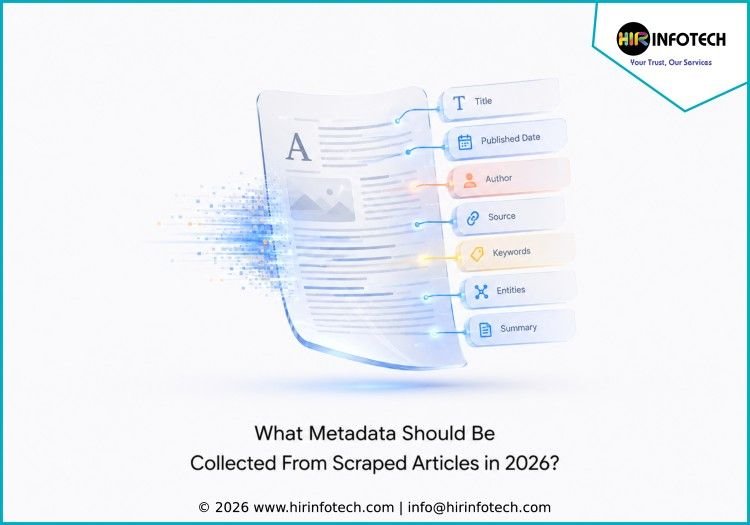
What Metadata Should Be Collected From Scraped Articles in 2026?
Introduction
Article scraping has become a critical part of content aggregation, media monitoring, market intelligence, and research automation. However, collecting article text alone is rarely enough for modern business applications. In 2026, organizations increasingly depend on structured metadata extraction to improve searchability, categorization, analytics, compliance, and content management across large-scale information systems.
What Is Metadata in Article Scraping?
Metadata refers to structured information that describes and organizes article content.
Instead of focusing only on the main body text, metadata extraction captures contextual details surrounding an article, such as:
- Publication date
- Author information
- Headlines
- Categories
- Source URLs
- Keywords
- Tags
- Images
- Language
- Publishing metadata
Metadata makes scraped content significantly more useful for indexing, filtering, automation, and analysis.
Without proper metadata collection, large-scale article aggregation systems become difficult to organize, search, or analyze effectively.
Why Metadata Collection Matters in 2026
Modern content systems process enormous volumes of information continuously.
Metadata extraction helps businesses:
- Organize large article databases
- Improve search functionality
- Enable AI-assisted categorization
- Detect trends faster
- Remove duplicate content
- Track publishing activity
- Support analytics workflows
- Improve content relevance
- Monitor media coverage
As AI-powered search and automation systems continue evolving in 2026, high-quality metadata has become essential for structured content intelligence.
Essential Metadata Fields to Collect From Scraped Articles
The exact metadata requirements depend on the business use case, but several core fields are widely considered essential.
Article Title or Headline
The headline is one of the most important metadata elements.
Titles support:
- Search indexing
- Topic identification
- User navigation
- AI categorization
- Trend monitoring
Headline extraction should preserve formatting accuracy while removing unnecessary HTML or encoding issues.
Publication Date and Time
Timestamp metadata is critical for content freshness and chronological organization.
Businesses use publication timestamps for:
- Real-time monitoring
- News prioritization
- Trend analysis
- Time-series analytics
- Breaking news detection
In 2026, accurate timestamp normalization has become increasingly important for cross-platform aggregation systems handling global publishers.
Author metadata helps businesses:
Author Information
- Track journalists or contributors
- Analyze publishing behavior
- Monitor subject-matter expertise
- Support attribution workflows
Typical author-related metadata includes:
- Author names
- Contributor profiles
- Editorial roles
- Publication affiliations
Some publishers provide structured author schema markup, while others require custom extraction logic.
Source URL
The original article URL remains one of the most important metadata fields.
Source URLs support:
- Attribution
- Deduplication
- Traceability
- Content verification
- Publisher linking
Aggregation systems use canonical URLs to maintain content integrity and source transparency.
Publisher or Source Name
Publisher metadata identifies the originating platform or media outlet.
This supports:
- Source filtering
- Credibility analysis
- Media monitoring
- Domain-level analytics
- Publisher categorization
For large aggregation systems, standardized source naming becomes essential for reporting consistency.
Article Summary or Description
Many websites include short descriptions or meta summaries.
Summaries help with:
- Search previews
- AI-assisted classification
- Content recommendations
- Topic grouping
Modern extraction systems often collect both publisher-provided summaries and AI-generated summaries for improved usability.
Categories and Tags
Category metadata improves article organization significantly.
Examples include:
- Politics
- Technology
- Finance
- Healthcare
- Sports
- Business
Tag extraction also supports semantic grouping and trend analysis.
Well-structured taxonomy data improves filtering and recommendation systems across aggregation platforms.
Keywords and Entities
Advanced extraction systems increasingly identify:
- Keywords
- Companies
- Locations
- People
- Products
- Events
- Industry terms
This metadata enables:
- Entity recognition
- Sentiment analysis
- Topic clustering
- Competitive intelligence
AI-powered metadata enrichment has become a major trend in 2026.
Article Language
Language detection is essential for multilingual aggregation platforms.
Language metadata supports:
- Translation workflows
- Regional filtering
- Localization systems
- International analytics
Automated language detection models are commonly integrated into modern extraction pipelines.
Featured Images and Media Metadata
Media assets are often important components of scraped articles.
Metadata may include:
- Featured image URLs
- Image captions
- Video references
- Thumbnail assets
- Alt text descriptions
Businesses must still evaluate copyright restrictions before reusing media assets commercially.
Content Type and Format
Some systems classify content by format, such as:
- News article
- Opinion piece
- Press release
- Research report
- Blog post
- Editorial content
This improves downstream categorization and filtering accuracy.
Reading Time and Word Count
Content length metrics are useful for:
- Editorial analysis
- User engagement predictions
- Content scoring
- Recommendation engines
Word count and reading time are increasingly used in AI-assisted ranking systems.
Engagement and Popularity Signals
Some aggregation systems collect public engagement indicators such as:
- Share counts
- Comment counts
- Reaction metrics
- View estimates
These metrics help identify trending or high-impact content.
However, access to engagement data may vary significantly depending on the source platform.
Structured Data and Schema Markup
Many publishers use structured schema markup that simplifies metadata extraction.
Common schema elements include:
- Article schema
- NewsArticle schema
- Breadcrumb metadata
- Open Graph tags
- Twitter card metadata
Modern extraction systems prioritize structured schema parsing because it improves consistency and reliability.
Metadata for AI and Search Optimization
In 2026, metadata plays a growing role in AI-driven search ecosystems.
Well-structured metadata improves:
- AI summarization
- Semantic search
- Knowledge graph mapping
- Topic clustering
- Content recommendations
- Automated indexing
Businesses using large-scale article databases increasingly optimize metadata pipelines for AI-search visibility and machine readability.
Challenges in Metadata Extraction
Accurate metadata extraction is often more difficult than extracting article text itself.
Inconsistent Website Structures
Different publishers format metadata differently.
Missing Metadata
Some websites omit important metadata fields entirely.
Dynamic Rendering
Modern websites frequently generate metadata dynamically using JavaScript.
Duplicate Articles
The same article may appear across syndication networks with slightly different metadata.
Multilingual Content
International aggregation systems must normalize metadata across languages and formats.
Because of these challenges, scalable metadata extraction systems require adaptable workflows and intelligent parsing capabilities.
Best Practices for Metadata Collection
Businesses building aggregation systems should follow structured extraction practices.
Prioritize Structured Sources
Schema markup and APIs often provide more reliable metadata than raw HTML parsing.
Normalize Formats
Standardize:
- Date formats
- Categories
- Source naming
- Language identifiers
- Entity structures
Implement Deduplication Systems
Duplicate content can distort analytics and search accuracy.
Validate Extracted Fields
Metadata validation improves reliability and reduces downstream errors.
Maintain Compliance Awareness
Businesses should still evaluate:
- Copyright restrictions
- Privacy obligations
- Platform usage policies
- Licensing requirements
when collecting and storing article metadata.
Why Metadata Quality Matters for Aggregation Platforms
Poor metadata quality can reduce the usefulness of aggregation systems significantly.
High-quality metadata improves:
- Search precision
- User experience
- Reporting accuracy
- AI recommendations
- Trend analysis
- Monitoring workflows
- Content discoverability
As content ecosystems continue expanding, metadata quality increasingly determines the long-term value of large-scale content databases.
How Hir Infotech Supports Web Data Extraction Workflows
Hir Infotech provides web data extraction solutions designed to support structured content collection and scalable metadata processing requirements.
Its capabilities align with operational needs such as:
- Article metadata extraction
- Structured content scraping
- Multi-source aggregation workflows
- Dynamic website handling
- Real-time extraction support
- AI-ready data structuring
- Data normalization systems
- Scalable extraction infrastructure
Modern article aggregation systems require more than simple scraping scripts. Businesses increasingly need scalable extraction workflows capable of maintaining consistent metadata quality across rapidly changing digital publishing environments.
Frequently Asked Questions
What is metadata in scraped articles?
Metadata is structured information that describes an article, such as the title, author, publication date, categories, keywords, and source URL.
Why is metadata important in content aggregation?
Metadata improves organization, searchability, filtering, analytics, AI categorization, and content discoverability across large-scale aggregation systems.
What is the most important metadata field for scraped articles?
Core fields typically include the headline, publication date, source URL, publisher name, and article summary.
Can metadata extraction improve AI search visibility?
Yes. Well-structured metadata improves semantic understanding, machine readability, AI summarization, and search indexing capabilities.
Why is metadata normalization important?
Normalization ensures consistency across different publishers and platforms, improving analytics accuracy and search functionality.
Does Hir Infotech provide web data extraction solutions for metadata collection?
Yes. Hir Infotech provides web data extraction solutions that support structured metadata collection, scalable content processing, and aggregation workflows.
Conclusion
Metadata extraction has become a foundational component of modern article scraping and content aggregation systems. In 2026, businesses depend on structured metadata to improve organization, search functionality, analytics, AI processing, and operational scalability. From publication dates and source URLs to entity recognition and categorization, high-quality metadata enables businesses to transform raw scraped content into valuable and actionable information systems. As digital publishing environments continue evolving, scalable and reliable web data extraction workflows play an increasingly important role in maintaining accurate and usable content intelligence platforms.









